
- 1. Three Common Shim Types, Three Different Purposes
- 2. 1. Standard Shim: Flat Uniform-Thickness Spacer
- 3. 2. Notch Shim: Slotted Shim for Quick Service Adjustment
- 4. 3. Triangle Shim: Tapered Shim for Angle Correction
- 5. Quick Comparison: Shim, Notch Shim and Triangle Shim
- 6. How to Choose the Right Shim Type
- 7. General Installation Best Practices
- 8. Frequently Asked Questions
- 9. Custom Shim Supply for Automotive and Heavy Equipment
Shim vs Notch Shim vs Triangle Shim: Differences, Applications and Installation Guide
Three Common Shim Types, Three Different Purposes
Across passenger cars, commercial trucks, buses, construction machinery and industrial machinery, shims are used to fill clearance, adjust preload, level mounting surfaces and correct assembly geometry. Although all three products belong to the shim family, the design intent, manufacturing control and installation rules are not interchangeable. Selecting the wrong type can lead to uneven tire wear, poor handling, driveline vibration, loose mounting and premature component failure.
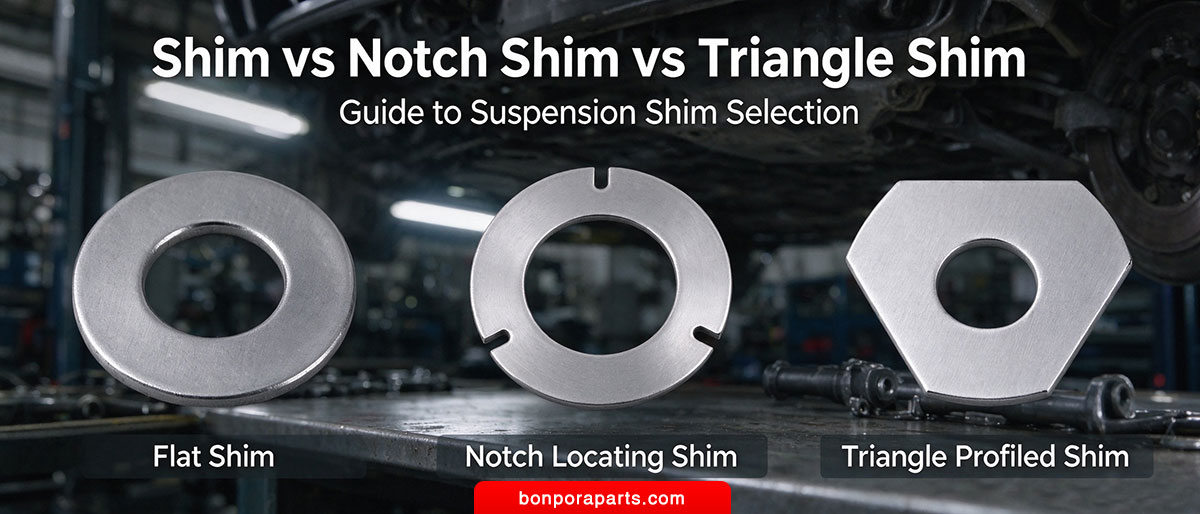
Standard shim — uniform-thickness flat spacer for gap compensation and leveling.
Notch shim — slotted shim for fast service without full bolt removal.
Triangle shim — tapered angle shim for camber, caster, toe and thrust angle correction.
1. Standard Shim: Flat Uniform-Thickness Spacer
A standard shim is a flat spacer plate with equal thickness across the whole surface. It fills assembly clearance, sets bearing preload, levels mating surfaces and compensates for manufacturing tolerance. Common shapes are round, rectangular and custom blanked outlines with plain mounting holes. A standard shim does not change the angular position of parts; it adds consistent thickness between two surfaces.
Typical Applications
Engine bearing preload, rocker seat clearance and valve train spacing
Transmission and transfer case axial clearance control
Brake pad noise reduction and clearance compensation
Subframe, body mounting and leaf spring spacing
Pump, motor and generator base leveling in industrial equipment
Materials and Manufacturing
Common materials include carbon steel, spring steel, stainless steel, brass and engineered polymers. Thin high-precision shims are produced by chemical etching, fine blanking or surface grinding. Medium and thick shims are stamped, laser cut or water jet cut. Finishing steps include deburring, heat treatment when required, galvanizing, black oxide treatment or powder coating for corrosion resistance under vehicle and outdoor exposure.
Installation Notes
Clean mating surfaces to remove rust, grit and oil before assembly.
Avoid stacking too many thin layers, since multiple sheets can slip and reduce clamping stability.
Follow the torque sequence of the service manual and recheck clearance after tightening.
2. Notch Shim: Slotted Shim for Quick Service Adjustment
A notch shim, also called a slotted shim or U-slot shim, carries an open notch instead of a fully enclosed bolt hole. The main advantage is service efficiency. The technician loosens the bolt rather than removing it completely, then slides the notch shim into position. This saves significant time during repeated alignment checks and on-site adjustment work.
Typical Applications
Vehicle axle brackets and suspension support mounts
Heavy machinery base alignment and generator set leveling
Workshop positions where alignment values are measured, adjusted and verified in several rounds
Truck, trailer and construction equipment chassis adjustment
Materials and Manufacturing
The base material follows the same range as standard shims. Production focus lies on notch accuracy and edge quality. Most notch shims are stamped with the slot formed in one operation; small-batch custom sizes use laser cutting. The notch edge must be fully deburred to prevent stress cracking and binding during insertion. Heavy-duty notch shims use higher-grade steel with heat treatment for suspension and axle loads.
Installation Notes
Align the notch directly with the bolt shank and confirm the slot width allows smooth sliding without pinching the thread.
After torquing, confirm the shim cannot shift sideways under load.
Never replace an OEM-rated high-load hardware shim with a thin, low-strength slotted part.
3. Triangle Shim: Tapered Shim for Angle Correction
A triangle shim, or tapered angle shim, is designed to create a controlled angular offset rather than uniform spacing. Its thickness tapers across the face, so installation between two mounting surfaces changes the assembly angle. This type is the primary choice for wheel alignment correction such as camber, caster, toe, thrust angle and pinion angle adjustment.
Typical Applications
Torsion beam rear axles on passenger cars, SUVs and new energy vehicles
Shock absorber brackets and steering knuckle assemblies
Leaf spring hangers on trucks and buses
Lifted truck driveline and off-road suspension geometry correction
Remedies for tire scrub, steering pull, uneven shoulder wear and driveline vibration
Materials and Manufacturing
Unlike flat shims, triangle shims require strict angle control. Most are fabricated from medium or high-strength carbon steel. The tapered face is milled, molded or press formed to maintain a consistent slope. Finished parts are inspected for flatness and angle tolerance to avoid point loading under clamping force. Surface protection includes galvanizing, black oxide or powder coating according to the working environment.
Installation Notes
Complete wheel alignment measurement first, then install the shim in the correct orientation. A reversed taper will worsen misalignment and increase safety risk.
Seat the tapered surface fully against the mating component; no single side may carry point load.
After installation, retest alignment specifications and check brake hose, caliper and suspension interference before a road test.
A triangle shim corrects geometry; it cannot replace structural repair for bent control arms, twisted frames or damaged axles.
Quick Comparison: Shim, Notch Shim and Triangle Shim
| Item | Standard Shim | Notch Shim | Triangle Shim |
|---|---|---|---|
| Core Function | Equal-thickness gap compensation, preload and leveling | Gap compensation with open slot for fast repeated adjustment | Angular offset for camber, caster, toe, thrust and pinion correction |
| Geometry | Uniform thickness, plain bolt holes | Open U or C notch aligned to the bolt | Tapered wedge profile with defined slope angle |
| Main Applications | Engine bearings, transmission clearance, brake noise, body spacing, machine leveling | Axle brackets, suspension mounts, motor and pump base alignment, service workshops | Torsion beam axles, shock brackets, knuckle mounts, leaf spring hangers, lifted drivelines |
| Manufacturing Focus | Thickness tolerance, flatness, edge deburring | Notch dimension accuracy, slot edge strength and deburring | Slope angle precision, tapered face flatness and load distribution |
| Key Installation Risk | Excessive stacking, dirt trapped between layers | Half-seated slot, sideways slip after tightening | Wrong orientation, partial contact, hidden brake or hose interference |
How to Choose the Right Shim Type
When only uniform spacing is needed
Use a flat standard shim to raise or space a component evenly, set preload or level a base surface where no angle change is required.
When repeated tuning is expected
Select a slotted notch shim for positions that need several rounds of measurement and adjustment, especially where full bolt removal would slow service.
When geometry must be corrected
Use a tapered triangle shim only when the goal is to change suspension or driveline angle. Match the shim angle and orientation to alignment readings.
Using the wrong shim type is a common workshop mistake. Stacking many flat shims to form an angle is unreliable and unsafe. A notch shim installed where a fully retained bolt-hole shim is required may move under dynamic load. A triangle shim that does not match the vehicle correction requirement will not deliver stable alignment.
General Installation Best Practices
Select material and load rating that match the working environment, including temperature, vibration and corrosion exposure.
Underbody and outdoor applications require anti-corrosion coating such as galvanizing, black oxide or powder coating.
Clean all contact faces before assembly and remove burrs, rust and old sealant.
Apply torque in stages according to the service manual, then measure the result after tightening.
For safety-critical steering, brake and suspension work, record alignment readings and inspect all nearby parts for interference.
Frequently Asked Questions
What is the difference between a standard shim and a triangle shim?
A standard shim has uniform thickness and fills gaps, sets preload or levels mating surfaces. A triangle shim is tapered across its face and changes the assembly angle for camber, caster, toe, thrust angle or pinion angle correction.
Why use a notch shim instead of a flat shim?
A notch shim carries an open slot that slides around the bolt. Technicians only loosen the bolt instead of removing it completely, which speeds up repeated alignment checks and on-site adjustment work.
Can flat shims be stacked to replace a triangle shim?
Stacking flat shims to form an angle is not recommended. Multiple layers can slip under load and cannot deliver a stable, controlled angular offset. Use a dedicated tapered triangle shim matched to the required angle.
Where are triangle shims used on vehicles?
Triangle shims are commonly used on torsion beam rear axles, shock absorber brackets, steering knuckle mounts, leaf spring hangers, lifted truck drivelines and off-road suspension setups to correct alignment geometry and reduce tire wear.
What materials are shims made from?
Common materials include carbon steel, spring steel, stainless steel, brass and engineered polymers. Heavy suspension and axle shims use heat-treated high strength steel with galvanizing, black oxide or powder coating for corrosion resistance.
Custom Shim Supply for Automotive and Heavy Equipment
BONPORA supplies standard flat shims, notch slotted shims and tapered triangle shims for passenger vehicles, new energy suspension systems, commercial trucks and construction machinery. Material, thickness, angle and surface treatment can be matched to your drawing or sample.
Request Shim Quote