
- 1. Core Functions of Energy Suspension Bump Stops
- 2. Vehicle Application Scenarios for Threaded Rubber Bump Stops
- 3. General Industrial & Civil Use Cases
- 4. Important Buying & Usage Notes
- 5. Frequently Asked Questions
- 5.1. Q1: What are energy suspension bump stops?
- 5.2. Q2: What are the main applications of threaded rubber bump stops on vehicles?
- 5.3. Q3: Why do threaded rubber bump stops reduce vibration and noise?
- 5.4. Q4: How to select the correct threaded rubber bump stop?
- 5.5. Q5: When should I replace rubber suspension bump stops?
Energy Suspension Bump Stops – Threaded Rubber Shock Absorbing & Anti-Slip Bump Stops
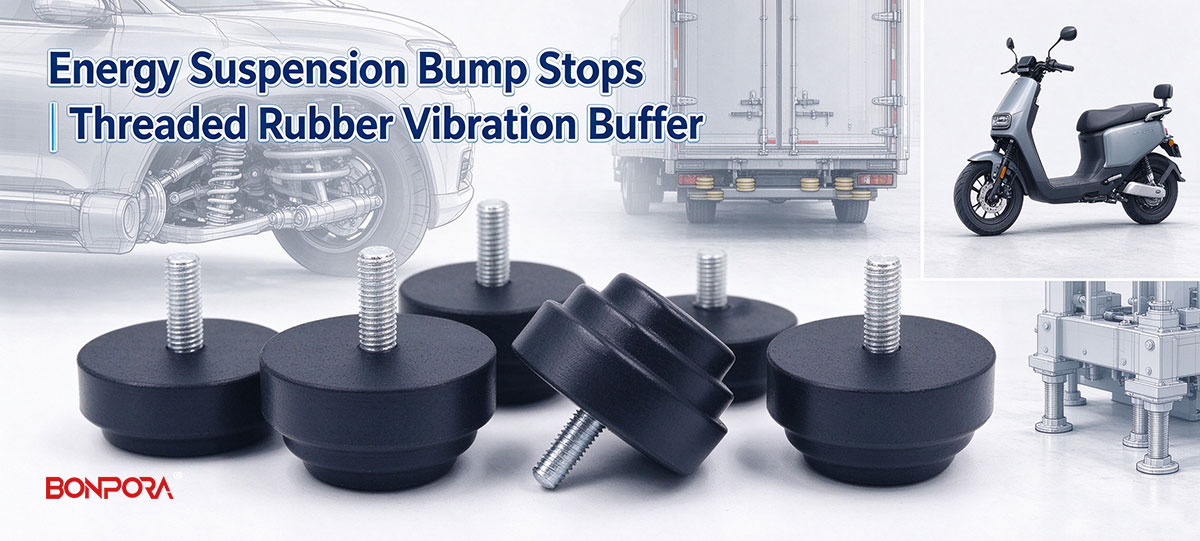
Energy suspension bump stops (threaded rubber bump stops with metal stud) are versatile vibration isolation and impact buffer parts widely used in automotive suspension systems, truck cargo bodies, electric two-wheelers, industrial machinery, household appliances, furniture and tripod support systems. Combining high-friction elastic rubber body and rigid threaded metal bolt, this product solves vibration transfer, metal impact noise and equipment sliding displacement problems in many scenarios.
Core Functions of Energy Suspension Bump Stops
Anti-slip Stabilization: The high-friction rubber surface grips smooth hard surfaces such as tile and wood flooring firmly, locking equipment position and preventing sliding and shifting.
Vibration Damping & Noise Reduction: Rubber elasticity absorbs and dissipates running vibration energy, blocking vibration and noise transmission paths between the equipment and mounting base.
Flexible Threaded Mounting: Integrated metal threaded stud provides strong connection compatibility. It can be screwed onto tripods, small home appliances, industrial machines, furniture feet and various custom support structures.
Vehicle Application Scenarios for Threaded Rubber Bump Stops
Thanks to rubber damping characteristics and reliable threaded connection, energy suspension bump stops have mature applications across multiple vehicle categories.
1. Powertrain Damping Support
It can work as simplified motor and engine mounts. Installed directly between engine / electric motor and frame via threaded studs, rubber deformation absorbs high-frequency vibration from powertrain operation. It stops vibration from transferring into the cabin and greatly improves quietness and riding comfort. It is popular for small-displacement gasoline engines and new energy vehicle drive motors.
2. Cargo Box & Body Anti-Collision Buffer
Install these bump stops on truck and lorry cargo door and side board contact positions. Replace hard metal-to-metal contact. When closing cargo doors, rubber absorbs impact energy, preventing permanent deformation and abnormal knocking noise caused by repeated metal collision. It also reduces continuous abrasion between cargo box and vehicle body during driving.
3. Vibration Isolation for On-Board Accessories
For on-board inverters, portable car fridges, car audio hosts and other electronic devices, fix them to factory reserved screw holes using these threaded bump stops. The rubber layer filters bumping vibration from the road, protecting delicate electronic assemblies from loosening or failure caused by long-term cyclic vibration, and eliminates resonance noise from hard metal connection.
4. Buffer for Two-Wheelers & Tricycles
Mount the threaded rubber bump stops on main stands, foot pegs and side stands of electric bikes and motorcycles. During parking, it cushions the impact when the stand touches the ground. While riding, it filters fine vibration transmitted from the pavement. It stabilizes parking and riding feeling and reduces rigid wear between metal components.
General Industrial & Civil Use Cases
Apart from automotive markets, energy suspension bump stops are widely adopted for lab equipment, testing instruments, tripods, air compressors, small production machines, cabinet feet and office furniture. It keeps equipment stable on slippery floors and lowers working noise in workshops and rooms.
Important Buying & Usage Notes
Verify thread specification (diameter and pitch) before purchase. Matching thread size guarantees tight installation and avoids loose threads or slipping.
Check rubber condition regularly. If the rubber surface ages, cracks or friction texture wears flat, replace the bump stop promptly. Degraded rubber loses anti-slip and damping performance and brings safety risks.
Do not exceed the designed load capacity. Overloading will lead to permanent rubber compression and shortened service life.
Frequently Asked Questions
Q1: What are energy suspension bump stops?
Q2: What are the main applications of threaded rubber bump stops on vehicles?
Q3: Why do threaded rubber bump stops reduce vibration and noise?
Q4: How to select the correct threaded rubber bump stop?
Q5: When should I replace rubber suspension bump stops?
- Prev.:High-Performance Shock Absorber Steel Shim Kit — Accurate, Long-Lasting, Tunable
- Next.:Chinese Suspension Factory Vetting & Remote Factory Audit | Bonpora Auto Suspension Supplier