
- 1. 1. Where Steel Spacers Sit on a Mountain Bike
- 2. 2. How to Confirm Spacer Size: Outer Diameter, Inner Diameter, Thickness
- 3. 3. How to Replace Steel Spacers, Step by Step
- 4. 4. Post-Installation Maintenance
- 5. 5. Price Reference: Retail vs Wholesale
- 6. 6. Why BONPORA Steel Spacers Fit Bicycle OEM and Aftermarket
- 7. 7. FAQ
- 7.1. What thickness spacer do I need to put a 10-speed cassette on an 11-speed HG freehub?
- 7.2. Can I use an aluminum spacer instead of a steel spacer on a mountain bike?
- 7.3. How do I know if a steel spacer is worn?
- 7.4. What is the wholesale MOQ for custom bicycle steel spacers?
- 7.5. Do steel spacers need grease during installation?
- 8. Request a Sample Pack
How to Replace Mountain Bike Steel Spacers: Size, Steps, Maintenance and Price Guide
On a mountain bike, the small ring of steel that sits between the cassette and the freehub body, between the crank spindle and the bottom bracket cup, or between the hub axle and the frame dropout, is easy to ignore until shifting goes vague, creaks appear, or the crank rubs the frame. That ring is the steel spacer. A spacer that is 0.5 mm too thin lets the cassette move under load; a spacer that is 2 mm too thick blocks the largest cog. For bike brand owners, aftermarket distributors and repair workshops, choosing the right steel spacer and knowing how to install it correctly is part product engineering, part service quality.
This guide answers the four questions every buyer and mechanic asks: how to confirm spacer size (outer diameter, inner diameter, thickness), how to replace it, how to maintain it after the job, and what price is fair at retail and wholesale level.
1. Where Steel Spacers Sit on a Mountain Bike
Three common locations use machined steel spacers rather than aluminum or carbon rings:
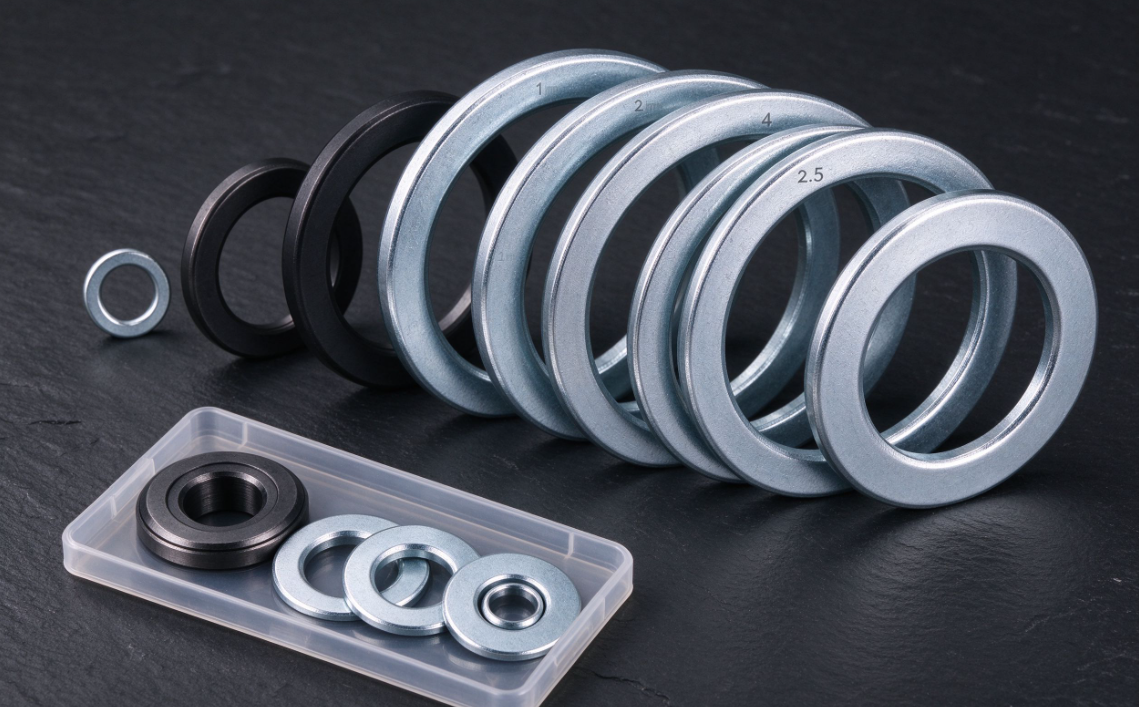
Cassette / freehub spacer — sits behind the cassette stack on the freehub body. It converts an 11-speed HG freehub to accept a 10- or 9-speed cassette, or sets the gap between an XD / XDR / Micro Spline body and the cog pack. Common thicknesses are 1.0, 1.5, 1.85, 2.0, 2.18, 2.35 and 2.5 mm.
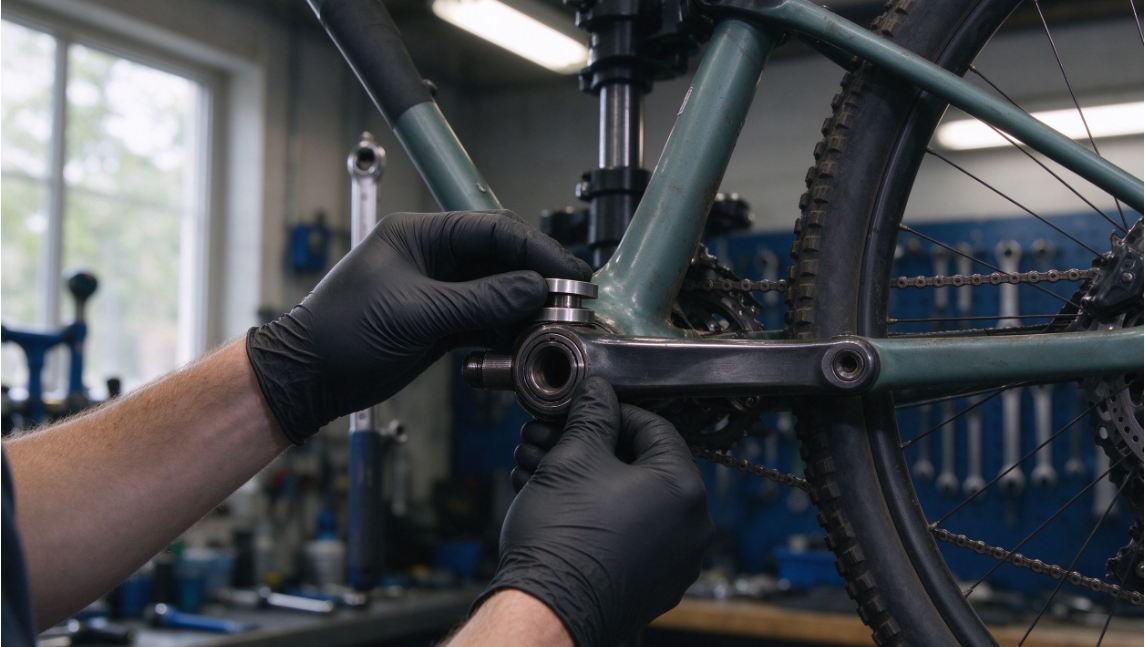
Bottom bracket (BB) spacer — slips over the crank spindle between the bearing cup and the crank arm. It adjusts chainline and stops crank rub on frames with 68 mm or 73 mm shell widths. Hollowtech II and DUB systems use 1.0 mm, 2.0 mm and 2.5 mm shims.
Hub axle washer / dropout spacer — sits between the axle nut and the frame or hub flange, centers the wheel and corrects dish. These are usually flat steel washers stamped to size.
Headset stem spacers, the rings that raise handlebar height, are usually aluminum or carbon, so they are outside the scope of this article.
2. How to Confirm Spacer Size: Outer Diameter, Inner Diameter, Thickness
Never replace a spacer by eyeballing it. Three dimensions decide fit.
2.1 Three dimensions you must measure
| Dimension | What it means | Typical value on MTB | How to measure |
|---|---|---|---|
| Thickness (T) | Width of the ring along the axle. The single most critical value. | Cassette spacer: 1.0 – 2.5 mm. BB spacer: 1.0 – 4.5 mm. Hub washer: 0.5 – 2.0 mm. | Digital caliper, measured at three points around the ring. |
| Inner diameter (ID) | Hole size. Must slide freely over the spline or spindle without play. | Cassette spacer ID ≈ 15.0 – 17.5 mm. BB spacer ID matches spindle (24 mm, 30 mm or DUB 28.99 mm). Hub washer ID matches axle (9 mm quick release, 12 / 15 / 20 mm thru axle). | Caliper across the bore, at two perpendicular directions. |
| Outer diameter (OD) | Outside edge. Must clear the lockring, cup or frame, and carry enough bearing surface. | Cassette spacer OD ≈ 22 – 26 mm. BB spacer OD ≈ 30 – 38 mm. Hub washer OD ≈ 18 – 26 mm. | Caliper across the outside edge. |
2.2 Practical measurement workflow
Remove the old spacer cleanly and lay it on a flat surface.
Measure thickness first. If the old spacer looks deformed, take the gap left on the freehub or spindle with the cassette / crank installed, and reverse-engineer the required thickness.
Measure ID against the part it slides onto. A steel spacer that is 0.2 mm too small in ID will not seat; 0.5 mm too large will not center the stack.
Measure OD against the lockring or cup recess. The spacer must not protrude beyond the locking face.
Cross-check with the standard: HG 11-to-10-speed conversion uses a 1.85 mm spacer; SRAM XDR on a road freehub uses 1.85 mm; DUB MTB on a 68 mm BSA shell uses 2.5 mm inner left, 2.5 mm inner right and 4.5 mm outer right.
Buyer tip for OEM: ask the spacer supplier for a dimension sheet with OD, ID, thickness, material grade, hardness and flatness tolerance. A reliable factory holds thickness to ±0.05 mm and flatness to 0.02 mm on bicycle-grade shims.
3. How to Replace Steel Spacers, Step by Step
3.1 Replacing a cassette / freehub steel spacer
Shift to the smallest cog, open the quick release or thru axle.
Fit a lockring tool (Shimano TL-FC / HG standard) and turn the lockring counter-clockwise.
Lift the cog pack off the freehub body. The old spacer will slide out behind it.
Clean the freehub splines with isopropyl alcohol. Inspect the old spacer for burring or cupping.
Place the new spacer onto the freehub body, with the chamfered side facing the cassette.
Re-stack the cogs in the correct order, thread the lockring by hand, then torque to 30 – 40 N·m.
Spin the wheel. The cassette must not rock, and shifting into first and top gear must be crisp.
3.2 Replacing a bottom bracket steel spacer
Remove the crank bolts, pull the crank arms off the spindle.
Slide the old spacer(s) off the spindle. Keep them in order — left inner, left outer, right inner, right outer.
Wipe the spindle and the inside face of the crank arm.
Fit the new spacer(s) in the original order. If chainline is off by 1 mm, move a 1 mm shim from one side to the other rather than adding more.
Reinstall the crank, torque the fixing bolts to the manufacturer spec (typically 12 – 16 N·m for M8, 14 – 16 N·m for M6).
Check for rubbing under the chainstay or seat tube when you turn the crank by hand.
3.3 Replacing a hub axle washer / dropout spacer
Loosen the axle nut or thru-axle, remove the wheel.
Slide the old washer off the axle.
Replace with a steel washer of the same ID and a thickness that centers the wheel in the frame.
Reinstall the wheel, true the hub in the dropout, torque to spec and recheck dish.
4. Post-Installation Maintenance
Steel spacers rust and lose flatness if they are treated as a one-time fit. A 20-minute service routine every season extends life by several times.
Keep dry and clean. After wet rides, wipe the freehub body, BB spindle and dropout faces. Salt on winter roads is the fastest way to corrode a stamped steel washer.
Grease lightly. A thin film of anti-seize or assembly paste on the spacer face prevents galvanic seizure between steel and aluminum.
Re-torque after the first ride. Lockrings and crank bolts can settle 5 – 10 percent in the first 50 km. Recheck at 100 km.
Inspect every three months. Look for cupping, edge burr, rust pits or a color change on the steel. Any one of these means replace the spacer, not bend it back.
Store spares in a dry box. Steel spacers in a workshop drawer with a desiccant packet will outlast loose parts on a shelf.
Do not mix material. A steel spacer stacked on an aluminum freehub is fine; two steel spacers stacked without grease will weld themselves together by cold corrosion.
5. Price Reference: Retail vs Wholesale
Steel spacers are low-cost, high-volume parts. Price depends on material (stamped low-carbon steel vs hardened stainless), tolerance, order volume and packaging.
| Segment | Unit price | MOQ | Notes |
|---|---|---|---|
| Consumer retail, single piece (Amazon, LBS) | USD 1.5 – 5.0 | 1 | Branded packs of 3 – 7 sizes sell for USD 8 – 18. |
| Retail bulk, 100 – 500 pcs | USD 1.0 – 1.1 | 100 | Typical Alibaba listing for 1 / 1.5 / 1.85 / 2.0 / 2.18 / 2.35 mm cassette washer sets. |
| Wholesale factory, 1,000 – 5,000 pcs | USD 0.16 – 0.65 | 1,000 | Stamped low-carbon steel, zinc-plated or nickel-plated finish. |
| OEM custom, over 10,000 pcs | USD 0.08 – 0.35 | 10,000 | Custom OD / ID / thickness, logo stamping, mixed-size packaging. |
| Hardened stainless (SUS304 / SUS420) | +30 – 80 percent over carbon steel | — | Worth it for wet climates and e-bike applications. |
Buyers should watch for hidden cost: plating, passivation, laser marking, retail blister packaging and sea freight all add unit price. Ask for an FOB quote that splits part cost, plating cost and packaging cost.
6. Why BONPORA Steel Spacers Fit Bicycle OEM and Aftermarket
BONPORA manufactures precision stamped and machined steel components for automotive chassis systems — PU bump stops, shock absorber shims, valve plates, ball joint washers, bushings, thrust washers and spacer shims. The same stamping, heat-treatment and plating lines that serve car OEMs run bicycle-grade steel spacers today.
Material options: SPCC low-carbon steel, 65Mn spring steel, SUS304 / SUS420 stainless.
Size range: OD from 6 mm to 60 mm, ID from 3 mm to 40 mm, thickness from 0.1 mm to 5 mm. Tape any cassette spacer, BB shim or hub washer and send the drawing. We reverse-engineer it.
Tolerance: thickness ±0.02 mm on spring-steel shims, flatness 0.02 mm.
Surface: zinc, nickel, black oxide or passivated stainless, with salt-spray test reports available.
MOQ: from 5,000 pcs for custom tooling, from 1,000 pcs for standard sizes in stock.
Marking: laser or stamped logo, size code and batch number on every ring.
Brand owners, bike distributors and repair-chain buyers looking for a steady steel spacer supplier can request a free sample pack (1.0 / 1.5 / 1.85 / 2.0 / 2.35 mm cassette shims, plus 1.0 / 2.0 / 2.5 mm BB shims) through the BONPORA contact page.
7. FAQ
What thickness spacer do I need to put a 10-speed cassette on an 11-speed HG freehub?
Use a 1.85 mm steel spacer behind the cassette. This is the industry standard defined by Shimano HG freehub compatibility charts. A 1.0 mm spacer alone is not enough and will cause shifting noise under load.
Can I use an aluminum spacer instead of a steel spacer on a mountain bike?
Aluminum is acceptable for headset stem spacers, but for cassette, BB and hub applications steel is preferred because it carries lockring pressure without deforming. An aluminum spacer that cups under 40 N·m torque will loosen the cassette over time.
How do I know if a steel spacer is worn?
Three signs: visible rust pits on the face, edge burr or cupping (the ring rocks when laid on glass), and thickness loss of more than 0.1 mm versus spec. Replace it at any sign of the three.
What is the wholesale MOQ for custom bicycle steel spacers?
Most Chinese factories, including BONPORA, start custom tooling at 5,000 to 10,000 pieces per size. Standard sizes (1.0, 1.5, 1.85, 2.0, 2.5 mm) are usually available from 1,000 pieces.
Do steel spacers need grease during installation?
A thin coat of assembly paste or anti-seize is recommended, especially where steel touches an aluminum freehub or crank. This prevents galvanic seizure and makes the next service easy.
Request a Sample Pack
If you source bicycle components, e-bike drive parts or repair-kit hardware, contact BONPORA today for a free steel spacer sample pack and a dimension sheet. We export to distributors in Europe, Southeast Asia and the Americas, and support your private-label packaging.
- Prev.:Steel Shim Kit China Factory | Types, Material, Craft & Remote Factory Inspection‑Bonpora Parts
- Next.:...