sales@bonporaparts.com
0086-10-64988621
English
The core differences in chassis suspension between traditional fuel vehicles and new energy vehicles are mainly reflected in the following six points. The difference in vehicle weight and axle load is the most significant difference between traditional fuel vehicles and new energy electric vehicles.
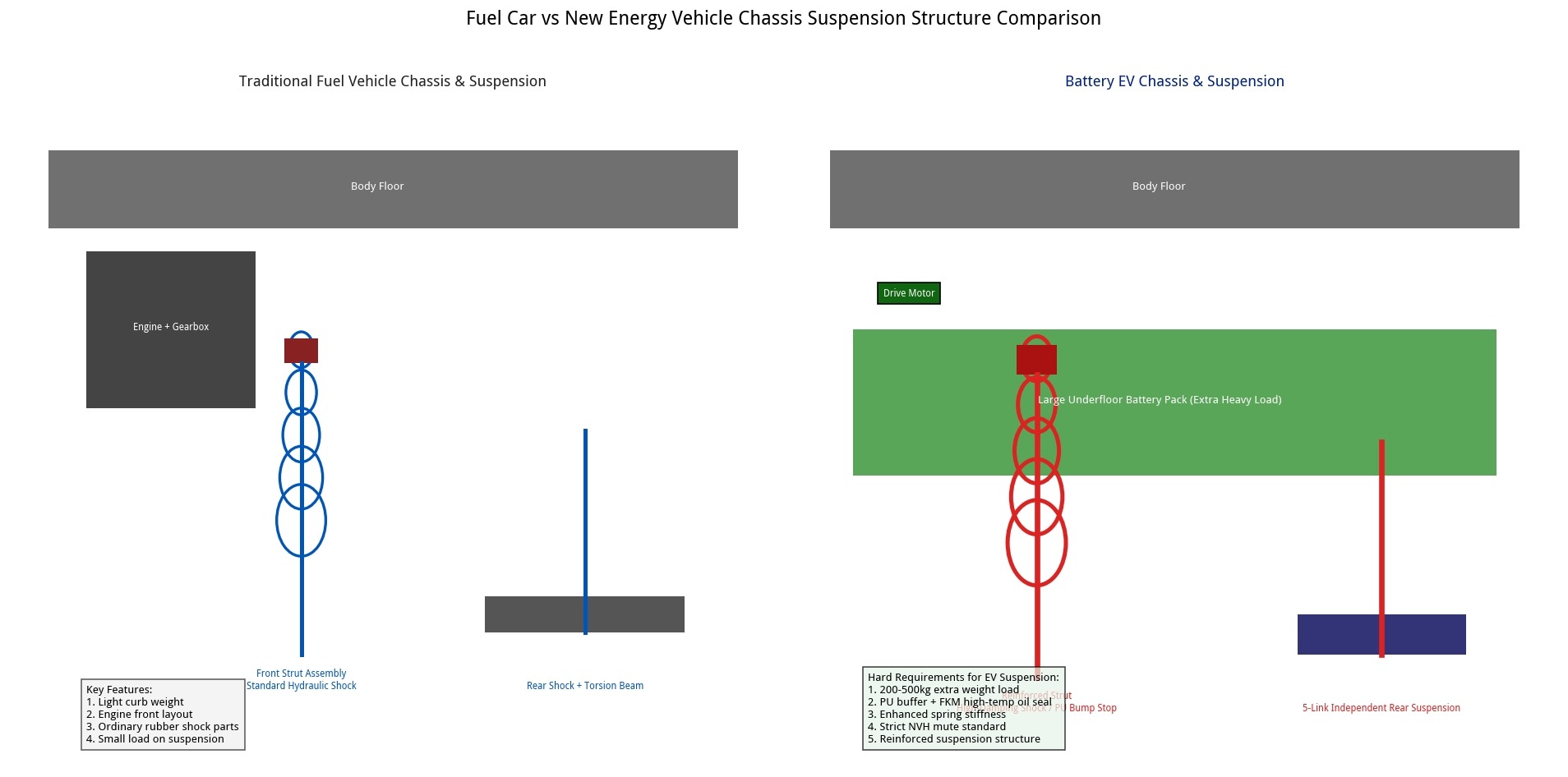
(One、Suspension Difference Between Fuel Cars & EVs)
(1) Difference in vehicle weight and axle load
fuel-powered vehicle
Balanced weight distribution, front/middle engine and gearbox, small difference in front and rear axle load; The spring-loaded mass is stable and the weight fluctuation range is narrow.
Pure electric new energy vehicles
The battery pack is placed under the chassis, increasing the overall weight of the vehicle by 200-500kg and significantly increasing the front/rear axle load;
The weight is concentrated in the middle of the chassis, and the spring-loaded mass is much higher than that of fuel vehicles in the same class;
The four-wheel drive dual motor model has greater axle load distribution and instantaneous torque impact;
Lightweight models (micro electric cars) have a relatively high proportion of body weight and unsprung mass.
(2) Differences in vibration and noise control requirements
fuel-powered vehicle
Equipped with an engine and exhaust mechanical noise, the suspension only needs to filter out road bumps, and the NVH standard is loose.
new energy vehicle
No internal combustion engine noise, road noise, suspension abnormal noise, and damping friction noise will be infinitely amplified; The NVH control level of the entire vehicle has been upgraded by one level, and the requirements for rubber parts and damping cylinders to be quiet are strict.
(3) Different power impact and handling conditions
Fuel powered vehicles: Linear torque output, smooth starting and acceleration impact, slow suspension load changes.
New energy vehicles: instantaneous peak torque of the motor, severe pitching impact during rapid acceleration and braking; The battery has strong rigidity, and the road impact is directly transmitted to the shock absorber, with a higher frequency of high-frequency reciprocating compression and stretching.
(4) Chassis space layout constraints
Fuel powered vehicles: Adequate space is reserved in the engine compartment and trunk, and the design freedom of shock absorbers, springs, and buffer blocks is high.
New energy vehicles: The chassis is covered with battery packs, the ground clearance is limited, and the suspension installation space is compressed; The shock absorber assembly, dust cover, and buffer block must be miniaturized and thinner, while bearing larger loads.
(5) Differences in thermal environment
Fuel powered vehicles: engine cooling is the main focus, and the temperature around the shock absorbers is moderate.
New energy vehicles: The battery cooling system and electronic control module are closely attached to the suspension, and the shock absorber rubber parts and oil seals are exposed to high temperatures for a long time, accelerating aging.
(6) Differences in Suspension Structure Selection
| Regional structure | conventional fuel-powered vehicles | new energy electric vehicle |
|---|---|---|
| Mainstream front suspension | MacPherson, double wishbone | Lightweight strengthening of MacPherson and five link double wishbone, with a large number of aluminum alloy swing arms to reduce unsprung mass |
| Rear suspension | Torque beam, multi link | High end models come standard with a five link independent suspension to reduce battery bumps and pressure; Improved torsion beam for low-end micro electric vehicles |
| Matching configuration | Ordinary hydraulic shock absorber | High configuration comes standard with electronic control AVS/CDC adaptive damping and air suspension, suitable for battery shock resistance requirements |
| Stabilizer bar design | Conventional thickness anti roll | Bold stabilizer bar and elongated plum string to counteract the significant tilt caused by the battery |
Having understood the differences in chassis suspension between conventional fuel vehicles and new energy vehicles, let's now talk about the hard technical requirements for the complete set of shock absorber components for both types of vehicles
(1) Rigid standard for shock absorber damping cylinder (pillar assembly)
Requirements for fuel vehicles
Conventional twin tube hydraulic structure, damping attenuation standard: damping force attenuation ≤ 20% at 100000 kilometers;
Oil seal temperature range -30 ℃~110 ℃, ordinary nitrile rubber oil seal is sufficient;
The thickness of the chrome plating layer on the piston rod is ≥ 0.03mm, which meets the requirements of conventional gravel road protection.
Mandatory upgrade requirements for new energy vehicles
1) Damping force increased by 25% to 40%: suppresses sudden acceleration/sudden braking nodding and battery bouncing up and down;
2) Double the fatigue resistance standard: the number of cycles for reciprocating compression and tensile testing is ≥ 500000 times (250000 times for fuel vehicles);
3) High temperature aging resistant oil seal: FKM fluororubber oil seal, temperature resistant -40 ℃~140 ℃, resistant to high temperature radiation from battery packs;
4) Thickened piston rod and cylinder wall: to cope with larger axle loads and prevent deformation and oil leakage of the cylinder body;
5) Electronic shock absorption exclusive seal: compatible with CDC/AVS solenoid valve, zero internal leakage, avoiding electronic control failure and error reporting;
6) Low friction inner wall coating: reduces piston rod friction noise and adapts to high NVH standards of new energy vehicles.
(2) Rigid requirements for spiral springs
Fuel powered vehicle: ordinary silicon manganese spring steel, linear elasticity, fatigue test 300000 times without fracture.
new energy vehicle
Material upgrade: High strength alloy spring steel, thicker cross-section, increased yield strength by 30%;
Elastic curve optimization: Progressive spring, with automatic stiffness increase under heavy load (full load+battery);
Anti corrosion standard upgrade: electrophoresis+double-layer spray coating to cope with condensation water vapor corrosion of chassis batteries;
Prohibit unilateral stiffness deviation: The deviation of left and right spring elasticity should be ≤ 3% to prevent uneven force on the battery.
(3) Rubber vulnerable parts (top rubber, buffer block, spring cushion, lining)
Fuel powered vehicle: ordinary natural rubber/CR chloroprene rubber, with a service life of 2-3 years.
Hard indicators for new energy vehicles
1) Buffer limit block: High density polyurethane PU must be used, and ordinary rubber cannot be used; Anti compression permanent deformation ≤ 8%, no cracking after repeated heavy load impact;
2) Top rubber support rubber: high damping modified rubber, filters fine vibrations, and eliminates low-speed fine crushing noise; The built-in flat bearing has improved the noise reduction level, and there is no rustling sound when turning;
3) High and low temperature resistance, hydrolysis resistance: The battery chassis has a lot of condensation water, and the rubber cannot turn white, expand, or soften;
4) Mandatory service life requirement: warranty mileage ≥ 150000 kilometers, fuel vehicles only 100000 kilometers.
(4) Dust cover accessories
Fuel powered vehicle: Ordinary corrugated rubber dust cover is sufficient.
new energy vehicle
Thickened corrugated structure to prevent damage from gravel impact;
Resistant to low temperature hardening, not brittle in winter;
Combined with a miniaturized shock absorber, compact design, and non-interference with battery pack pipelines.
(5) Install accessories (stabilizer bar linkage, screw bracket)
The chassis load of new energy vehicles is greater, and the fatigue strength of all bolts and plum string ball joints is improved. The ball joint dust cover is resistant to electrolyte corrosion, preventing chassis loosening and abnormal noise.
If you understand the differences in chassis suspension between conventional fuel vehicles and new energy vehicles, then you will know how to choose suitable automotive chassis suspension accessories for different types of vehicles. Bonpora has been engaged in professional chassis suspension for many years and is a high-quality supplier that can provide a full range of products for different road conditions, regions, and vehicle models. If you have any needs in this regard, please contact us
