
Sway Bar vs Tie Rod: Which Should You Choose for Body Reinforcement?
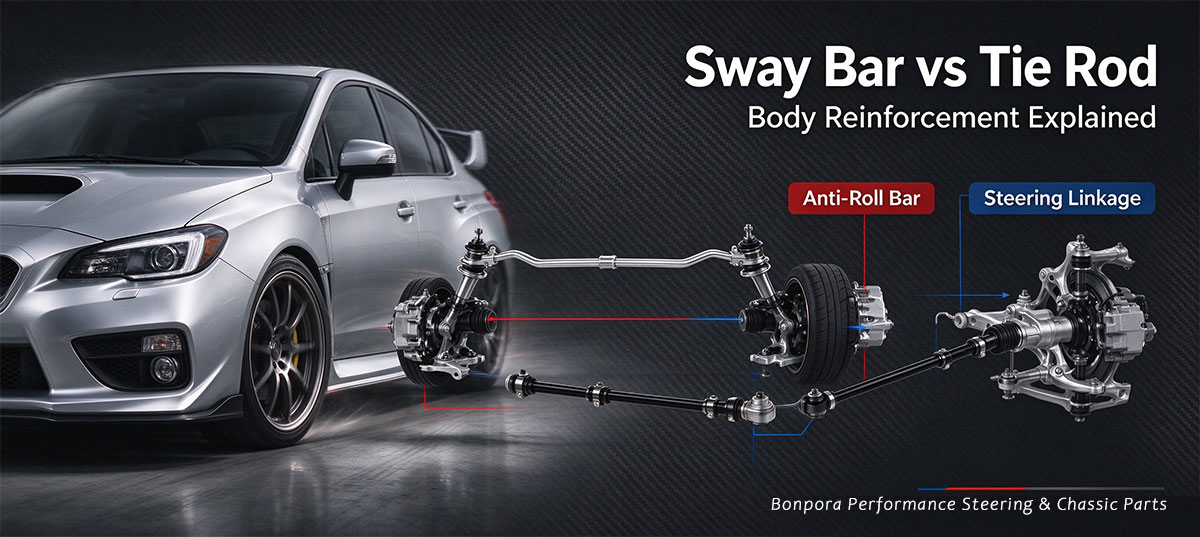
If you enjoy modifying cars, you have probably asked whether body reinforcement is better achieved with a sway bar or a tie rod. The answer depends on what you want to improve. A sway bar mainly affects body roll and cornering stability, while a tie rod is part of the steering system and influences steering response, alignment, and tire contact. The two parts serve different purposes, so choosing one over the other is not simply a matter of which is “better.”
What Is a Sway Bar?
A sway bar, also called an anti-roll bar, is a torsion bar connected between the left and right sides of the suspension. When the vehicle leans during cornering, the sway bar twists and resists body roll. This can reduce lean, improve front-rear balance, and make the car feel more stable in fast changes of direction.
Advantages of a Sway Bar
Reduces body roll: Helps the vehicle stay flatter during cornering.
Improves stability: Can make the car feel more predictable in quick maneuvers.
Adjustable stiffness: Some aftermarket sway bars allow tuning for different driving styles.
Good for spirited driving: Popular in street tuning, track days, and motorsport applications.
What Is a Tie Rod?
A tie rod is part of the steering linkage. It connects the steering rack to the steering knuckle and transmits driver input to the wheels. While it is not technically a “body reinforcement” part in the same way as a sway bar, a stronger or more precise tie rod can improve steering feel, reduce play, and help maintain wheel alignment under hard use.
Advantages of a Tie Rod
Improves steering response: Reduced slack can make steering feel more direct.
Supports alignment accuracy: A robust tie rod is less likely to deflect under load.
Enhances tire contact: More precise steering geometry can improve grip and tire wear consistency.
Useful for performance builds: Often upgraded in track, drift, and race-oriented projects.
Differences Between Sway Bar and Tie Rod
| Component | Main Function | Primary Benefit |
|---|---|---|
| Sway Bar | Reduce body roll | Flatter cornering, better stability |
| Tie Rod | Connect steering system to wheels | Better steering response and alignment |
Which Should You Choose?
If your goal is to reduce body roll and make cornering feel more stable, a sway bar is the more direct choice. If your goal is to improve steering precision, reduce play, and strengthen the steering linkage, a tie rod upgrade is more relevant. In many performance builds, both are used together rather than as an either/or choice.
FAQ
Q1: Is a tie rod considered body reinforcement?
A: Not in the same sense as a sway bar or chassis brace. A tie rod is part of the steering system, but upgrading it can improve rigidity and response.
Q2: Can I install a sway bar and tie rod at the same time?
A: Yes. They serve different systems, so they are often upgraded together in performance builds.
Q3: Will a sway bar improve steering?
A: Indirectly. By reducing body roll, a sway bar can make steering feel more stable, but it does not replace a precision steering linkage.
Q4: When should I upgrade my tie rods?
A: Consider upgrading tie rods when you notice loose steering, inconsistent alignment, or when building a car for track and heavy performance use.
Q5: Are aftermarket sway bars and tie rods universal?
A: No. Both must match the vehicle model, suspension design, steering geometry, and installation points.
Source Performance Steering and Chassis Parts from Bonpora
If you are sourcing tie rods, steering linkage components, or related chassis parts for performance projects, Bonpora can support your procurement with consistent component supply. For product details, visit our tie rod product page:
https://www.bonporaparts.com/en/tie-rods/
For quotations, sample requests, or technical discussions, contact our team at sales@bonporaparts.com.
- Prev.:McPherson Suspension Parts Buying Guide: Control Arms, Bushings, Links & Shock Absorber Components
- Next.:Control Arm vs Lower Arm: What’s the Difference for Chassis Upgrade