
- 1. 1. What the Recall Actually Says About the Failure Mode
- 2. 2. Where Welded Chassis Parts Fail
- 3. 3. Market Context: The Category Keeps Growing While Tolerances Tighten
- 4. 4. Six Lines to Add to Every Welded-Part RFQ
- 5. 5. What BONPORA Supplies
- 6. 6. Why Importers Stay With BONPORA
- 7. 7. Start With the Part Numbers You Actually Sell
Built on Sound Welds: Chery Rear Axle Recall Exposes the Weakest Link in Chassis Sourcing
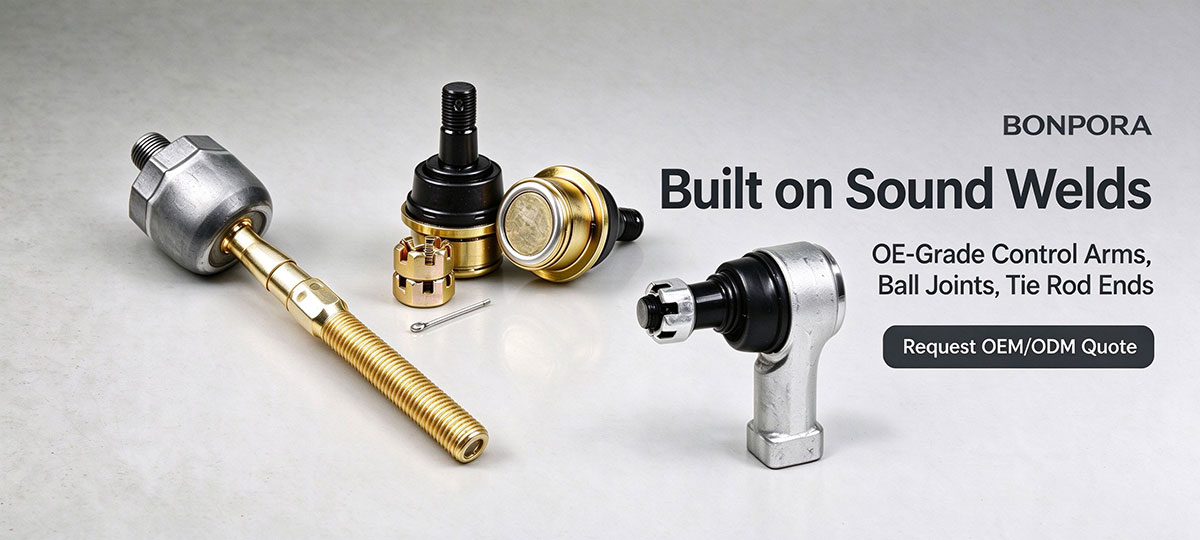
A suspension failure that ends with a wheel leaving the vehicle rarely begins with the part that looks weakest. It usually begins at a weld.
On 6 November 2026, Chery Automobile filed recall S2026M0146V with the State Administration for Market Regulation of China. From 27 November 2026, the company will recall 53,882 Tiggo 5x and Omoda vehicles built between 6 June 2022 and 31 December 2023. The stated cause is a production process problem: the weld between the rear axle trailing arm and the sleeve may be inadequate. In extreme cases the weld at that location can fail and separate, causing loss of wheel control and a crash risk.
The remedy is a free inspection of the rear axle production date code, followed by replacement of the axle where the vehicle falls into the defective batch. Read that remedy sentence again, because it is the part that matters to a buyer and not only to an owner.
1. What the Recall Actually Says About the Failure Mode
Three details in the filing are worth separating from the headline number:
The joint is structural, not decorative. A trailing arm to sleeve connection carries the wheel loads and the braking torque reaction. When it separates, no downstream component can compensate.
The cause is described as a process problem, not a design problem. That places the failure in weld preparation, penetration, fit-up or post-weld control, which is precisely the territory a purchasing department can specify and audit.
The remedy is batch-based. Identification runs through a production date code, which means the manufacturer expects the defect to be confined to a production window rather than spread across the whole programme.
The same failure pattern has appeared outside China as well: media reports in October 2026 described an Omoda 5 rear axle failure in Malaysia that led to a recall of roughly 8,878 vehicles there. One failure mode, more than one market, and the common denominator is a welded suspension structure.
2. Where Welded Chassis Parts Fail
Most welded suspension components look identical across suppliers in a catalog photo. They do not behave identically in service. The differences sit in five places:
Weld penetration. A visually acceptable bead can still be a partial-penetration joint. Only a documented procedure and cross-section sampling reveal the difference.
Fit-up gap at the sleeve. Excessive gap forces the welder to bridge space, which encourages lack of fusion at the root.
Heat-affected zone. A weld that is sound in the as-welded condition can still lower fatigue life if cooling and post-weld treatment are not controlled.
Coating after welding. E-coat over an incompletely cleaned weld traps process residue and hides porosity until corrosion opens it.
Lot traceability. A part that cannot be traced to a weld date and a weld operator cannot be recalled, sorted or defended in a warranty dispute.
3. Market Context: The Category Keeps Growing While Tolerances Tighten
| Segment | Size and growth | Source basis |
|---|---|---|
| Automotive control arm market | USD 15.74 billion (2025) to USD 22.56 billion (2034), 5.5 percent CAGR | Verified Market Reports |
| Suspension stabilizer bar link market | USD 4.41 billion (2025) to USD 7.04 billion (2034) | Verified Market Reports |
| Steering tie rod market | USD 18.9 billion (2024) to USD 36.8 billion (2034), 6.6 percent CAGR | Industry market research |
| Asia-Pacific share of automotive chassis market, 2025 | 49.28 percent, growing at 9.76 percent CAGR to 2031 | Mordor Intelligence |
A growing category attracts capacity, and new capacity is where process discipline is most likely to slip. That is the connection between a recall in one country and a purchasing decision in another.
4. Six Lines to Add to Every Welded-Part RFQ
Whether you are buying control arms, axle links, bracket assemblies or any welded suspension component, these six requirements move the specification from appearance to evidence:
Welding procedure specification and its qualification record — the WPS and the corresponding PQR, not a general certificate.
Penetration requirement stated numerically — weld leg size or throat thickness, with the inspection method named.
Sleeve and boss fit-up tolerance — a maximum gap before welding, written into the drawing.
Non-destructive testing with a sampling plan — magnetic particle or ultrasonic inspection at a defined frequency, with records retained.
Lot marking that supports recall — a production date code or heat number on the part itself.
Fatigue and proof-load test data — results for the exact part number, not for a similar family.
Any supplier who cannot answer these six questions in writing is asking you to carry their process risk in your warranty reserve.
5. What BONPORA Supplies
BONPORA manufactures steering, suspension and chassis components in Hubei, China, and supplies importers, distributors, workshop groups and private label programmes. Our range covers:
Ball Joints and Ball Joint Kits — castle nut, cotter pin, circlip and flat washer supplied in the box.
Tie Rod Ends and Rack Ends — inner and outer, hardened studs and controlled taper fit.
Stabilizer and Sway Bar Links — including adjustable and chrome-plated adjusting links with PU bushings.
Rubber Bushings and PU Buffer Blocks — OE-matching dimensions and compound options.
Control Arm Components — OE-matching geometry, bushing and ball joint options for front and rear applications.
Steel Shims, External Tooth Lock Washers and Flat Washers — the fastening layer that preserves clamp load.
Full specifications appear on our Products page. Send a VIN list or a competitor part number list and we will return a coverage map with material and coating data.
6. Why Importers Stay With BONPORA
A part that fails visibly costs one claim. A part that fails quietly costs a customer.
Process documentation as standard — material, heat treatment and coating records supplied with the quotation.
Complete kits — hardware included, so installation is correct the first time.
OEM and ODM programmes — your brand, packaging and part numbering on our engineering.
Mixed-container loading — practical for distributors who stock breadth rather than depth.
Scheduled lead times — built around your selling season, not our production convenience.
7. Start With the Part Numbers You Actually Sell
The fastest way to judge a chassis supplier is to send three part numbers you already stock and ask for the weld or joint specification behind each one. If the answer arrives as a certificate rather than a specification, keep looking. If it arrives as a drawing with penetration, tolerance and test data, you have found a supplier worth a programme.
Send us those three part numbers today and we will return the specification, the coating data and an OEM/ODM quotation within one business day.
Request a quote for ball joints, tie rod ends, stabilizer links, bushings or control arm components. Coverage maps, material specifications and OEM/ODM pricing available.
- Prev.:Steering Linkage Integrity: Tie Rod Ends, Rack Ends and the Fastening Lessons of 2026
- Next.:...