
810,000 Vehicles, One Fastener Gap: The Parts Behind the Largest Recalls of November 2026 | BONPORA
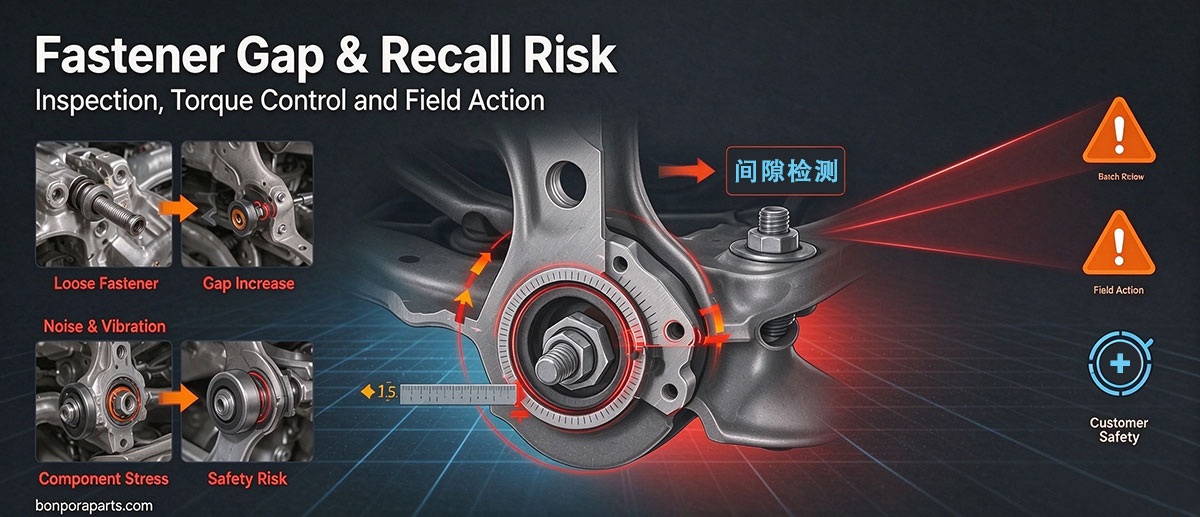
A batch of recall notices published by the Defective Product Recall Center of the State Administration for Market Regulation covers more than 810,000 vehicles across several manufacturers in China. Read the list of defects and something unexpected appears. The largest campaigns are not about software, battery management or driver assistance. They are about a bolt that holds the steering rack to the subframe, a nut on a stabilizer bar link, a pin layout inside a steering pump connector, and a retainer on a fuel line quick connector.
China Automotive News reviewed those notices on 20 November 2026 and reached a conclusion that applies well beyond one market: the weakest links in the safety chain are the connection nodes that nobody puts on the launch slide.
Four Defects, One Category of Part
| Component | Failure mode described | Consequence |
|---|---|---|
| Subframe to steering rack fixing bolt | Corroded by road salt and moisture, then breaks | Rack housing can break, steering control lost |
| Front stabilizer bar link nut | Axial force below specification, nut does not hold the joint | Link separates, roll control degraded |
| Steering pump connector | Pin layout does not conform to specification | Power assist drops out |
| Fuel line quick connector | Retainer lifts unexpectedly | Leak, fire risk |
Four different components, four different drawings, one shared property: each is a joint. Each exists to hold two things together under load, and each fails at the interface rather than in the bulk material. No casting cracked. No forging was undersized. The failure was in the connection.
None of Them Fail Instantly
This is the part that matters for a purchasing decision. These defects are progressive, not instantaneous. The vehicle works, then works less well, then one day does not. Vibration loads the joint millions of times. Temperature cycles the coating. Road salt starts the corrosion cell. Torque relaxes as the joint settles. Each cycle removes a little margin, and the margin disappears long after the vehicle left the line.
A software defect can be fixed over the air in a week. A corroded bolt cannot. It needs a workshop, a lift, a technician, a part, and in the worst case a steering rack. That asymmetry explains why a component worth a few cents can trigger a campaign whose cost per vehicle is measured in hundreds.
A fastener priced in cents can carry a failure cost in millions. That ratio is the whole argument for treating it as a safety part rather than a commodity.
Why the Risk Collects at Tier Two and Three
China Automotive News quotes Cui Dongshu, secretary general of the China Passenger Car Association, who links the pattern to compressed development cycles. The article adds a supply chain explanation that any importer will recognise: fasteners, wiring connectors and line joints are mostly tier two and tier three items, low unit price, thin margin, sitting at the far end of the chain. Development budget and incoming inspection attention move toward the battery, the electronics and the driver assistance stack, because that is where the visible differentiation is.
The consequence is structural, not personal. When a part is bought as a commodity, it is inspected as a commodity, which usually means sampling. Heat treatment consistency, plating thickness and fixture assembly are exactly the variables that sampling of fifty pieces cannot see. A small batch of under-tempered nuts or a plating line running at the low end of its window passes a sample and fails in service eighteen months later.
The article also names the commercial pressure behind the choice: at thin margins, the question of whether to run one more corrosion cycle or raise the sampling ratio is answered by cost, not by risk. That is a management failure dressed as procurement efficiency.
Three Questions That Separate a Part From a Safety Part
Ask for clamp load, not torque. A torque specification is a proxy. What holds a stabilizer link to a strut is the axial force in the nut, and that force depends on the friction coefficient between nut, thread and face. Change the plating, change the lubricant, change the coating weight, and the same torque produces a different clamp load. A nut that met the torque wrench and still let the joint separate is the definition of a specification that measured the wrong thing. Ask the supplier to state the axial force target, the friction coefficient window, and how both are verified per lot.
Treat coating as part of the design. For a bolt living in the splash zone behind a front wheel, the coating system is not cosmetic. Zinc flake with a defined friction characteristic, a stated salt spray duration, and a named plating line are engineering data. The same drawing number produced on three lines, with three pre-treatments, yields three corrosion lives. The drawing should name the process, and the certificate should name the line.
Replace visual check with proof. A quick connector retainer that lifted was not verified; it was looked at. A link nut that lost axial force was not measured; it was torqued to a number. Proof means a pull test on the retainer, a torque-and-mark with the mark photographed against the lot, and a recorded result that can be pulled up two years later when a dealer in another country reports the first failure.
| What buyers usually specify | What actually decides field failure |
|---|---|
| Torque value | Clamp load and friction coefficient window |
| Coating type | Coating thickness, friction class, plating line identity |
| Visual inspection | Pull test or proof load per lot, recorded |
| Sampling plan | Lot-level process records for heat treat and plating |
| Drawing revision | Notification when a process or a source changes |
What BONPORA Documents on Every Reference
BONPORA manufactures steering and suspension components in Hubei, China, and supplies importers, distributors, assemblers and private label programmes in Europe, the Gulf, Southeast Asia, Africa, Latin America and North America. We are not a vehicle manufacturer and we do not run recalls. What we can do is make the documentation side of a programme uninteresting to a regulator.
Ball Joints and Ball Joint Kits — castle nut, cotter pin, circlip and washer, with kit content listed line by line, nut grade stated and the coating identified.
Tie Rod Ends and Rack Ends — inner and outer, hardened studs, stated thread class, left-hand and right-hand drive held on separate part numbers.
Control Arms — OE-matching geometry, stated bushing grade, ball joint variants identified by revision.
Stabilizer and Sway Bar Links — fixed, adjustable and chrome-plated adjusting links, with the nut and the axial force target specified as a pair.
Rubber Bushings and PU Buffer Blocks — including MB3C-18061-1, supplied to a stated hardness and compression set specification.
Steel Shims, Lock Washers and Flat Washers — to the coating specification of the fastener they sit under, because the washer sets the friction that sets the clamp load.
Each reference ships with a specification sheet covering material grade, hardness, thread class, coating type and thickness, friction class where the joint is torque-controlled, grease fill and kit content. Lot identification is marked on the part where the drawing allows it, process records are retained against the lot, and any change of material source, heat treatment line, plating line or assembly cell is notified before shipment rather than after the first claim.
A Practical Next Step
Send the part numbers you buy today, the platform they serve, whether the application is passenger car, light truck or heavy steer axle, and your annual volumes. You will receive a coverage map, a specification sheet per reference, the traceability fields we can commit to in writing, and a landed cost range for your destination port.
- Prev.:Suspension Systems of 2026 Shenzhen APEC Official VIP Vehicles: Air Suspension vs CDC Adaptive Damping
- Next.:...