sales@bonporaparts.com
0086-10-64988621
English
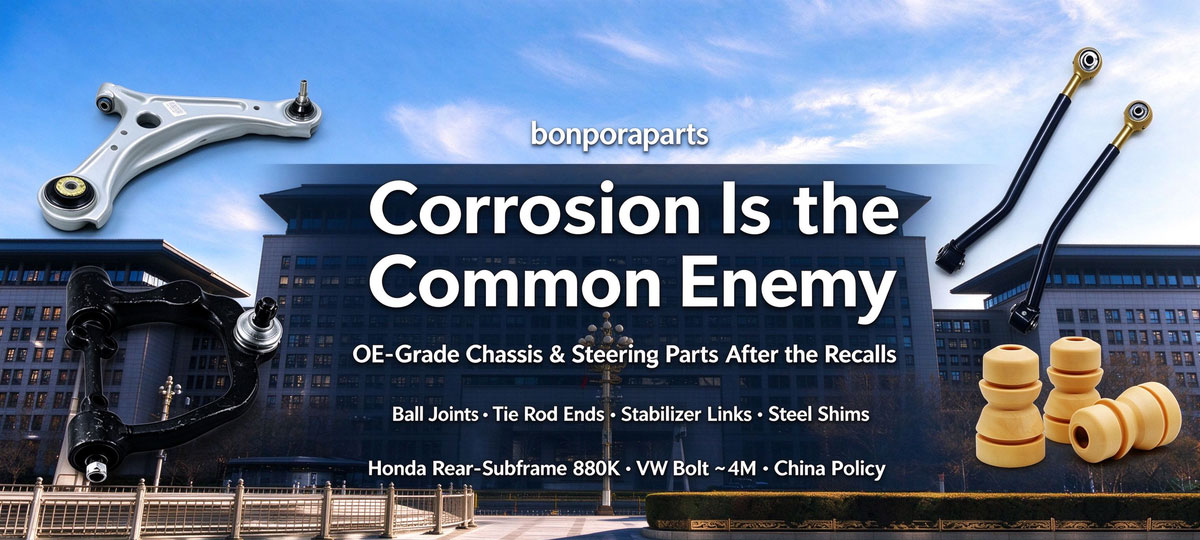
This week the aftermarket's biggest stories share one word: corrosion. American Honda has recalled 880,514 vehicles over rear-subframe rust that can make drivers lose control, while Volkswagen's steering-bolt recall now converges on roughly four million vehicles worldwide. Add a new national aftermarket policy from China, and import buyers get a clear signal: OE-grade, corrosion-resistant chassis and steering parts are the aftermarket stock of 2026.
American Honda has issued a recall covering 880,514 vehicles in the United States — certain 2016–2022 Honda Pilot, 2017–2023 Ridgeline, 2019–2023 Passport and 2014–2020 Acura MDX models sold across 21 salt-belt states. Corrosion in the rear subframe can cause drivers to lose control, increasing crash and injury risk. Honda estimates the defect affects only about 1% of the recalled vehicles and has reported no related injuries or warranty claims. Dealers will provide free subframe inspections and install reinforcement kits or replace components at no cost. In Canada, more than 130,000 Honda and Acura vehicles (Passport, Pilot, Ridgeline, MDX) are covered by the same rust issue (source: Ground News / American Honda).
Like VW's steering-bolt campaign, the Honda recall is a corrosion story: moisture, road salt and time silently attack chassis steel that the driver never inspects. That is precisely why aftermarket demand for durable, rust-resistant suspension hardware keeps climbing — every recall makes owners and workshops think about the next component that could corrode.
German reports, citing Handelsblatt, now put Volkswagen's potential global recall at roughly four million vehicles — about two million Volkswagen, more than one million Škoda, approximately 700,000 Audi and 200,000 Seat vehicles. In the United States, NHTSA has already opened a campaign covering about 208,000 vehicles (Atlas, Tiguan, Audi Q3). The defect: a corrosion-prone screw on the right side of the steering rack that can shear, impairing steering and raising crash risk. The fix is to replace the screw with a corrosion-resistant coated version, without structural changes (source: Handelsblatt via Ideal Rent a Car).
The two campaigns — Honda's subframe, VW's steering bolt — reinforce each other. Corrosion is not a single OEM's problem; it is the common enemy of every chassis and steering component exposed to salt-belt conditions. Distributors that stock parts with documented corrosion-resistant finish and OE-grade material are positioning for the service wave these recalls create.
Honda and VW are not alone. ZF North America has recalled aftermarket TRW and Lemförder track control arms (NHTSA 25E020) over a bush-sleeve gap that stresses the subframe during installation; Tesla recalled 2026 Model Y vehicles over front-suspension lateral-link fasteners that may not have been properly tightened (26V558); and Ford has issued inspection campaigns for front lower control-arm-to-steering-knuckle ball joints on F-600 models. Every campaign is a material-, fit- or torque-integrity problem in a component the driver never sees.
For import buyers, the lesson is that "OE-grade" is not a marketing phrase. Ball joints, tie rod ends, stabilizer links, bushings and the shims, lock washers and flat washers that secure them must match OE geometry, material grade and corrosion-resistant finish — because a subgrade replacement is not just a returned part, it is a liability.
Inside China, a new top-level policy is opening fresh demand for chassis and suspension parts. In early October 2026, nine ministries including the Ministry of Commerce jointly issued the Notice on Measures to Cultivate and Expand Automobile Aftermarket Consumption — China's first systematic national document supporting the aftermarket and vehicle modification industry, with 17 measures across six areas. Off-road modification in particular is seeing a surge in orders, which drives demand for upgraded control arms, stabilizer links, tie rods and mounting hardware both domestically and in export markets (source: 商务部等9部门新政).
For overseas buyers, this matters twice. It means Chinese factories are scaling production of the very categories global distributors want, and it means the upgrade-and-replace cycle is accelerating — a durable tailwind for ball joints, adjustable stabilizer links, tie rod ends and the hardware that goes with them.
Browse the full catalog at our product page: www.bonporaparts.com/en/products. Our range aligns directly with the categories in this week's recalls and policy push:
Ball joints and complete ball-joint kits (with cotter pins, nuts and washers) — the load-bearing pivot points that wear with mileage and road salt.
Tie rod ends and inner tie rods — steering wear items in every front-end inspection.
Stabilizer links, including adjustable links with rod ends — fast-turnover suspension parts and off-road upgrade favorites.
Rubber bushings and mounts — NVH and alignment parts riding the same service interval.
Steel shims, external-tooth lock washers, flat washers and fastener hardware — the corrosion-resistant fastening class now in the headlines.
An 880,000-vehicle subframe-corrosion recall, a steering-bolt recall nearing four million vehicles, and China's new aftermarket policy all point the same way: reliable, OE-grade, corrosion-resistant chassis and steering parts are the ones to stock. For distributors, workshop chains and e-commerce buyers, that is where demand and margin sit. The window to lock in a factory-direct, OE-grade source is open. Send your part list or OE cross-reference for a quotation, free sample program and delivery schedule.
Stock the parts corrosion puts in demand — backed by OE-grade quality. Email sales@bonporaparts.com today for a quote and full catalog.
