
When a Steering Knuckle Is Under-Strength: Linkage & Ball-Joint Quality Decide Steering Control
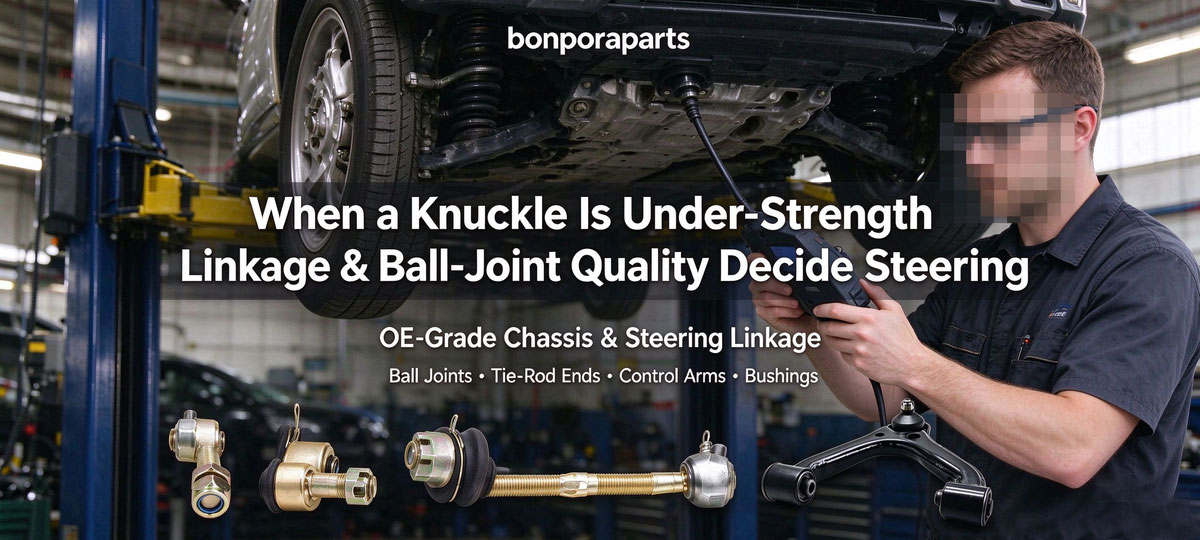
The steering knuckle is the part most drivers never see, yet it ties the steering and suspension together at every wheel. That is the point behind a recent Toyota recall in the United States covering 617 vehicles, including the 2026 Lexus TX350, RX350, RX500 and TX500 hybrids, and the Toyota Grand Highlander. In affected vehicles, forged-aluminum front steering knuckles from a certain production batch were not fully processed during manufacturing, leaving the finished parts with material strength below design specification. After a sudden large impact — such as hitting a pothole or a curb — an under-strength knuckle can break at the strut mounting point or the tie-rod mounting point, lowering steering control and, in some operating conditions, causing a loss of vehicle control and an increased risk of a crash. Dealers will inspect the front steering knuckles and replace any from the affected batch free of charge. For buyers who stock chassis and steering linkage, the recall is a reminder that a knuckle is only as strong as its material, its process — and the connections bolted to it. This article explains what a steering knuckle connects, why strength and process matter, and how to source OE-grade knuckles and the linkage that surrounds them.
1. Under-Strength Steering Knuckles Recalled
Toyota is recalling 617 vehicles in the United States because certain forged-aluminum front steering knuckles from a specific production batch did not complete all required manufacturing steps, leaving material strength below design specification. In service, a sudden large impact — a pothole, a curb — can fracture such a knuckle at the strut mounting point or the tie-rod mounting point. Because the knuckle is central to steering, a broken knuckle can reduce or completely eliminate steering control and, in some conditions, cause a loss of vehicle control and a higher risk of a crash. The remedy is a free inspection and, where needed, replacement of the affected front steering knuckles, with owner notification letters expected to be mailed November 2, 2026.
2. What a Steering Knuckle Connects
At each front wheel, the steering knuckle is the structural hub that ties together the steering and suspension loads. It carries the shock absorber or strut at its top, the lower control-arm ball joint at its base, and the tie-rod end that delivers steering input. In some designs it also carries the stabilizer-link connection. Braking, cornering, acceleration and road impact all flow through the knuckle and out through these connection points. If the knuckle is weak, the first place a failure shows is exactly where those loads concentrate: the strut mount and the tie-rod mount — the two failure points named in the recall.
3. Why Material and Process Decide Strength
Forged-aluminum knuckles are chosen for their strength-to-weight ratio, but that strength depends on the forging and heat-treatment process being carried out completely. The recall states that parts from a particular batch missed required production steps, so the finished material strength fell below design specification. A forging with an incomplete process can look identical on the outside while carrying a hidden weakness inside. That is why material verification — chemical composition, hardness, and process traceability — matters just as much as the finished geometry. A knuckle that cannot pass process and material checks is a risk no matter how clean it looks.
4. What This Means for the Aftermarket
Inspect the whole corner after a heavy impact — a hard pothole or curb hit can stress the knuckle, the strut mount, the ball joint and the tie-rod end together, and a damaged connection can hide a cracked knuckle.
Treat the knuckle and its linkage as one system — an OE-grade knuckle is only as reliable as the ball joint, tie-rod end and fasteners that carry load into it.
Demand material and process verification — chemical composition, hardness and process traceability matter as much as finished geometry.
Source complete linkage — avoid mixing a good knuckle with weak linkage that rebuilds the same weak point.
5. OE-Grade Chassis and Steering Linkage from Bonpora
Bonpora supplies OE-grade chassis and steering linkage — ball joints, inner and outer tie-rod ends, control arms and rubber bushings — designed to OE geometry with validated materials and surface treatment. Because the buyer works directly with the factory, material, heat treatment and process traceability can be confirmed against the application. For a distributor or workshop, factory-direct sourcing of complete, verified chassis linkage is the practical way to keep every steering knuckle surrounded by parts as strong as the part itself.
Contact: sales@bonporaparts.com | Product page: www.bonporaparts.com/en/products
- Prev.:When a Rear Control-Arm Pin Slides Out: Arm, Bushing & Fastener Quality Decide
- Next.:2026 Auto Parts Aftermarket Boom: Why Chassis & Suspension Wear Parts Are in Record Demand