
- 1. What Actually Happened in the SAIC Volkswagen Recall
- 2. Why De-Icing Salt Is the Real Enemy of Chassis Parts
- 3. The Market Is Growing, and So Is the Demand for Durability
- 4. How Professional Buyers Should Specify Corrosion Resistance
- 5. The Components to Stock for Salt-Belt Markets
- 6. Why Buyers Rely on BONPORA
- 7. Build Your Chassis Coverage With BONPORA
Road Salt Season: Why Corrosion-Resistant Chassis Parts Decide 2027 Contracts
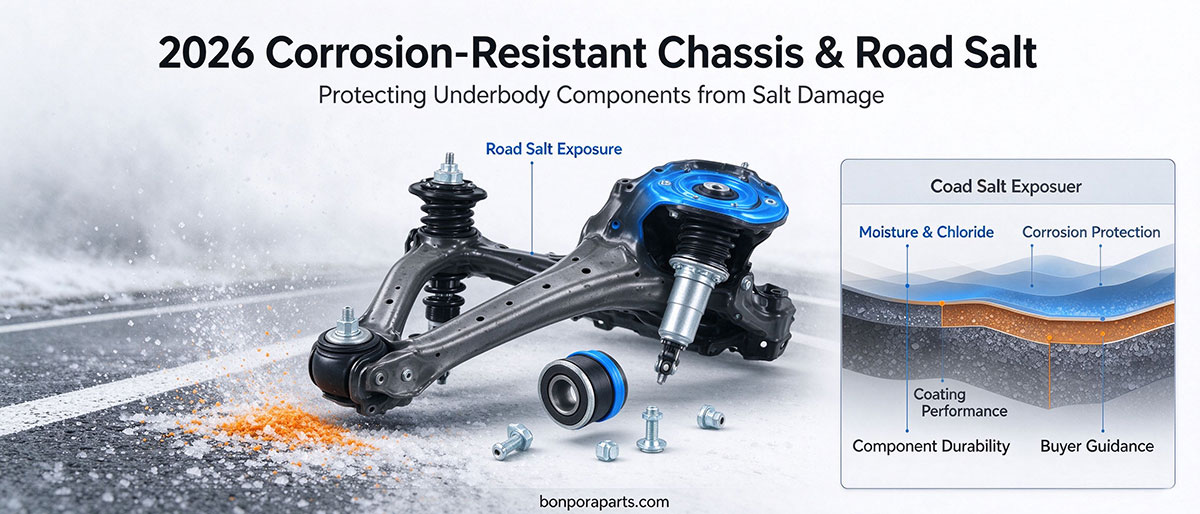
One bolt, one hundred and seventy thousand vehicles, and a two month wait. On November 4, 2026, SAIC Volkswagen filed a recall with China regulatory authorities covering 170,739 vehicles built between late 2016 and autumn 2026. The cause is not a design flaw in the steering system. It is corrosion: a single fastening bolt where the subframe meets the right side of the steering rack. For aftermarket buyers, this is the clearest possible signal that corrosion resistance, not just dimensional accuracy, is what separates a reliable chassis supplier from a risky one.
What Actually Happened in the SAIC Volkswagen Recall
The recall notice, filed under reference S2026M0139V, describes the failure chain precisely: vehicles exposed long term to moisture and road de-icing salt may see the right side subframe to steering rack fastening bolt corrode. As corrosion progresses the bolt may break, the right side steering rack connection may fail, and steering function becomes limited, creating a safety risk.
Two details matter as much as the defect itself:
The fix is a corrected fastener, replaced free of charge by authorized dealers, with the recall scheduled to start on January 15, 2027. Owners were also advised to stop safely and contact a dealer if they notice abnormal metallic knocking from the front axle area or abnormal steering feel.
The scope is global and much larger than one brand. On the same day, Volkswagen China sales and FAW Volkswagen also filed recalls, bringing the combined China filing above 580,000 vehicles. Media reports indicate the Volkswagen Group expects to handle roughly 2.86 million vehicles worldwide for the same class of steering system bolt corrosion and fracture risk.
Read that again in procurement terms: a component costing a few cents drove a campaign covering millions of vehicles across ten years of production. Durability is not a detail. It is the whole argument.
Why De-Icing Salt Is the Real Enemy of Chassis Parts
Steering and suspension components live in the worst environment on the vehicle: low, exposed, constantly sprayed with water, grit and chloride. Road de-icing salt accelerates what engineers call galvanic and crevice corrosion, and it attacks exactly the features that keep a chassis joint safe:
Threaded fasteners — the bolt that failed in this campaign. Once threads corrode, clamp load drops long before the bolt visibly breaks.
Taper and ball stud surfaces on tie rod ends and ball joints, where corrosion changes fit and accelerates boot damage.
Rubber and polyurethane bushings on stabilizer links, where salt and grit work into the joint and degrade the elastomer.
Shims and washers, where a corroded mating face loses preload and lets a joint work loose.
This is why the specification that matters in a purchase order is not only the drawing dimension. It is the surface treatment, plating thickness and salt spray hours behind that dimension.
The Market Is Growing, and So Is the Demand for Durability
Independent research shows a category with steady volume growth:
The global suspension stabilizer bar link market is estimated at about USD 4.41 billion in 2025 and projected to reach USD 7.04 billion by 2034.
The automotive ball joint market is projected to grow from about USD 3.51 billion in 2026 to USD 4.93 billion by 2034, a 4.4 percent CAGR, with Asia-Pacific the dominant region.
The steering tie rod market is valued at about USD 18.9 billion in 2024 and projected to reach USD 36.8 billion by 2034, a 6.6 percent CAGR.
Growth in these categories is not driven by new vehicle production alone. It is driven by replacement cycles, and replacement cycles are set by how long a part survives salt, grit and load. A supplier who extends that cycle wins repeat orders.
How Professional Buyers Should Specify Corrosion Resistance
When you write an RFQ for chassis components, these five lines do more for your warranty cost than any price negotiation:
Base material and heat treatment — specify grade and hardness range, not just a part number.
Coating system — zinc-nickel, zinc flake or equivalent, with a stated coating thickness.
Salt spray hours — require a documented neutral salt spray result, not a verbal claim.
Boot and seal material — chloroprene or equivalent for chloride exposure, with a verified crimp.
Torque and prevailing torque data — because a corroded fastener that still spins freely has already failed.
The Components to Stock for Salt-Belt Markets
BONPORA supplies a focused, OE-oriented range available as OEM, ODM and private label:
Ball Joints and Ball Joint Kits — with castle nuts, cotter pins, circlips and flat washers, coated for chloride exposure.
Tie Rod Ends and Rack Ends — inner and outer, precision taper with corrosion-resistant finishes.
Stabilizer and Sway Bar Links — including adjustable and chrome-plated adjusting links with PU bushings.
Rubber Bushings and PU Buffer Blocks — OE-matching geometry, formulated for salt and grit environments.
Steel Shims, External Tooth Lock Washers and Flat Washers — the fastening layer that preserves preload.
Control Arm Components — OE-matching geometry for front and rear applications.
Browse the full catalog on our Products page and cross-reference coverage against your fleet and VIN database.
Why Buyers Rely on BONPORA
In a category where a single fastener can trigger a recall covering millions of vehicles, buyers need a supplier who documents durability instead of promising it.
OE-grade quality at OEM cost — correct materials, heat treatment and protective coatings.
Complete kits — fastening hardware included so first-time installation is correct.
Private-label flexibility — your brand, our engineering, a stable supply line.
Reliable lead times — container-ready scheduling ahead of the winter salt season.
Build Your Chassis Coverage With BONPORA
We are a China-based manufacturer of steering-and-suspension and chassis components, exporting globally with competitive OEM/ODM pricing, complete technical documentation and a partner-friendly after-sales policy. If your market sits in the salt belt, tell us your coating and salt spray requirements and we will quote against them.
Send your part numbers or RFQ today and get application coverage, coating specifications and a 2027 OEM/ODM quote within one business day.