
- 1. What Microcellular PU vs Rubber Actually Compares
- 2. The Eight Dimensions, Side by Side
- 3. Microcellular PU vs Rubber on the Stiffness Curve
- 4. The Money: Tooling, Freight and Claims
- 5. A 100-Point Procurement Matrix You Can Copy
- 6. Market-by-Market: Europe, the Gulf and Southeast Asia
- 7. Ten Checks Before You Release the Drawing
- 8. FAQ
- 8.1. Is microcellular polyurethane the same thing as a polyurethane bush?
- 8.2. Can I replace a rubber bump stop with a polyurethane one without changing the drawing?
- 8.3. Which material lasts longer in a hot climate?
- 8.4. What density should I specify for a microcellular PU bumper?
- 8.5. Is rubber cheaper at 10,000 pieces?
Microcellular PU vs Rubber Bump Stops: Procurement Matrix
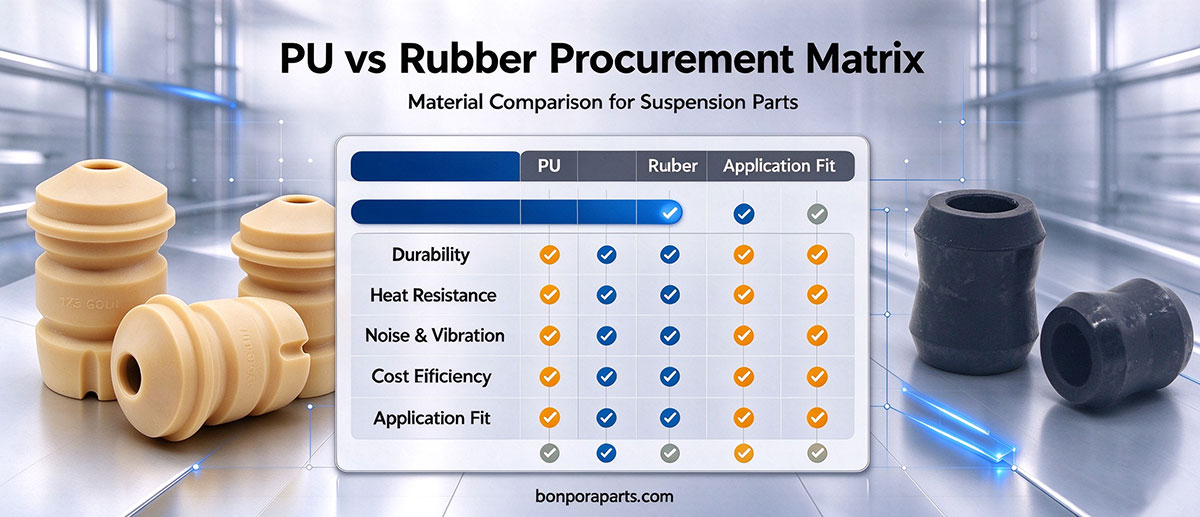
Microcellular PU vs rubber bump stops is decided by load case and engagement frequency, not by material prestige. Polyurethane holds a progressive curve and holds its height under heat; rubber costs less and suits stops that are rarely touched. The eight-dimension matrix below turns that judgement into a score you can defend in a review.
Both parts will fit the same pocket on the damper. That is the trap. A rubber stop and a cast polyurethane stop can share a bore, a free height and a drawing number, and still behave differently at the seventieth percentile of travel, in the third summer, and on the claim that arrives eleven months after the sale.
What Microcellular PU vs Rubber Actually Compares
Start with the vocabulary, because catalogue labels are looser than drawing labels.
"Microcellular" describes a cell structure, not a polymer family. A cast polyurethane bumper is poured into a mould as a reacting liquid, and the reaction leaves a fine closed-cell structure with a denser skin at the surface. That structure is what allows a compact part to carry a rising load without behaving like a solid block. Bonpora's published description of the part is high-elasticity polyurethane in an MDI or NDI system, installed on the shock absorber piston rod, with a stated working range of -40 °C to +90 °C on the on-road range and up to +100 °C on the off-road range. The microcellular label is the industry's shorthand for that cell structure; the number that pins it down is density.
On the rubber side, the word covers several compounds. Natural rubber, SBR, EPDM and NBR all appear in chassis catalogues, and a "rubber bump stop" in a listing may be a solid vulcanised part, an EPDM stop chosen for weather, or a polyurethane part described loosely because the template has one field for "rubber". The only reliable check is the material line on the drawing.
The process difference explains most of the commercial differences. A rubber bumper is vulcanised in a compression mould: a solid blank is cured under heat and pressure. A cast polyurethane bumper is poured as a liquid and then cured, with a post-cure to stabilise properties. Casting allows the formulation to be adjusted across a wide window, so resilience, hardness and dynamic behaviour can be tuned to the application. Vulcanisation gives a mature, repeatable process with low material cost and a long service history.
That is also why the two families are inspected differently. Bonpora's bumper range is released against four items under an IATF 16949 quality system: static stiffness curve, compression set, hardness and appearance. A solid rubber stop is more often released on hardness, tensile strength, compression set and appearance, with the curve inferred from the drawing.
The Eight Dimensions, Side by Side
The microcellular PU vs rubber comparison is easiest to read as eight trade-offs. The last column is what a buyer should ask for, because a claim without a test condition is not a specification.
| Dimension | Microcellular PU | Rubber (NR, SBR, EPDM) | What to verify |
|---|---|---|---|
| Piece price | Higher per part at equal envelope; the chemical system costs more than a rubber compound | Lower; mature compounding base and a wide supplier field | Price at the same annual volume, packaging and Incoterm |
| Tooling | Cast tools in aluminium or steel; cost driven by cavity count and finish | Compression moulds; often simpler geometry and robust tooling | Who owns the tool, how it is amortised, whether it can move |
| Weight | Roughly half the density of a solid compound; trade figures commonly quoted at 0.45–0.65 g/cm³ | Solid compounds usually above 1.0 g/cm³, commonly quoted near 1.1–1.25 g/cm³ | Weighed part mass on the drawing, not a brochure range |
| Stiffness curve | Three levers: density, hardness and profile | Hardness and profile, with less leverage from density | Force at 25, 50 and 75 per cent deflection, plus engagement height |
| Temperature | Stated -40 °C to +90 °C on the on-road range | NR typically about -40 °C to +80 °C; EPDM wider on heat, poor in oil | Continuous temperature at the part, not the bay peak |
| Oil, brine, abrasion | Good resistance to oil, grease and abrasion | NR swells in oil; EPDM resists weather but not oil | Cleaning chemicals, de-icing brine, stone-chip exposure |
| Compression set and life | Holds height well under repeated cycling; NDI where the part works hard | Takes set under sustained load and heat | Set conditions: 25 or 40 per cent compression, 23 or 70 °C, 24 or 70 h |
| End of life | Thermoset; regrind as filler only, chemical recycling in specialised streams | Thermoset; crumb and devulcanisation routes are more established | IMDS, REACH or a take-back requirement |
Two rows decide most programmes: the stiffness curve and the compression set. A stop engaged twice a year does not need a finely tuned curve, and a stop that carries load continuously will be judged on how much height it keeps. Price rarely decides anything alone, because the part is cheap relative to the labour of replacing it.
The choice also has to be read against the rest of the on-road bump stop range, where one damper position may be served by several profiles. A profile change and a compound change are both product changes, and both require the curve to be re-verified rather than assumed.
Microcellular PU vs Rubber on the Stiffness Curve
A bumper is a spring, not a cushion. It comes into play only as the suspension runs out of travel, adding resistance progressively so the suspension never arrives at a hard limit. Progressiveness comes from the profile: a tapered, waisted or ribbed shape increases the effective section as load rises, which is why two bumpers of the same compound with different profiles are not interchangeable.
The material adds two more levers. In a cast microcellular part, density can be lowered to soften the early part of the curve while the skin and profile keep the top firm; hardness moves the whole curve up or down. That gives a polyurethane supplier three ways to hit a target curve. A solid rubber stop generally has two, because the compound is not cellular and the density lever is not available.
The difference shows at the top of the travel, where the driver feels it. A curve that rises too early produces a thump over speed humps and a harshness customers describe as bottoming out, even when the damper has travel left. A curve that rises too late lets the damper reach its internal stop, and the noise moves from a soft thud to a metallic knock.
Two consequences for a specification:
Ask for force at three deflections, not one. A single figure at 50 per cent compression can be met by curves that feel completely different at 20 and at 80 per cent.
Ask for the engagement height with the curve. The same curve engaged 15 mm earlier behaves like a much stiffer stop.
The Money: Tooling, Freight and Claims
Cost comparisons in the microcellular PU vs rubber decision go wrong in three places: tooling compared as a lump sum without an amortisation basis, freight ignored because the part is small, and claims excluded because they sit in another budget.
The model below prices one part number over five years for a programme of 1,000 vehicles, four stops per vehicle, so 4,000 parts. Prices, tooling and claim rates are illustrative placeholders; replace them with your own quotations and warranty data.
| Cost line, illustrative | Microcellular PU | Rubber |
|---|---|---|
| Piece price at 4,000 pcs | 7,400 (1.85 each) | 5,280 (1.32 each) |
| Tooling, one part number | 9,000 | 5,200 |
| Freight, 4,000 pcs by volume | 78 | 147 |
| Claims, temperate market | 1,237 (20 claims at 61.85) | 3,679 (60 claims at 61.32) |
| Five-year total, temperate market | 17,715 | 14,306 |
| Claims, hot heavy-duty market | 1,484 (24 claims at 61.85) | 7,358 (120 claims at 61.32) |
| Five-year total, hot market | 17,962 | 17,985 |
Three things are worth pulling out.
First, the freight line looks trivial and is not. At a nominal 130 USD per cubic metre for consolidated cargo, the rubber part costs almost twice as much to move because a solid compound packs fewer pieces per carton. On a light, bulky part, packaging density is a cost driver, the same mechanism covered in our bump stop cost breakdown.
Second, in a temperate market with a rarely engaged stop, cash favours rubber by about 19 per cent over five years. Polyurethane does not win this model on money. It has to win on function, and the functional reason has to be written down, because a sourcing decision that contradicts its own cost model will be reopened at the next review.
Third, the ranking is not stable. Raise the claim rate on the rubber part from 1.5 to 3.0 per cent of parts, which is what a hot, dusty, heavily loaded duty cycle can do to a compound that takes set, and the totals cross: 17,962 against 17,985. The crossover sits at roughly 120 claims per 4,000 parts over five years. That is the number to argue about, not the piece price, because it decides which material is cheaper in the market you actually sell into.
Request a specification sheet or a sample pair for bench comparison before you release the drawing.
A 100-Point Procurement Matrix You Can Copy
The matrix converts the discussion into a score. Score each dimension from 1 to 5, multiply by its weight, and add. The weights reflect how much each dimension usually moves total cost of ownership for a chassis stop; adjust them if your programme has a different centre of gravity, but keep the total at 100.
| Dimension | Weight | A score of 5 looks like | A score of 1 looks like |
|---|---|---|---|
| Engagement frequency and load severity | 20 | Stop is used weekly; heavy vehicle or loaded duty cycle | Stop is touched a few times a year on a light vehicle |
| Stiffness curve requirement | 15 | Curve specified at three deflections with a tight band | Drawing says "as per sample", no curve on file |
| Temperature at the part | 15 | Sustained above 80 °C or below -30 °C in service | Sheltered position, mild climate, no heat source nearby |
| Life and set target | 15 | Height loss limit after heat ageing is stated and tested | No set requirement, life expressed only in years |
| Weight and packaging density | 10 | Part weight target exists, or the part ships by air | Sea freight, no weight target, carton already optimised |
| Tooling and batch economics | 10 | Low volume, frequent engineering changes, short runs | High volume, one drawing for years, single cavity pays back |
| Price sensitivity of the channel | 10 | Price is the main sales argument in the category | Price is a small share of the installed cost |
| Documentation and end of life | 5 | IMDS, REACH and a take-back question are on the table | No material declaration required |
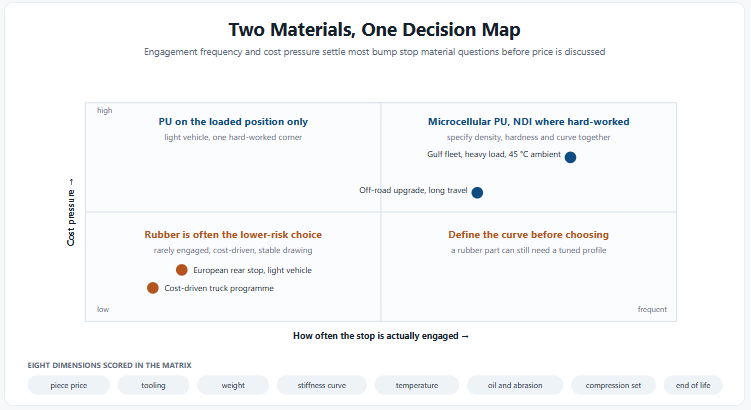
Bands: 70 and above points to microcellular polyurethane, with MDI as the default and NDI where the drawing or duty cycle calls for it. Between 45 and 69 points to a mixed approach, polyurethane on the loaded position and rubber where the stop is rarely engaged. Below 45, rubber is usually the lower-risk choice, and the money saved is real rather than deferred.
Two hard gates override the score, because no weighting should outvote a physical limit:
Sustained temperature outside the stated -40 °C to +90 °C range of the on-road bumper. That is a compound conversation before it is a material-family conversation, and it should happen before the tool is cut.
Oil, brine or abrasive exposure at the contact face. A standard natural rubber grade will swell and soften; the drawing has to name a resistant compound or the material has to change.
A third gate applies to logistics rather than physics: if the part ships by air, or the vehicle programme carries a mass target, the density advantage of a microcellular part usually settles the question before the matrix is filled in.
Market-by-Market: Europe, the Gulf and Southeast Asia
The same reference number can be sold into all three regions, and the microcellular PU vs rubber answer shifts with the market. What changes is which failure mode appears first.
| Market | Dominant load case | Default choice | What to check |
|---|---|---|---|
| Europe | Comfort and noise judged at low amplitude; cold winters; road salt | PU where a curve is specified; rubber on rarely engaged rear positions of older platforms | Brine on the contact face; ten-year durability expectations |
| Gulf | 45–50 °C summer ambient, dust, heavy loads, frequent full compression | PU, with NDI where the stop works hard | Heat ageing of the rubber alternative; dust packing at the strike pad |
| Southeast Asia | Mixed road quality, humidity, price-led channel | PU on the front axle; rubber acceptable on low-cost rear positions | Hydrolysis resistance of the PU grade in humid storage |
Europe is where the curve matters most, because the complaint that reaches a distributor is usually about noise and harshness rather than a broken part. The Gulf is where compression set decides the outcome: a rubber stop that takes a set in the first hot season has lost the early part of its travel, and the suspension reaches the hard limit sooner for the rest of its life. Southeast Asia combines humidity with price pressure, where a mixed bill of materials often beats a single-material policy.
Ten Checks Before You Release the Drawing
The matrix picks a family. This list makes the drawing releasable. Each item is cheaper to fix now than after the tool is cut.
Write the load case in one sentence: how often the stop is engaged, at what deflection, with what load.
Put the stiffness curve on the drawing as force at three deflections, with the engagement height beside it.
State free height, compression length and the gap at static ride height, each with a tolerance.
Name the compound system rather than the family: MDI, NDI, or a rubber grade with its hardness range.
State the continuous temperature at the part, and say whether it is measured or estimated.
List the media the part will meet: engine oil, brake fluid, brine, cleaning chemicals, dust.
Fix part mass and packaging density if the part ships by air or the carton is already tight.
Agree tooling ownership, amortisation and transfer rights in writing, including who pays for a cavity change.
Name the four inspection items and the records that travel with each batch: curve, set, hardness, appearance, plus batch code.
Ask for the material declaration and the end-of-life route before the first shipment, not after the first customer audit.
A supplier who can answer all ten has a process that matches the drawing. A supplier who answers six and promises the rest is describing a part that will be re-engineered during the first claim.
FAQ
Is microcellular polyurethane the same thing as a polyurethane bush?
No. Both are cast polyurethane, but a bush is normally a solid, higher-hardness part bonded or pressed into a metal sleeve, while a bumper is a cellular part whose structure contributes to the progressive curve. The material data does not transfer between them.
Can I replace a rubber bump stop with a polyurethane one without changing the drawing?
Only if the curve, free height and engagement gap still match. A polyurethane part of the same envelope is usually stiffer at the top of the travel, so a straight swap can shorten the effective travel. Compare force at three deflections, and treat the substitution as a product change with a first-article submission.
Which material lasts longer in a hot climate?
Compression set decides it. A cast polyurethane stop generally retains height better under sustained load and heat, while a solid rubber stop can take a permanent set within a season of heavy use. The honest comparison is a set test at the temperature the part actually sees, not a generic service-life claim.
What density should I specify for a microcellular PU bumper?
Specify the density your curve needs, and ask the supplier to confirm it on the first-article report. Trade figures for cast microcellular bumper compounds commonly sit between 0.45 and 0.65 g/cm³, but density interacts with hardness and profile, so a number copied from another programme will not reproduce another programme's curve.
Is rubber cheaper at 10,000 pieces?
At the piece-price line, usually yes. At the total-cost line, it depends on claims. In the model above the materials cross at roughly a 3 per cent claim rate over five years, which is reachable in a hot, dusty, heavily loaded duty cycle. Run your own claim history through the table before treating piece price as the answer.
A material decision is easier to defend when it is written as a score rather than a preference. Send the load case, the curve and the target market, and the microcellular PU vs rubber recommendation can be checked against the same eight dimensions used here.