
- 1. What Dual-Site Manufacturing Means for a Parts Buyer
- 2. Why Single-Plant Sourcing Concentrates Risk
- 3. Two Bases, Two Roles: Luoyang and Wuxi Compared
- 4. Five Ways a Second Plant Reduces Supply Risk
- 5. Scoring Your Current Supplier: A Single-Factory Risk Table
- 6. Dual-Site Manufacturing Cost Model: Duplication vs Shutdown
- 7. A Four-Week Contingency Plan for Moving Volume Between Sites
- 8. FAQ
- 8.1. Does the same part come out identical from two different production lines?
- 8.2. Who owns the moulds if my volume runs across two plants?
- 8.3. Is dual-site manufacturing from one supplier the same as dual-sourcing from two suppliers?
- 8.4. If both sites are IATF 16949 certified, can volume move without repeating documentation?
- 8.5. What volume split makes a second production base worthwhile for a mid-size aftermarket programme?
Dual-Site Manufacturing: How a Second Plant Lowers Supply Risk
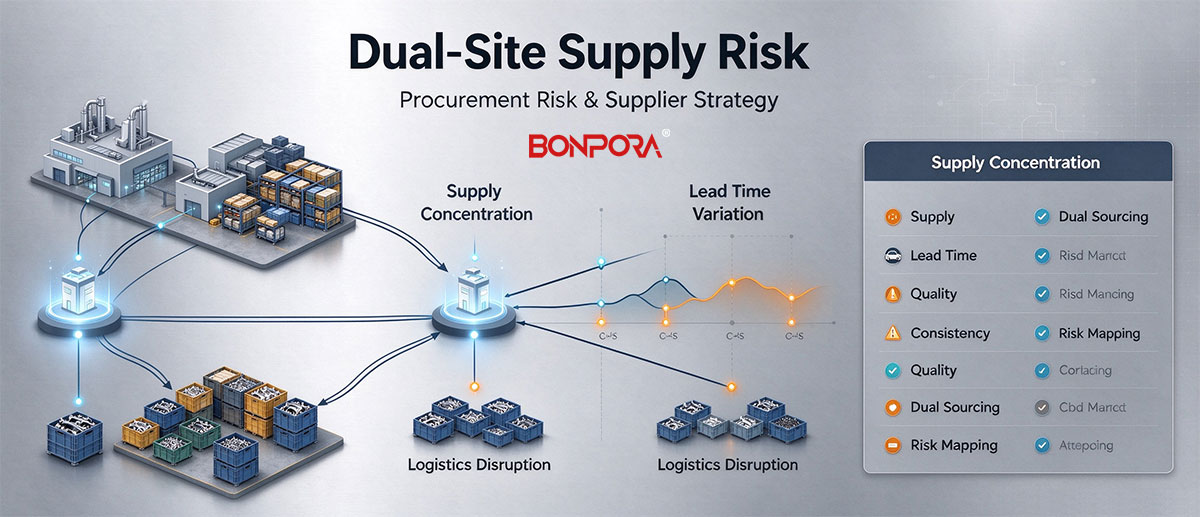
If your whole bump stop programme runs through one plant, a single fire, flood or extended lockdown can halt shipments within a week. Dual-site manufacturing spreads one part across two factories so volume can move when one stops. This guide explains how the two-base model works, what duplication actually costs, and how to score your current supplier.
What Dual-Site Manufacturing Means for a Parts Buyer
Dual-site manufacturing means the same product family is qualified and produced at more than one physical plant under one management system. It is not the same as dual-sourcing, where two independent companies each make the part. In a one-company, two-base model, material standards, inspection limits, batch coding and engineering support stay shared, which shortens qualification when volume moves.
The distinction matters for what you can ask a supplier to do. If a company operates two bases, the reasonable request is not "build me a second factory" but "qualify my reference numbers at the second site and tell me how quickly volume can shift". That is a purchasing conversation, not a capital project.
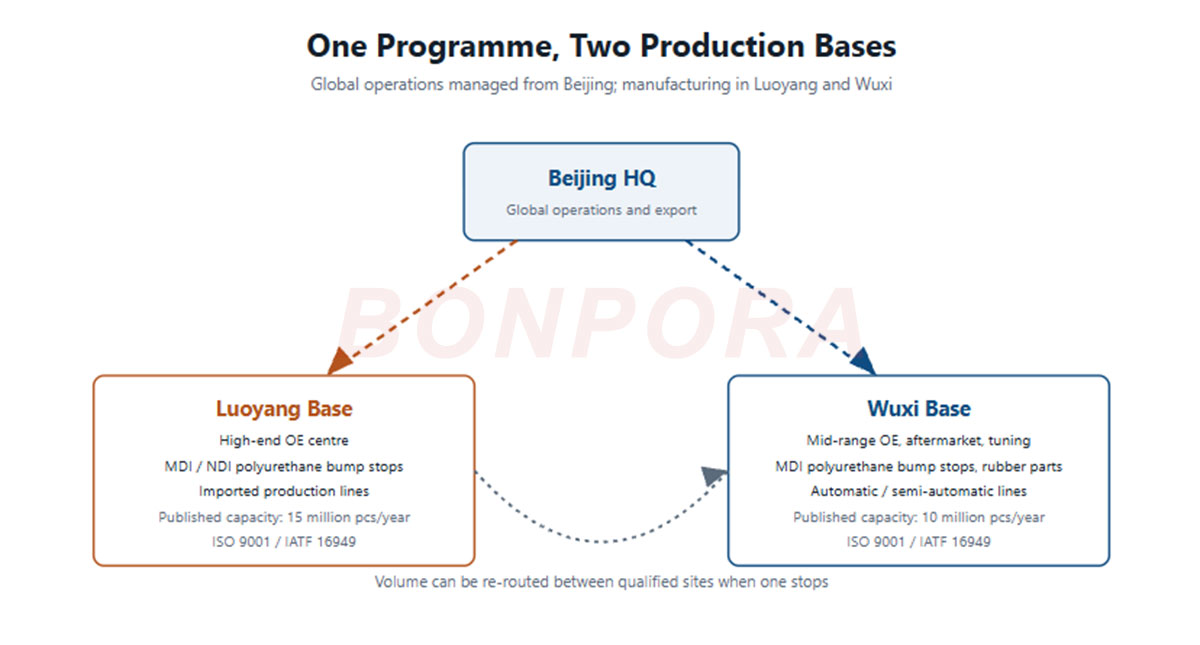
Our own structure follows this model. Global operations are managed from Beijing, with two manufacturing bases in Luoyang and Wuxi and strategic partner factories for stamped metal components such as steel shims, sleeves and brackets. The overview of dual base manufacturing and IATF 16949 quality control describes how the two sites divide their roles. Both bases are ISO 9001 and IATF 16949 certified, and both support custom development from drawings or samples.
For a buyer of chassis and suspension parts, the practical question is not whether two bases exist on paper. It is whether the second base can actually take your part: whether the right material system, the right tooling and the right inspection capability sit there, and whether moving would invalidate anything you have already approved. The rest of this article walks through those checks.
Why Single-Plant Sourcing Concentrates Risk
A single production site concentrates several independent hazards into one point of failure:
Physical events. Fire, flood and earthquake remain the classic scenarios, and moulded-elastomer plants carry specific fuel loads: polyol and isocyanate tanks, curing ovens, solvent stores.
Regional disruptions. Power rationing, public-health lockdowns and extreme heat events have each stopped Chinese factories for days or weeks in recent years. A second base only helps if it sits outside the affected region.
Equipment and process events. A failed press, a contaminated mixing vessel or a broken mould can idle one line while the rest of the plant runs. If your part runs on that line only, plant-level redundancy does not reach you.
Logistics chokepoints. Inland plants depend on longer drayage to port. Port congestion or a trucking shortage hits them twice: once inbound for materials, once outbound for your containers.
Quality containment. A material batch issue at one site can force a hold across everything produced in the affected window. If that is your only source, the hold is your stockout.
None of these events is frequent, which is exactly why buyers underprice them. The correct comparison is not "did it happen last year" but "what does one occurrence cost, and what annual probability makes protection worth buying". Section six puts numbers on that trade. The other guides in our buyer guides hub cover the adjacent decisions: certificate verification, remote audits and quotation comparison.
There is also a softer cost that spreadsheets miss: requalification time. Qualifying a brand-new supplier for a moulded polyurethane part typically takes months of sampling and validation. Moving volume to a second qualified base inside the same company is measured in weeks, because the drawings, inspection standards and material specifications do not change. See our IATF 16949 vs ISO 9001: What a Parts Buyer Should Verify for how to check that a certificate really covers the site you are buying from.
Two Bases, Two Roles: Luoyang and Wuxi Compared
A second plant only lowers risk if the two sites are genuinely capable of covering each other. Here is how the two bases divide their work, based on the published company profile and manufacturing overview:
| Dimension | Luoyang base | Wuxi base |
|---|---|---|
| Positioning | High-end OE centre | Mid-range OE, aftermarket and performance tuning |
| Polyurethane system | MDI and NDI | MDI |
| Product focus | High-performance polyurethane bump stops, precision plastic and rubber parts | Polyurethane bump stops and rubber parts |
| Equipment | Imported production lines | Automatic and semi-automatic lines |
| Published capacity | 15 million pieces per year | 10 million pieces per year |
| Certification | ISO 9001 / IATF 16949 | ISO 9001 / IATF 16949 |
Three details in that table deserve a buyer's attention.
First, the polyurethane systems differ. MDI and NDI chemistries are not interchangeable; they sit at different points on heat resistance, dynamic fatigue and cost. Luoyang runs both systems and handles the high-performance end, while Wuxi's MDI focus covers large-scale aftermarket and mid-range OE volumes. If your part is an NDI formulation, the fallback site is Luoyang, and the risk conversation should say so explicitly.
Second, capacity is split roughly 60/40 between the sites by the published figures. That ratio is large enough that a site-level problem does not have to become a programme-level stop: re-routing even a third of your volume is realistic without touching tooling ownership or pricing structures.
Third, geography diversifies logistics. Luoyang sits inland in Henan province; Wuxi sits in the Yangtze River Delta, within trucking distance of the Shanghai container ports. A regional event that closes one corridor does not automatically close the other. Metal stamped components such as shims and brackets come from strategic partner factories under unified quality standards, so the same review applies to those sources: ask which legal entity makes what, and where.
Five Ways a Second Plant Reduces Supply Risk
The benefits of a second production base are concrete and checkable. These are the five that matter most for chassis parts:
Capacity backup. When one site stops, the other can absorb re-routed volume using existing lines and shift patterns; our Bonpora polyurethane jounce bumpers, for example, are produced on both bases. The published combined scale means a mid-size aftermarket programme is a small share of either site's throughput, not a fight for scraps.
Logistics flexibility. Two sites in different regions give two port options and two inland corridors. During port congestion or a regional lockdown, the site that can still ship is the one that keeps your season alive.
Certification coverage at both sites. When both plants hold ISO 9001 and IATF 16949, volume can move without starting certification from zero. Part-level validation is still required per site, but the management system, documentation structure and audit history carry over. For what to verify on the certificates themselves, read our IATF 16949 vs ISO 9001 comparison.
Mould transferability. Tooling designed and maintained to one standard can physically move between sites. This is a contract question as much as a technical one: confirm in writing that tooling can be transferred between the supplier's own bases, who pays the freight and revalidation, and how quickly.
Failure isolation. A quality hold, a contaminated material batch or a process nonconformity at one site does not have to stop the other. Batch traceability that records the producing site lets a supplier quarantine the affected window and keep shipping clean stock from the second base.
Each of these five can be verified during a supplier review, remotely if needed. Ask for evidence, not assurances: certificate copies with site addresses, mould tags with asset numbers, batch-code structure showing the plant identifier, and the last internal audit schedule covering both sites.
Scoring Your Current Supplier: A Single-Factory Risk Table
Use the table below to score any current or prospective supplier of moulded suspension parts. Score each row 0, 1 or 2: 0 means the condition is not met or unknown, 1 means partially met, 2 means fully met with documented evidence. The maximum score is 20.
| # | Criterion | What to verify | Score 0–2 |
|---|---|---|---|
| 1 | Site count for your part family | Which physical sites can produce your SKU today, by name and address | |
| 2 | Tooling ownership and transfer rights | Contract clause; asset tags; written right to move tooling between the supplier's own sites | |
| 3 | Certification coverage per site | Certificate numbers, scope and site addresses; both sites current | |
| 4 | Capacity headroom | Stated annual capacity versus your programme share at each site | |
| 5 | Logistics options | Nearest ports per site; alternative corridors documented | |
| 6 | Material supply redundancy | Compound preparation capacity at each site; second raw-material source qualified | |
| 7 | Test capability per site | Stiffness, durability and temperature/humidity testing available at each location | |
| 8 | Batch traceability | Batch code structure identifies the producing site and material lot | |
| 9 | Disruption history and recovery | Recent incidents at either site and documented recovery actions | |
| 10 | Engineering support duplication | DFM review, formula development and sample support available at both sites |
Interpret the total honestly: 0–7 means you are effectively single-sourced and should start qualification of an alternate route now; 8–13 means partial protection exists but the gaps are identifiable, usually in tooling rights or per-site test capability; 14–20 means the structural protection is in place and the remaining work is part-level validation.
Most buyers discover their weakest row is either 2 or 7. Tooling that legally cannot move, and a second site without its own compression-set and stiffness bench, are the two gaps that quietly turn "we have two plants" into "we have two buildings".
Dual-Site Manufacturing Cost Model: Duplication vs Shutdown
The objection to qualifying a second base is cost: a second mould, duplicated validation, and a small premium from splitting batches. The counterweight is the cost of one severe stoppage. Here is an illustrative model for a mid-size aftermarket programme; every figure is a worked example for structure, not a quotation.
Baseline assumptions (illustrative): annual volume 120,000 pieces of one bump stop; ex-works price 2.00 USD; contribution margin 1.80 USD per piece; production split evenly across 52 weeks.
Cost of one severe event at a single plant (six-week full stop, assumed 10% probability per year):
| Cost item | Calculation | Amount (USD) |
|---|---|---|
| Shipment shortfall | 6/52 × 120,000 = 13,846 pieces | — |
| Air-freight recovery, 40% of shortfall | 5,538 pieces × 0.38 premium | 2,100 |
| Lost contribution on the remainder | 8,308 pieces × 1.80 | 14,954 |
| Emergency requalification elsewhere | First articles, validation, travel | 8,500 |
| One distributor account lost | Annual contribution | 12,000 |
| Total event cost | 37,554 | |
| Expected annual loss at 10% probability | 0.10 × 37,554 | 3,755 |
Annual cost of dual-site protection (illustrative):
| Cost item | Calculation | Amount (USD/year) |
|---|---|---|
| Second mould | 9,000 amortized over 5 years | 1,800 |
| Duplicated sample approval and validation | 900 amortized over 3 years | 300 |
| Split-batch premium | 0.015 × 120,000 pieces | 1,800 |
| Total annual cost | 3,900 |
The breakeven probability is 3,900 ÷ 37,554 ≈ 10.4% per year. If you believe a severe, six-week stoppage at your single source is more likely than once a decade, duplication already pays for itself on this model. Two adjustments push the threshold lower: the model ignores short disruptions of one or two weeks, which are far more common and cheap to absorb from a second base; and it values the lost account at only one year of contribution. If your account mix includes seasonal programmes, a missed season can cost the account outright, which is precisely the 12,000 line above.
The model also shows what to negotiate. The second mould dominates the fixed cost, so the useful conversation is about tooling ownership, amortization terms and whether an existing standard mould in the supplier's range can substitute for part of your range. Batch-split premiums of around 1.5 cents per piece are typical industry practice for moderate splits, but should be verified with the supplier rather than assumed.
A Four-Week Contingency Plan for Moving Volume Between Sites
Protection that exists only on paper fails in week one of an incident. If you buy from a two-base supplier, agree the switching mechanics while everything is calm. A four-step sequence:
Map the programme. List every reference number, the site that currently produces it, the qualification status of the other site, and the tooling location for each.
Pre-agree the split and triggers. Write down the normal split, the events that shift it, and who decides. A trigger such as "shipment delayed more than five working days moves the next order to the alternate site" removes the negotiation from the crisis.
Validate the alternate site before you need it. Run a first-article package at the second site during normal times: dimensional report, hardness, stiffness curve and appearance checks. If you skip this, your "backup" is unqualified exactly when you need it.
Rehearse the paperwork. Confirm which documents change when the producing site changes, so shipments are not stuck at customs or in your customer's incoming inspection.
The accompanying checklist, expanded:
Both sites' certificates are current, with site addresses matching the plants.
Tooling ownership and inter-site transfer rights are in the contract, with costs assigned.
Each reference number has a defined qualified site and a target alternate site.
The normal volume split and the shift triggers are written and signed.
A first-article package exists for each site, dated within the last twelve months.
Batch coding identifies the producing site on every carton.
Packaging and labelling differences between ports and destinations are agreed.
Lead-time deltas between the two sites' shipping routes are known to your planner.
Emergency contacts exist for both sites, with response-time expectations.
The risk table in section five is re-scored quarterly and after any incident.
Item 5 is where most programmes are exposed when tested. A first-article package older than a year, or one that exists for only the primary site, converts your second base from a ready reserve into a project.
FAQ
Does the same part come out identical from two different production lines?
Within one company's two bases, the formulation and the inspection limits are shared, but each line still runs its own first-article approval. Process windows such as cure temperature and demould time can shift hardness and dimensions slightly between lines, which is why stiffness curve, compression set, hardness and appearance checks are repeated per site. Ask a supplier to show the first-article deltas between sites on a part similar to yours; small, documented differences are normal, undocumented ones are not.
Who owns the moulds if my volume runs across two plants?
Ownership is whatever your contract states, so the clause matters more than the practice. In a one-company, two-base model, tooling normally sits in the supplier's asset system, and moving it between their own sites is simpler than transferring to a third party. Still confirm in writing: which entity holds title, whether inter-site moves require your approval, and who pays freight and revalidation.
Is dual-site manufacturing from one supplier the same as dual-sourcing from two suppliers?
No, and the difference is useful. One company with two bases shares management systems, material standards and traceability, so qualification of the second site is faster and cheaper, but your exposure to one company's finances remains. Two independent suppliers give true company-level independence at the cost of a full second qualification. Many buyers combine both: a two-base primary source plus a qualified backup elsewhere for critical references.
If both sites are IATF 16949 certified, can volume move without repeating documentation?
Certification covers the management system, not the part. Common industry practice is to repeat first-article inspection and update control-plan site references when production changes site, and some OE programmes require formal notification or re-approval for any site change. Verify the expectation with your own customer before relying on an informal move, and keep the per-site first-article packages current so the documentation exists when needed.
What volume split makes a second production base worthwhile for a mid-size aftermarket programme?
There is no fixed ratio; it depends on your breakeven probability. The model above puts it at roughly one severe stoppage per decade for the figures used. If your category has ever missed a selling season because of one factory, a 70/30 split with per-site validation is a common starting point, and the ten-row risk table will show whether tooling rights and test capability need fixing first.
Whether you are auditing a current single-plant source or structuring a new programme, the questions in this article are answerable in one or two emails: which site makes what, where the tooling sits, what the certificates cover, and what the split would be. For a specific reference number or a custom part developed from your drawings, ask for the dual-base plan alongside the price.
- Prev.:Price Negotiation Levers That Actually Move Bump Stop Quotes
- Next.:Microcellular PU vs Rubber Bump Stops: Procurement Matrix