
- 1. What a Bump Stop Price Negotiation Can Move, and What It Cannot
- 2. Six Levers, Ranked by Return
- 3. Three Moves That Stall a Bump Stop Price Negotiation
- 4. The Order to Negotiate In: Three Rounds
- 5. What Belongs in the Term Sheet
- 6. Worked Model: Two Quotes, One Part, Different Terms
- 7. The Negotiation Prep Sheet
- 8. FAQ
Price Negotiation Levers That Actually Move Bump Stop Quotes
A bump stop price negotiation moves on six levers, and the unit price is only one of them. Volume commitment, shared tooling, non-functional tolerances, carton design, payment terms and mixed loading each change a different line of the cost stack. Haggling, three-way bids and stretched payment change nothing.
A cast polyurethane bumper leaves a factory carrying five cost pools: compound, moulding, insert, tooling, and the packaging and freight that follow it. A quotation showing one number has compressed those five into a figure the buyer cannot inspect, which is why two quotes for the "same" part are often not for the same part. The bump stop cost breakdown explains that anatomy; this guide is about the choreography around it — which lever to pull, in what order, what it costs the supplier, and what you give back to get it.
What a Bump Stop Price Negotiation Can Move, and What It Cannot
A quotation is not a price. It is a bundle of decisions about material system, cavity count, tooling route, packing and terms, and the figure at the bottom is the sum of the ones the supplier chose on your behalf. A bump stop price negotiation that opens on the sum, without opening the decisions, asks the supplier to absorb the difference somewhere you cannot see.
Four lines resist movement, and treating them as negotiable is how a discussion becomes a discount and then a claim:
The compound rate for a named system. A grade has a market price; a lower number means a different grade.
The cure. Shortening it is not free, because it reappears as compression set.
The insert, where the drawing calls for one. It is a bought-in stamped part with its own grade and coating.
Fixed charges on a small shipment, which do not shrink with the unit price.
What does move is the gap between what a supplier must spend and what a supplier must guess. An incomplete drawing is priced as uncertainty, and uncertainty is priced high. A tender that fixes nine fields is the lowest-cost lever in the discussion, because it removes a risk premium from every line at once: reference range, material system, hardness with tolerance, static stiffness curve, compression set limit, free height at both ends, temperature range, colour and marking, and packaging. It is also why the jounce bumper range is quoted against a released drawing rather than a photograph, and why MDI and NDI are not interchangeable in a tender: MDI covers most passenger car positions with a balance of resilience and cost, while NDI is specified for harder working positions where properties must hold under heat and repeated cycling, at a higher material cost and a more demanding casting process.
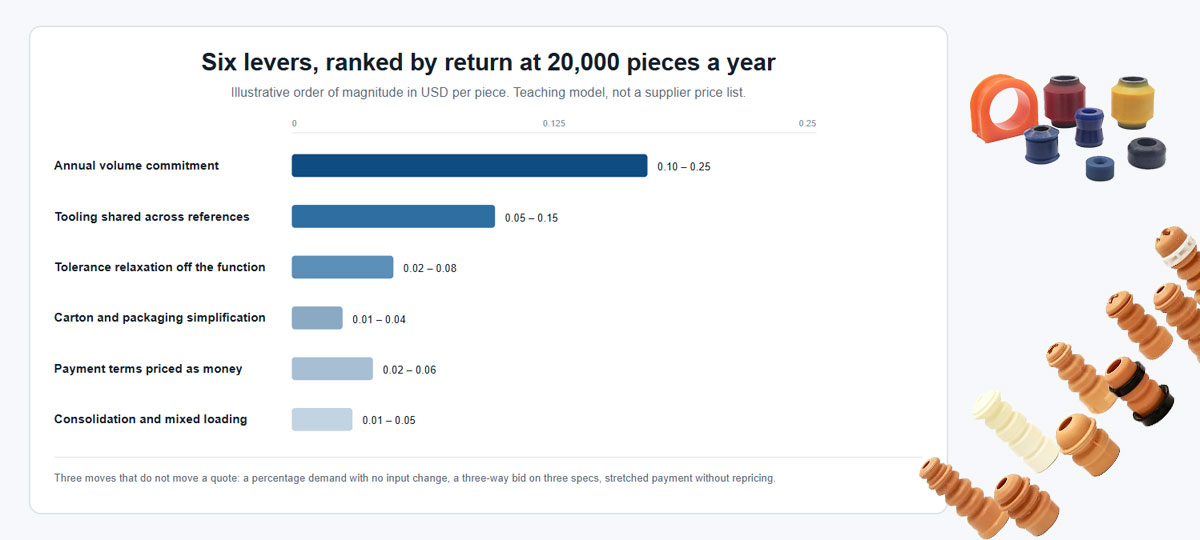
Six Levers, Ranked by Return
A bump stop price negotiation is usually lost by pulling them in the wrong order. The six are ranked by what they return for the effort at a typical 20,000-piece annual volume. Values in the last column are illustrative order-of-magnitude figures for teaching the comparison, not a price list.
| Lever | What it changes in the quote | What you put on the table | Order of magnitude, USD per piece (illustrative) |
|---|---|---|---|
| Annual volume commitment | Tooling amortisation, batch minimums, scheduling priority | A rolling 12-month forecast with a committed quarterly floor | 0.10 to 0.25 |
| Tooling shared across references | Cavity count per mould, and how many moulds exist | Permission to consolidate part numbers onto one profile | 0.05 to 0.15 |
| Tolerance relaxation off the function | Trimming, sorting, first-off inspection time | A signed deviation leaving functional dimensions untouched | 0.02 to 0.08 |
| Carton and packaging simplification | Units per carton, carton cube, freight per piece | A packaging drawing agreed before production | 0.01 to 0.04 |
| Payment terms priced as money | The supplier's working capital, not the part | A bank instrument or a shorter term in exchange for price | 0.02 to 0.06 |
| Consolidation and mixed loading | Container fill and fixed shipment charges | Fewer, larger releases and a longer planning horizon | 0.01 to 0.05 |
Annual volume commitment. Not a threat to move the order; a forecast with a floor under it. A supplier who can see twelve months of demand reserves cavity time, plans compound around a standard hardness instead of a special one, and spreads trial and first-off costs over a known quantity. Ask for two prices in return: one for the committed band, one for the band below it, so the downside is priced instead of argued later.
Tooling shared across references. Where two part numbers differ only in catalogue history, one verified profile can serve both, halving moulds, trial shots and batch minimums. Nobody is asked to accept a lower margin, which is what makes it usable. The price of pulling it is engineering attention: someone must confirm the references share bore, free height and behaviour, and the stiffness curve is the evidence, not the reference number.
Tolerance relaxation where no function depends on it. A bumper drawing carries two kinds of tolerance. One sets behaviour — free height, bore, seat diameter, the profile that produces the progressive curve. The other describes a surface nobody touches, and a tolerance there that forces an extra trimming pass or a full sorting operation is a purchased habit; removing it costs only the operation it deletes. Removing one that sets the curve is a different transaction: you are buying a cheaper part by accepting a different part.
Carton and packaging simplification. A bumper is light, so freight is volume limited rather than weight limited, and carton design therefore sits inside landed cost. A carton holding more parts without loading the profile is a saving on every shipment. The buyer's side is discipline: agree the packaging drawing before the run, accept a neutral pack where printed artwork adds cost and approval time, and stop revising the carton after the first shipment.
Payment terms priced as money. Thirty extra days is a loan, and it has a rate. On a 45,200 annual spend at an 8 per cent cost of capital, thirty days is worth about 297 a year — real, but small next to a tooling decision. Asking for the days without saying what they are worth invites the supplier to recover them in the next quotation, where nobody is looking.
Consolidation and mixed loading. Fixed charges per shipment are the least compressible line in a small order, and the way to compress them is to ship less often with more in each container. Where the same supplier also makes bushings, shims or mounts, a mixed load spreads documentation and minimum charges. What the buyer gives is planning: fewer, larger releases and a longer horizon.
Three Moves That Stall a Bump Stop Price Negotiation
Most bump stop price negotiation failures happen in the first email, and in one of three ways.
A percentage demand with no change of input. Ten per cent off a 2.10 quotation removes 0.21 per piece, more than the moulding and packaging lines together can absorb. A supplier who accepts it finds the difference where you did not specify: a grade that meets hardness but not the curve, a shorter cure, a thinner insert coating. The demand does not fail; it succeeds, and it buys a different part.
A three-way bid on three different specifications. Three suppliers answering three drawings produce three numbers that cannot be ranked, and the lowest of them is usually the one that answered the least of the question.
Stretched payment without repricing. Moving from 30 to 90 days without agreeing what the term is worth leaves two options: recover it at the next review, or serve the customer who pays on time first when capacity is tight. Neither appears on the quotation you are comparing.
The Order to Negotiate In: Three Rounds
Sequence matters more than aggressiveness, because each round produces what the next one needs.
Round one, before any number. Send the same tender with the nine fields filled, state the annual and first-order quantity, and ask each supplier to confirm in writing that the fields are complete. A quote that answers a guess is not comparable. The buyer guides library sets out the adjacent decisions in the same format.
Round two, on the split. Ask for compound, moulding, insert, tooling, packaging and freight quoted separately, with incoterm and currency named. This is not a request for the margin; it is how you learn which line a lever can aim at.
Round three, one lever per exchange. Take the highest-return lever first, put the concession on the table with its condition attached, and ask for the price that follows.
Record every concession with its condition. A price that depends on a volume floor, a packaging revision or a payment term is not a price until the condition sits beside it, and conditions kept only in an email thread vanish at the first audit.
Re-run total cost, not unit price. Compare twelve-month cash cost, including tooling, freight, fixed shipment charges, the cost of the terms and the cost of the stock the release schedule forces you to hold.
Close on the term sheet, not the handshake. The last exchange should produce a document naming the price, the band, the tooling route, the packaging revision and the payment days, because the next argument will be about which version was agreed.
What Belongs in the Term Sheet
Nine lines, each present because its absence has cost somebody money:
Price, currency and validity period, with the volume band each price applies to.
A committed floor per quarter, and the price below it.
Tooling: who owns the mould, what the price includes, what a transfer would consist of.
MOQ per release and the release schedule, written as a schedule.
Packaging drawing revision, units per carton, carton marking.
Payment days, instrument, and when the clock starts.
Incoterm, and whether freight is quoted per carton or per shipment.
Warranty term, claim procedure, and the batch records behind a claim.
A concession log: each concession, its condition, its date.
Worked Model: Two Quotes, One Part, Different Terms
Two quotations for the same 20,000-piece annual requirement show why a bump stop price negotiation that ranks offers by unit price reaches the wrong answer. Both are illustrative models on one MDI profile with a stamped insert.
Quote A is 2.10 per piece with a 9,000 tooling invoice, four releases of 5,000, 30 per cent at order and 70 per cent before shipment, and a 100-piece carton at 0.058 cubic metres. Quote B is 2.26 per piece with tooling inside the price, two releases of 10,000, payment 60 days after the bill of lading, and a 120-piece carton at 0.064 cubic metres.
| Twelve-month line, 20,000 pieces (USD, illustrative) | Quote A | Quote B |
|---|---|---|
| Parts at the quoted unit price | 42,000 | 45,200 |
| Tooling invoice | 9,000 | 0 |
| Cost of the payment terms at 8 per cent | 400 | -297 |
| Sea freight at 130 per cubic metre | 1,508 | 1,391 |
| Fixed charges, 300 per shipment | 1,200 | 600 |
| Stock carrying at 8 per cent on average inventory | 420 | 904 |
| Twelve-month cash cost | 54,528 | 47,798 |
Quote A is 7.6 per cent cheaper per piece and 6,730 more expensive over the year, 12.3 per cent of the total. Four effects sit inside that gap: the 9,000 tooling invoice is 2.8 times the whole unit-price difference of 3,200; the four-release schedule pays 600 more in fixed charges; the better carton saves 117 in freight; the earlier payment costs 697 more than the later one. Against that, Quote B carries 484 more in stock, the honest cost of shipping less often, and the reason the release schedule belongs in the negotiation rather than the logistics inbox.
The same arithmetic brackets the tooling question. With a 0.16 per piece gap, the 9,000 tooling saving is absorbed at about 56,000 pieces a year. Below that, a supplier-owned tool at a higher unit price is usually cheaper; above it, paying for the mould wins, and the mould should then belong to the buyer with a transfer clause. That is the number to bring to the table.
The Negotiation Prep Sheet
One page filled before the first call is worth more than a target percentage in a bump stop price negotiation. For each lever, write what you are offering, what you want back, the evidence you will accept, and where you stop.
| Lever | What you offer | What you ask in return | Evidence you will accept |
|---|---|---|---|
| Volume commitment | 12-month forecast, quarterly floor of ______ | Banded price, plus a price for the band below | Price table by band, valid to a stated date |
| Tooling | Paid tool, or supplier-owned tool at a higher unit price | Ownership and transfer terms; first article report | Clause naming the owner and the transfer contents |
| Profile consolidation | Two references merged onto one verified profile | One mould, one batch minimum, one stock line | Stiffness curves for both references, compared |
| Tolerance | Signed deviation on ______ (non-seating faces only) | Removal of the extra trimming or sorting operation | Drawing revision with the deviation marked |
| Packaging | Neutral pack, carton drawing frozen for 12 months | More units per carton at the same carton strength | Carton drawing with cube and compression rating |
| Payment | 30 days from bill of lading, or a bank instrument | Price net of the term | The term priced as a line, not folded into the unit price |
| Consolidation | Two releases a year instead of four, mixed with ______ | A share of the fixed-charge saving | Freight quoted per shipment and per cubic metre |
| Specification | A complete tender with nine fields fixed | No risk premium on the quotation | Written confirmation that all fields were answered |
Five rules make the sheet work. Fill it before the call, because a ledger written live becomes a wish list. Put one lever in each email, so the arithmetic stays attributable. Never trade two levers for one concession, because a supplier cannot price a bundle better than you can. Write the condition beside the price, since an unconditional discount is the only kind that survives an audit. Re-run the model after each round: a concession that lowers the unit price and raises cash cost is not a concession.
If you need the specification values behind these levers for a specific position, request the specification sheet or a sample against your drawing rather than working from generic figures.
FAQ
Can we negotiate a bump stop price at 3,000 pieces a year?
You can, but different levers work. At that volume the tooling line dominates the unit price, so the useful question is the commercial route: whether an existing profile covers the application at carton quantities, or whether a new mould can be justified at all. Volume commitment and consolidation have little to bite on; specification completeness and packaging still do. Asking for 10 per cent off asks a supplier to delete a line that is mostly mould amortisation.
Who should own the mould in a bump stop programme?
Agree it before the purchase order, because ownership decided afterwards is a dispute rather than a clause. A buyer-owned tool costs more up front and makes a supplier change possible. A supplier-owned tool keeps cash in the unit price and makes the exit harder. Either way, the term sheet should name the owner, list what a transfer includes, and state which drawing revision the tool was built to.
How many suppliers should be in a quotation round?
Two or three, all quoting the same tender. More adds quoting noise without information; fewer removes the reference point. The failure mode is not the number of suppliers but the number of specifications: three suppliers answering three drawings produce numbers that cannot be ranked, and the lowest usually answered least.
Does a cheaper compound always produce a cheaper quote?
No, because hardness is the easiest property to quote and the least informative. Two bumpers of the same hardness can produce very different force against deflection curves, which is why the stiffness curve and compression set belong in the acceptance criteria. MDI and NDI are not interchangeable either: a substitution that meets the hardness figure can miss the dynamic behaviour the position needs, and the difference appears as a ride complaint rather than as an incoming inspection finding.
Is a longer lead time worth a lower price?
Only if the release schedule is priced with it. A longer lead time is usually a statement about capacity priority, and its cost is the stock you hold to cover the gap. In the model above, halving the releases saved 600 in fixed charges and cost 484 in carrying, close to a wash; the saving became real only because carton and terms moved at once. Cost the two together.
A quotation is a set of decisions before it is a number, and the six levers are the decisions worth reopening. Send the drawing, the annual quantity and the release schedule, and request a quotation that shows the pools rather than a single figure, so the next conversation is about lines instead of percentages.
- Prev.:Container Loading: Cartons, Pallets and Moisture Control
- Next.:Dual-Site Manufacturing: How a Second Plant Lowers Supply Risk