
- 1. Why Container Loading Is a Volume Problem for Suspension Parts
- 2. Carton Specification: Five Numbers to Fix Before the Container Is Booked
- 3. The Stack-Load Calculation Behind a Collapsed Bottom Layer
- 4. Pallet Patterns and Container Loading Counts: 20GP, 40HQ, Floor or Pallet
- 5. Floor Loading vs Pallets: Where the Saving Disappears
- 6. Moisture Control: Desiccant, Liners and Container Rain
- 7. A Container Loading Checklist and a One-Page Loading Plan
- 8. FAQ
- 8.1. How many cartons of bump stops fit in a 20GP and a 40HQ?
- 8.2. Should we ship bump stops on pallets or floor loaded?
- 8.3. How much desiccant does a 40HQ need for a 30-day voyage?
- 8.4. Polyurethane does not absorb much water, so why does moisture matter?
- 8.5. Who is responsible for crushed cartons, and when should we claim?
Container Loading: Cartons, Pallets and Moisture Control
Container loading for suspension parts is decided by volume, not weight. A 40HQ filled with polyurethane bump stops reaches roughly 45 percent of its payload before the last carton goes in, so the money sits in carton geometry, stack strength and moisture control rather than in freight negotiation. This guide puts numbers on all three.
A part that leaves the factory in good condition still arrives as a claim if the cartons were stacked past their compression limit or the container rained on the top layer. Both failures are predictable before booking, and both are cheaper to prevent than to argue about.
Why Container Loading Is a Volume Problem for Suspension Parts
The first number to fix is packed density: kilograms per cubic metre of finished carton. Compare it with the break-even density, payload divided by usable volume. For a 40HQ quoted at 26,000 kg payload and about 68 m³ of usable space, that break-even is roughly 380 kg/m³.
| Part family | Packed density (illustrative) | What runs out first | Consequence for the buyer |
|---|---|---|---|
| Polyurethane jounce bumper | ~180 kg/m³ | Volume | Freight per piece falls as pack density rises |
| Rubber bushing | ~260 kg/m³ | Volume | Carton geometry is the main cost lever |
| Control arm with bushings | ~420 kg/m³ | Payload | Weight limits the count, not the floor area |
| Steel shim stack | ~900 kg/m³ | Payload | Heavy goods surcharges and floor loading limits |
Bump stops sit firmly in the volume-limited group. A carton of 50 bumpers at 0.22 kg each, in a 600 × 400 × 300 mm box, holds 11 kg of product and 2.2 kg of packaging in 0.072 m³, which is 180 kg/m³. A full 40HQ then carries about 12,000 kg against a 26,000 kg payload: the container is full long before it is heavy.
Two consequences follow. A supplier quoting freight per piece is really quoting a carton design, so the drawing belongs in the quotation pack. And a weight-based freight budget under-estimates the container count, which surfaces later as a partial load and a second booking.
Carton Specification: Five Numbers to Fix Before the Container Is Booked
A drawing that states only length, width and height leaves three expensive decisions open. Pin down these five and the loading plan becomes arithmetic.
Internal dimensions with a tolerance. Board thickness and erection change the outside, so specify inside dimensions to about ±3 mm, because the layer count depends on them.
Pieces per carton. This number drives count accuracy at goods-in and the labour cost of picking.
Gross weight. Manual handling limits sit at 20 kg per carton in most markets, some at 15 kg.
Board grade and compression strength. The grade is only a proxy. The bottom layer needs a measured box compression test value on the drawing.
Pallet module. A carton designed for a 1200 × 1000 mm pallet will not tile a 1200 × 800 mm pallet without waste. Choose the module first.
Bonpora's stated packaging requirement for the jounce bumper range is a unit pack carrying reference and application, no load on the bumper profile inside the pack, a rigid master carton labelled with reference, quantity and batch, artwork approved before a private label run, and pallets built in even layers and strapped so lower cartons are not crushed. Each one maps to a failure mode that reaches the customer, so copy them into a specification even when the supplier is someone else.
| Field | What to write on the drawing | What it decides |
|---|---|---|
| Internal dimensions | 600 × 400 × 300 mm, ±3 mm | Cartons per layer, and therefore container count |
| Pieces per carton | 50, with reference and batch label | Count accuracy, picking labour |
| Gross weight | 13.2 kg maximum | Stack load, manual handling, pallet rating |
| Board grade and BCT | Double-wall BC, BCT 400 kgf minimum | Survival of the bottom layer after a sea voyage |
| Stack height | 6 cartons maximum in the container | Fill rate against crush risk |
| Pallet module | 1200 × 1000 mm, 5 cartons per layer | Floor utilisation and unload method |
The Stack-Load Calculation Behind a Collapsed Bottom Layer
Carton collapse is not bad luck. It is a compression calculation that was never done, and it takes two minutes.
The required box compression strength for the bottom carton is the weight it carries multiplied by a safety factor:
required BCT = gross weight × (stack height − 1) × safety factor
For the bump stop carton above, at six high with a safety factor of 4:
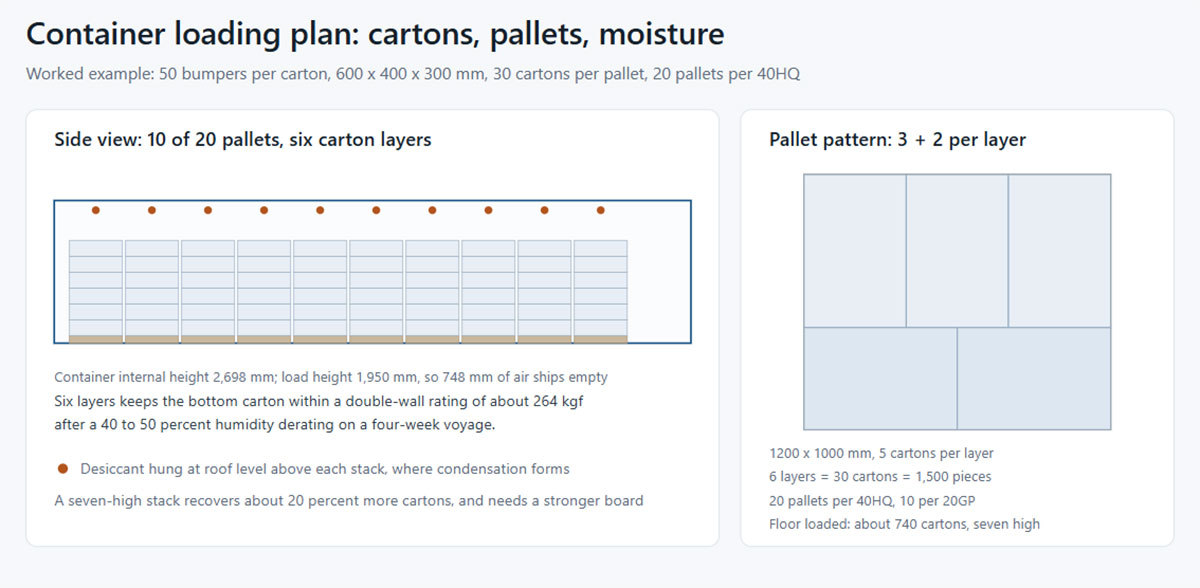
13.2 kg × 5 × 4 = 264 kgf
A double-wall carton of that footprint is commonly rated between 380 and 450 kgf at standard conditions, so the margin looks comfortable. Standard conditions mean about 23 °C and 50 percent relative humidity, and a container on a four-week voyage is neither. A derating of 40 to 50 percent over a long humid voyage is a normal planning assumption, not a worst case. Apply 45 percent to a 400 kgf board and the effective strength is 220 kgf against a 264 kgf requirement. The bottom layer then leans on the cartons beside it: lean, crushed corners, damaged parts.
| Stack height | Load on bottom carton | Required BCT at safety factor 4 | Practical reading |
|---|---|---|---|
| 3 high | 26.4 kg | 106 kgf | Comfortable for single-wall cartons |
| 4 high | 39.6 kg | 158 kgf | Double-wall, short voyage |
| 5 high | 52.8 kg | 211 kgf | Double-wall, lined container |
| 6 high | 66.0 kg | 264 kgf | The limit for a standard double-wall carton |
| 7 high | 79.2 kg | 317 kgf | Needs a stronger board or a pallet |
| 8 high | 92.4 kg | 370 kgf | Not advisable for light parts packed in board |
Three fixes are cheaper than a stronger carton: reduce the stack height, add a container liner to cut the moisture pick-up that causes most of the derating, or palletise so the load goes into the pallet deck instead of the cartons.
The safety factor is a commercial decision, not a physical constant. A factor of 3 suits short domestic runs handled twice, and 4 to 5 is common for a 30 to 45 day ocean leg with transhipment. Write it into the specification so an approved carton cannot later be substituted with a lighter board.
Pallet Patterns and Container Loading Counts: 20GP, 40HQ, Floor or Pallet
A 1200 × 1000 mm pallet loaded with 600 × 400 mm cartons takes five cartons per layer on the standard 3 + 2 pattern: three cartons with the 400 mm side along the 1,200 mm edge, and two rotated cartons filling the remaining 400 mm strip. At six layers that is 30 cartons, or 1,500 bumpers, standing 1,950 mm high including a 150 mm pallet.
| Container | Nominal internal dimensions | Usable volume | Pallets at 1200 × 1000 | Cartons floor-loaded | Pieces at 50 per carton |
|---|---|---|---|---|---|
| 20GP | 5,898 × 2,352 × 2,393 mm | ~28 m³ | 10 | ~360 | ~18,000 |
| 40HQ | 12,032 × 2,352 × 2,698 mm | ~68 m³ | 20 | ~740 | ~37,000 |
The last two columns carry a warning. Floor loading gains about 20 percent more cartons than palletising, because the pallet footprint and the gaps between pallets are recovered, but the gain assumes a seven-high stack. Seven high needs about 317 kgf after derating, beyond a standard double-wall carton. A buyer who accepts the floor-loaded count without raising the board grade has bought a freight saving and a damage claim together.
Container dimensions vary by carrier and by box ageing, so treat the table as planning values and confirm internal height before a floor-loaded plan is signed. A 20GP is less forgiving here: the door opening limits the stack before the internal height does.
Request the carton drawing, pallet pattern and batch inspection record for a specific reference
Floor Loading vs Pallets: Where the Saving Disappears
The freight argument for floor loading is real, and it is usually smaller than the handling and damage it creates. The model below uses one year of volume for a mid-sized distributor, with illustrative costs that a buyer can replace with local figures.
Assumptions: 720,000 pieces a year, 50 per carton, 2,800 USD per 40HQ, a 3.20 USD landed part cost, 40 USD per hour for warehouse labour, 65 USD per hour for a forklift with driver, and 12 USD per pallet.
| Cost line | Palletised | Floor loaded | Difference |
|---|---|---|---|
| Containers per year | 24 | 20 | −4 containers |
| Ocean freight | 67,200 | 56,000 | −11,200 |
| Pallets purchased | 5,760 | 0 | −5,760 |
| Destination unloading labour | 1,560 | 13,120 | +11,560 |
| Damage, repack and claims | 5,508 | 23,136 | +17,628 |
| Annual total | 80,028 | 92,256 | +12,228 |
A freight and pallet saving of roughly 17,000 USD is cancelled by 11,560 USD of hand unloading plus damage: 0.9 percent of floor-loaded pieces rejected for crushed cartons and scuffed profiles, against 0.2 percent on pallets. Unloading 740 cartons at 45 per hour takes 16.4 hours; twenty pallets take about an hour with a forklift.
Floor loading still wins in specific conditions, worth naming so the decision is not made by habit: the receiver has labour but no forklift, the carton survives seven high after derating, the parts are not crush sensitive at the profile, and the unload finishes inside terminal free time, because overrunning it adds detention at roughly 65 USD a day. Where any of those fails, pallets cost less in total even at a higher freight rate.
The same logic applies inside a palletised container loading plan. Export pallets must be heat treated and marked to ISPM 15, and a pallet 100 mm too tall can cost a whole layer across a container. Ask for loaded pallet height, not carton height.
Moisture Control: Desiccant, Liners and Container Rain
Container rain is condensation, and it follows the physics of a cold drink on a warm day. Cargo is loaded in warm, humid air. At night the steel roof cools faster than the cartons, the air beside it reaches its dew point, and water drips onto the top layer. A day-to-night swing of 20 to 30 °C starts it, and a voyage across climate zones repeats the cycle. Moisture control is the half of container loading that no freight rate reflects.
Most of that water is already in the box. Timber pallets commonly ship at 12 to 18 percent moisture content, corrugated at 6 to 9 percent, and the trapped air carries more. Steel inserts and shims show it first, then print and label damage, then the loss of carton strength described above.
| Voyage and packing | 20GP (~28 m³) | 40HQ (~68 m³) | Note |
|---|---|---|---|
| 20 days, no liner | 8 to 11 kg | 20 to 24 kg | Short leg, dry season |
| 30 days, no liner | 12 to 17 kg | 30 to 36 kg | Common planning case |
| 45 days, no liner | 16 to 20 kg | 41 to 48 kg | Transhipment routes |
| 30 days, with roof liner | 6 to 9 kg | 15 to 19 kg | Liner halves the load |
Those figures reflect typical trade practice at roughly 0.3 to 0.6 kg of desiccant per cubic metre without a liner, and they are a starting point for a dosing calculation rather than a specification. The number moves with voyage length, cargo moisture, whether the liner covers the roof as well as the walls, and how often the container is opened in transit. Ask for the calculation, not only the bag count.
Placement matters as much as quantity. Desiccant hung near the roof, where condensation forms, works harder than bags lying on the floor behind the last pallet. Prefer clay or silica gel to calcium chloride where the cargo is corrosion sensitive, because a split calcium chloride bag becomes a corrosion source, and check the container before loading for holes, a wet floor and residue from the previous cargo.
A Container Loading Checklist and a One-Page Loading Plan
The checklist below is written to be printed and signed, ordered by when each item can still be changed cheaply: a decision at the carton stage costs nothing, and the same decision at the loading bay costs a rework shift.
Confirm packed density and the limiting factor: volume or payload.
Confirm the container type against carton count, not weight.
Approve the carton drawing with internal dimensions and a tolerance.
State the minimum BCT on the drawing, with the test method.
State the stack height limit on the carton and on the loading plan.
Confirm the pallet module and cartons per layer.
Confirm loaded pallet height against container internal height.
Confirm pallet heat treatment and ISPM 15 marking.
Confirm the unit pack carries reference and application.
Confirm the master carton label carries reference, quantity and batch.
Approve private label artwork before the production run.
Calculate desiccant quantity for the voyage and the liner choice.
Specify desiccant placement, preferably hung near the roof.
Inspect the container: floor, walls, roof, seals, previous cargo residue.
Record the seal number and photograph the empty container.
Photograph each loading stage: first layer, mid-height, last pallet, closed doors.
Record cartons, pallets and gross weight on the loading plan.
Send the loading plan and photographs to the buyer before the vessel sails.
| Loading plan field | Example entry | Who confirms |
|---|---|---|
| Reference and description | Jounce bumper, OE family A | Buyer |
| Pieces per carton and cartons | 50 per carton, 480 cartons | Supplier |
| Pallet type and count | 1200 × 1000 heat treated, 16 pallets | Supplier |
| Layers and loaded height | 6 layers, 1,950 mm | Supplier |
| Container and seal | 40HQ, seal 1234567 | Forwarder |
| Gross weight | 6,336 kg cargo, 6,600 kg with pallets | Supplier |
| Desiccant | 32 kg clay, hung at roof, 4 points | Supplier |
| Photographs | Empty, first layer, mid, closed | Supplier |
| Damage noted at loading | None, or a list with photographs | Supplier and forwarder |
One page settles most arguments later. When cartons arrive crushed, the plan shows whether stack height was respected, whether desiccant was in place, and whether the damage existed before the doors closed. That evidence decides a claim; a photograph of a damaged pallet in a warehouse does not.
Buyers comparing freight terms should also read Incoterms for auto parts, because the point at which risk passes decides who owns a moisture claim, and the answer differs under FOB, CIF and DDP. The Bonpora on-road bump stop range is packed to the requirements above, and the Bonpora polyurethane jounce bumpers are inspected for stiffness curve, compression set, hardness and appearance under an IATF 16949 system, with a working range of −40 °C to +90 °C and a design life of at least 80,000 km or two years under normal use.
FAQ
How many cartons of bump stops fit in a 20GP and a 40HQ?
At 50 pieces per carton in a 600 × 400 × 300 mm box, a 20GP takes about 360 cartons floor loaded or 300 on ten pallets, and a 40HQ about 740 floor loaded or 600 on twenty. Treat those as planning values: the real count depends on carton dimensions, pallet module and internal height.
Should we ship bump stops on pallets or floor loaded?
Compare total cost, not freight alone. Floor loading typically gains about 20 percent more cartons per container, but it adds ten to fifteen hours of hand unloading and raises crush risk unless the carton is specified for a seven-high stack. For most distributors the palletised route is cheaper once unloading and damage are counted.
How much desiccant does a 40HQ need for a 30-day voyage?
A common planning figure is 30 to 36 kg of clay or silica gel for a 40HQ without a liner, falling to about 15 to 19 kg with a roof liner. Ask for the dosing calculation behind the number, because voyage length, cargo moisture and how often the container is opened all move it.
Polyurethane does not absorb much water, so why does moisture matter?
The part is not the main risk. Corrugated cartons lose a large share of their compression strength as they take up moisture, timber pallets release water vapour, and steel inserts or shims in the same shipment can corrode. Moisture control protects the packaging and the metal, which decides whether parts arrive fit to sell.
Who is responsible for crushed cartons, and when should we claim?
Responsibility follows the Incoterm and the bill of lading. Under FOB and CIF, risk passes at the port of shipment, so damage found at destination has to be evidenced against the carrier or the insurer, and photographs taken at loading are the strongest evidence a buyer can hold. Claim as soon as the container is opened, before cartons are moved, and keep the seal and loading plan with the photographs.
Get a quote with the carton drawing, pallet pattern and desiccant plan included