
- 1. The Responsibility Matrix: FOB vs CIF vs DDP
- 2. Why Rubber and Chassis Components Usually Move on FOB Terms
- 3. The Three Costs That Hide Inside DDP Quotes
- 4. Converting a Quote Between Terms: A Worked Example
- 5. An Incoterms Checklist for Auto Parts Before the PO
- 6. How Bonpora Quotes and Ships Rubber and PU Components
- 7. FAQ
- 7.1. Under FOB, who books the vessel if we do not have a forwarder in China?
- 7.2. Under DDP, does the seller really pay our import VAT?
- 7.3. Which incoterm should a first-time importer use for a trial order?
- 7.4. Cartons arrived crushed. Who claims under FOB and CIF?
- 7.5. Does EXW give the lowest unit price?
Incoterms for Auto Parts: FOB, CIF or DDP Compared
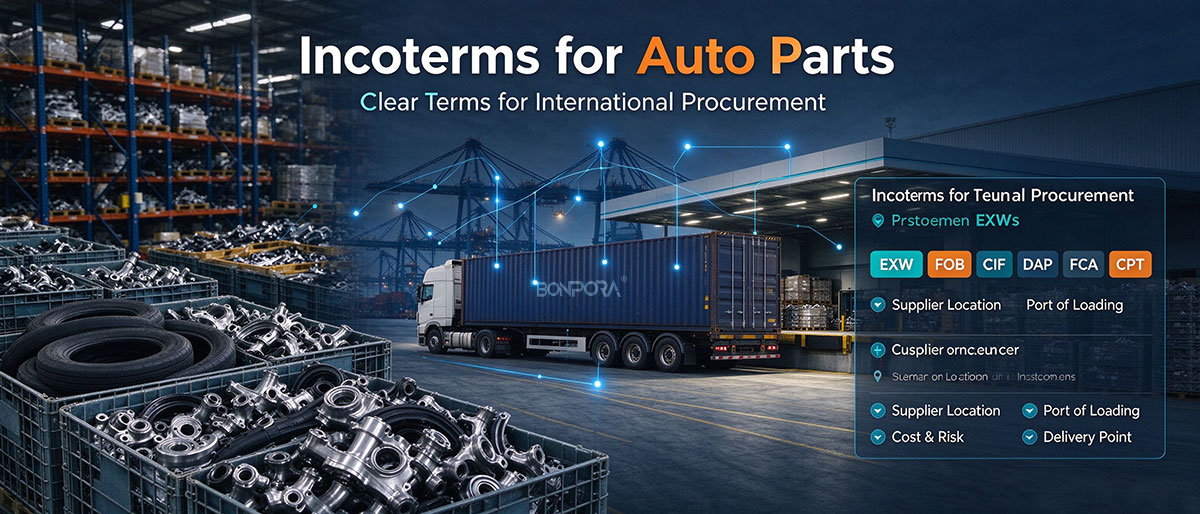
Incoterms decide who pays for each leg of an auto parts shipment and who carries the risk if cartons are lost or damaged in transit. For rubber and polyurethane components such as bump stops and bushings, the practical answer is usually FOB with a nominated forwarder; CIF suits smaller trial orders, and DDP should be accepted only when every hidden fee is visible.
That one-line answer hides a lot of money. A jounce bumper is a light, bulky part, so freight behaves differently than it does for steel brackets or machined housings, and destination charges, insurance clauses and import duties can move the landed cost of a chassis component by more than the unit price negotiation does. This article compares the three terms buyers meet when sourcing rubber and polyurethane auto parts from China, shows where each transfers cost and risk, works through a full quote conversion, and ends with a pre-order checklist.
The three-letter codes are defined by the International Chamber of Commerce, whose current edition is Incoterms 2020. The rules are voluntary: they apply only when a contract names a code, an edition and a place, and they allocate obligations between seller and buyer without touching title transfer or payment terms.## Incoterms for Auto Parts: What the Term Decides and What It Does Not
An incoterm answers three questions at once. Who arranges and pays for each stage of the journey from the factory floor to the named destination. At which physical point the risk of loss or damage passes from seller to buyer. And who is responsible for export and import formalities, including customs clearance and duties.
What an incoterm does not decide matters just as much for auto parts buyers. It does not transfer ownership of the goods, which is a matter of the sales contract. It does not fix payment terms such as T/T or letter of credit. And it says nothing about quality recourse: if a batch of bump stops fails a stiffness inspection, the warranty clause of the contract governs, not the incoterm. A DDP shipment with defective parts is still a defective batch; the term only changed who carried the freight risk on the way over.
Buyers should also note that the rules are grouped by transport mode: FAS, FOB, CFR and CIF are written for sea and inland waterway transport only, while the other seven rules of the 2020 edition suit any mode. Chassis parts almost always leave China in containers, which is why the ICC recommends FCA or CIP for containerised freight, but in the auto parts trade FOB and CIF remain the codes buyers and suppliers actually quote, and both work as long as both sides understand that the goods are delivered "on board" at the container terminal.
The Responsibility Matrix: FOB vs CIF vs DDP
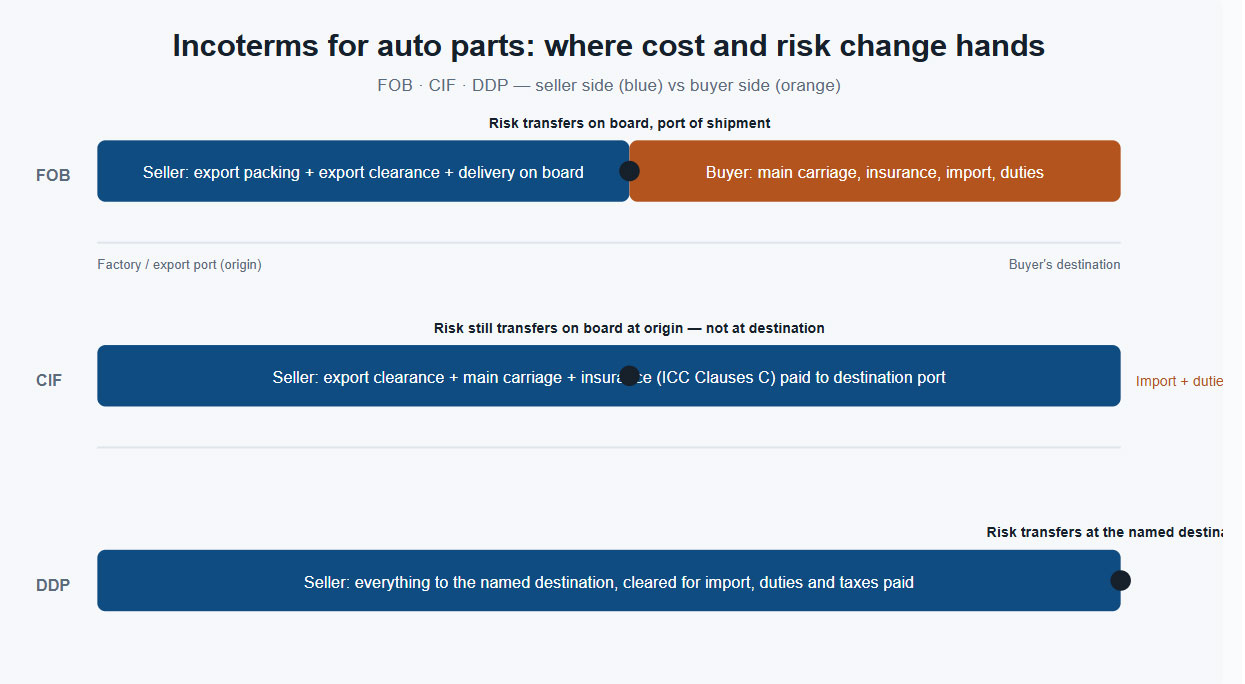
The fastest way to compare the three terms is a matrix of obligations. The table below is the version worth keeping on the desk during negotiation: it shows who performs and pays for each stage, and where the risk sits while the goods move.
| Obligation | FOB (named port of shipment) | CIF (named port of destination) | DDP (named destination) |
|---|---|---|---|
| Export packing and marking | Seller | Seller | Seller |
| Inland transport to port | Seller | Seller | Seller |
| Export customs clearance | Seller | Seller | Seller |
| Main ocean carriage, book and pay | Buyer | Seller | Seller |
| Marine insurance | Buyer (optional, recommended) | Seller (mandatory, ICC Clauses C minimum) | Seller (own account) |
| Point where risk transfers | On board, port of shipment | On board, port of shipment | Named destination, goods placed at buyer's disposal |
| Import customs clearance | Buyer | Buyer | Seller |
| Import duties and taxes | Buyer | Buyer | Seller |
| On-carriage to final warehouse | Buyer | Buyer | Seller |
Two rows in that matrix decide most arguments. The risk row shows the counter-intuitive point about CIF: the seller pays freight and insurance all the way to the destination port, but the risk of loss or damage passed to the buyer much earlier, when the goods went on board at the origin port. A CIF buyer whose container is damaged in transit claims on the insurance policy, not against the seller. The duties row is what makes DDP unusual: the seller is responsible for import clearance and taxes in the buyer's country, a compliance obligation most exporters are structurally unprepared for.
Why Rubber and Chassis Components Usually Move on FOB Terms
Ask an experienced buyer of Chinese auto parts which term they use and most will answer FOB with a nominated forwarder. The preference is not habit; it follows from the physics and economics of the product category.
The first reason is volume. Polyurethane bump stops and rubber bushings are light parts, so a container fills its cubic capacity long before it approaches its weight limit. On Bonpora's own wholesale guide for jounce bumpers, freight is described as usually volume-limited rather than weight-limited, and carton design is called out as a direct driver of landed cost. A buyer who controls the freight directly can consolidate cartons across suppliers into one container, re-plan the loading when a carton spec changes, and see the actual freight rate instead of an estimate folded into a unit price. Under CIF, that optimisation belongs to the seller and the buyer simply pays the result.
The second reason is destination charge transparency. Under CIF, the main carriage is paid at origin, but terminal handling, documentation, deconsolidation and delivery at destination are not, and the buyer meets them as local charges quoted by the seller's carrier. These destination charges are where CIF quietly becomes more expensive than it looked. Under FOB, the buyer's own forwarder quotes the whole door-to-door chain, and every line is visible.
The third reason is insurance quality. Under Incoterms 2020, a CIF seller is only obliged to insure under Institute Cargo Clauses (C), the narrowest cover, for 110 percent of the contract value. Clause C covers major casualties such as fire, stranding and collision, but not the wetting, handling damage and pilferage that light cartoned goods actually meet. A buyer who arranges cargo insurance under FOB can choose Clauses (A), often at a marginal cost difference on a light shipment.
None of this makes FOB the correct answer for every order. A first-time importer without a forwarder in China may find CIF or DAP simpler for a small trial order. The point is that the term should be chosen deliberately, with the landed cost worked out, not inherited from whatever the supplier quoted first. For how the parts themselves are specified, see Bonpora's jounce bumper selection and specification guide.
The Three Costs That Hide Inside DDP Quotes
A DDP quotation looks like the simplest thing in the world: one price, one destination, nothing to arrange. That simplicity is why the following three cost blocks tend to hide inside it, and why a DDP price is usually higher than the sum of its visible parts.
Duties and taxes funded at the seller's estimate. Under DDP the seller pays import duty and, in most destinations, import VAT or GST. The seller does not know the destination country's tariff treatment, preferential rules or valuation practice as well as the importer does, so the estimate built into the quote is deliberately conservative. The difference between estimate and reality is not refunded; it sits inside the price as a risk premium. On duty-sensitive chassis parts this premium alone can exceed the margin on the whole order.
Import clearance and destination handling. Brokerage fees, terminal handling at import, customs inspection and storage, and final-mile delivery all sit inside the DDP price. More sensitive is the compliance question: to clear imports in the buyer's country, someone must act as importer of record, which normally requires a local tax registration. Most Chinese exporters do not hold one, so the DDP service is subcontracted to a local broker or trading entity, whose margin is also inside the price and whose classification decisions the buyer never reviews. A pattern of mis-declaration can create a valuation or audit problem that lands on the buyer's own customs history.
The unitemised buffer. DDP quotes rarely break down their components, which makes the price impossible to verify against market rates. When three suppliers quote DDP to the same warehouse, the spread between them is often wider than for FOB, because each estimate of duty, brokerage and risk differs. The buyer is comparing three opaque bundles, not three prices for the same physical scope.
The practical rule: accept DDP for genuinely small shipments or markets where you have no import capability, and treat every DDP quote as a starting point that should be converted back to FOB plus itemised import costs before it is compared with anything. A DDP price is not wrong; it is a price for transferred work, and the work should be visible before signing.
Converting a Quote Between Terms: A Worked Example
A quote conversion makes the relationships concrete. The numbers below are an illustrative model for a 40-foot high-cube container of 12,000 polyurethane jounce bumpers from a Chinese port to a warehouse near Hamburg. Every figure is an assumption chosen to show the arithmetic, not a quotation; rates, duties and brokerage fees vary by route and season and must be verified per shipment.
| Cost block | Basis in the model | Total (USD) | Per piece (USD) |
|---|---|---|---|
| Ex-works value | 12,000 pcs at an assumed 2.00 | 24,000 | 2.000 |
| Inland haulage to port + export clearance | Seller's cost inside FOB | 900 | 0.075 |
| FOB value | Ex-works + inland + export clearance | 24,900 | 2.075 |
| Ocean freight, 40' HQ | Volume-limited light load | 3,600 | 0.300 |
| Marine insurance | 1.10 x CIF value at 0.25%, ICC Clauses (C) | 79 | 0.007 |
| CIF value | FOB + freight + insurance | 28,579 | 2.382 |
| Import duty | Assumed 3.5% on CIF value | 1,000 | 0.083 |
| Import brokerage + terminal handling at destination | Local quote | 450 | 0.038 |
| Final-mile delivery to warehouse | Local quote | 650 | 0.054 |
| DDP cost before seller's buffer | CIF + duty + brokerage + delivery | 30,679 | 2.557 |
| Seller's DDP risk buffer (illustrative 6%) | Duty and compliance uncertainty | 1,841 | 0.153 |
| DDP as quoted | 32,520 | 2.710 |
Read the table from the middle outward. The jump from FOB to CIF is 0.307 per piece, almost all of it the freight of a light, cube-consuming product. The jump from CIF to the quoted DDP is 0.328 per piece, of which only 0.175 is actual import cost at the model's assumptions; the remaining 0.153 is the seller's buffer for duty uncertainty and compliance risk. A buyer with a forwarder in Hamburg pays the same physical costs under FOB terms for roughly 2.55 per piece with every line visible and insurable under Clauses (A) instead of (C). The DDP price is a price for transferred work and transferred risk, not a dishonest number.
The model also shows why carton design belongs in the freight conversation. At 0.300 per piece of freight, a carton change that fits 5 percent more bumpers per container saves about 1,800 USD on this single container, before the duty that would otherwise be calculated on a higher freight-inclusive value. For a light part, packaging engineering and incoterm choice are the same cost discussion, which is how the landed cost section of Bonpora's wholesale procurement guide treats them.
If you want the assumptions in this model replaced with your lane's actual rates, request the specification sheet or a sample quotation with your destination and expected volume, and the conversion can be run on real numbers.
An Incoterms Checklist for Auto Parts Before the PO
The incoterm line on a purchase order is one sentence long, and most disputes around it come from things left unsaid around that sentence. The following checklist is designed to be worked through before signing; each item can be answered in a line of email and prevents a specific, recurring failure.
Confirm the full term, not just the code: FOB Qingdao, CIF Rotterdam, DDP buyer's warehouse. A code without a named place is ambiguous, and "FOB China" is not a term.
Confirm the edition in writing: "Incoterms 2020" on the quotation and the purchase order, because obligations changed between editions.
Under FOB, nominate your forwarder in writing with the booking deadline, and agree who books inland transport to the port.
Under CIF, ask which insurance clause applies. If only ICC Clauses (C) are quoted, price the upgrade to (A) before accepting the term for cartoned light goods.
Confirm who prepares the packing list with batch codes, so each carton links to a production lot and a future claim can be traced.
Convert every competing quote to the same incoterm before comparing unit prices, using a conversion like the table above.
For DDP, ask directly whether the seller acts as importer of record in your country or subcontracts the clearance, and to whom.
Agree the document set and timing: bill of lading, packing list, inspection record, certificate of origin when a preferential rate is claimed.
Check the loading plan: maximum stacking height, palletised or loose, and moisture protection, because polyurethane and rubber parts are sensitive to compression and humidity in a container.
Record the risk transfer point in the order notes for both sides, so the warehouse knows which party's claim procedure applies to transit damage.
A buyer who can answer all ten items has removed most of the ambiguity that turns a clean quotation into a claim negotiation. The broader context, how supplier quality systems and shipping documents connect, is covered in the site's other auto parts buyer guides.
How Bonpora Quotes and Ships Rubber and PU Components
The incoterm conversation is only useful if the goods themselves are export-ready. Bonpora's jounce bumpers are produced under an IATF 16949 quality system, with batch inspection of static stiffness curve, compression set, hardness and appearance, in MDI or NDI polyurethane systems selected according to the application. The stated working range is -40°C to +90°C, with compound adjustment possible for special service conditions agreed before tooling.
On the export side, the packaging standard written into the wholesale guide maps directly onto the obligations in the matrix above. Unit packs are poly bags or printed boxes marked with reference and application, with no load resting on the bumper profile. Master cartons are rigid and labelled with reference, quantity and batch, pallets are strapped without crushing lower cartons, and the packing list carries batch codes so each carton connects to its inspection record. Carton geometry is treated as a landed cost variable because freight for these parts is volume-limited.
Production runs on two bases, in Luoyang and Wuxi, both operating ISO 9001 and IATF 16949 systems, which gives buyers flexibility on origin port and inland routing. Luoyang focuses on high-end OE work and Wuxi on the mid-range programme, and both accept development from drawings or samples for custom profiles. The site is published in six languages, and enquiries state the destination, incoterm and volume explicitly, so the quoted unit price and the quoted shipping term are always separable and verifiable.
The fastest way to test any of this is to send one lane: part reference or sample, destination, and annual volume. Request a quotation and the reply will separate the ex-works value, the packaging, and the freight so the landed cost can be built on real numbers rather than estimates.
FAQ
Under FOB, who books the vessel if we do not have a forwarder in China?
You do not need your own office. Appoint an international forwarder with a China operation; most mid-size forwarders book a Chinese export container remotely within a day. If you prefer the seller to handle delivery to the carrier but want control of the main carriage, FCA with your named carrier is the cleaner instrument under the 2020 rules.
Under DDP, does the seller really pay our import VAT?
Yes, DDP includes duties and taxes, which is why the price looks high. The deeper question is whether the seller is legally able to act as importer of record in your country. Many are not, and the clearance is subcontracted to a local entity. Ask who that entity is before signing.
Which incoterm should a first-time importer use for a trial order?
CIF or DAP is usually the simplest for a small trial: the seller arranges the main carriage, and you face only the import side. Move to FOB with a nominated forwarder once volumes justify consolidating freight and reviewing destination charges line by line.
Cartons arrived crushed. Who claims under FOB and CIF?
Under both terms the risk passed to the buyer at the origin port, so the buyer bears the loss. Under CIF the buyer claims on the seller's insurance policy if the policy terms were met; under FOB the buyer claims on its own insurance if insured, otherwise absorbs the loss. In either case, photograph the damage before unloading, note it on the delivery document, and notify the carrier within the claim window. If the damage traces to packaging compression, the claim becomes a quality conversation with the supplier as well.
Does EXW give the lowest unit price?
The quoted unit price, yes; the landed cost, rarely. EXW removes the seller's inland transport and export clearance from the price but hands both, plus their coordination risk, to the buyer. After conversion to a common incoterm, the EXW advantage usually shrinks to a rounding error, and the buyer has taken on work at origin it is poorly placed to supervise.
- Prev.:304 Stainless Steel Serrated Lock Washer Internal External Tooth for Automotive Earthing Anti Loosening
- Next.:Remote Factory Audit: Vetting a Chinese Suspension Factory