sales@bonporaparts.com
0086-10-64988621
English
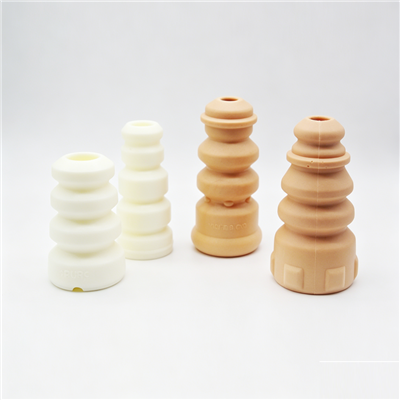
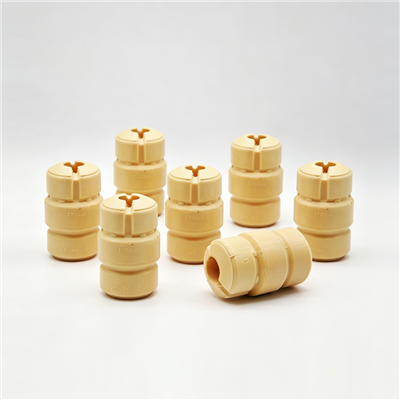
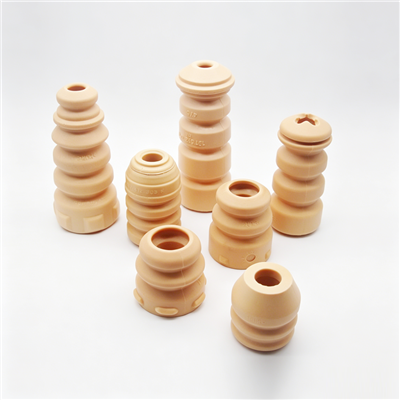
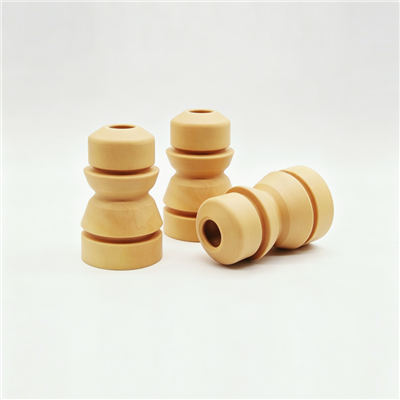
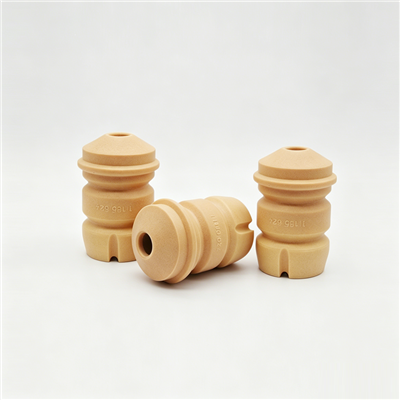
A jounce bumper, also known as a bump stop, bump rubber, rubber buffer or strut bumper, is an elastic component typically made of high elasticity polyurethane using an MDI or NDI system. It is installed on the piston rod of a shock absorber so that it provides progressive auxiliary stiffness at the end of the suspension compression stroke.
The wording matters, because it describes a spring rather than a cushion. The bumper is not a device that stops the suspension and it is not a part that is in contact during normal driving. It is an additional, non linear spring that comes into play only as the suspension runs out of travel, and its job is to add resistance progressively so that the suspension does not reach a hard limit.
Buyers searching for this part may use jounce bumper, bump stop, bump rubber, rubber buffer or strut bumper, and the same part may be listed as a strut top bumper, an axle bump stop or a suspension buffer depending on the position and the platform. When a catalogue is being built, all of the names should appear in the search fields, because the physical part does not change with the description.
A progressive element becomes stiffer as it is compressed. A polyurethane bumper achieves this through its own shape as well as through the material: a tapered, waisted or ribbed profile that increases in effective section as the load rises. That is why two bumpers made from the same compound but with different profiles are not interchangeable, and why the dimensions of the profile belong on the drawing as carefully as the material does.
Bonpora lists three functions for the part, and each of them has a practical consequence for the buyer.
The first stated function is to provide auxiliary stiffness at the end of the compression stroke, limit travel and prevent bottoming out. In practice this protects the damper from a metal to metal arrival, keeps the wheel from travelling beyond the designed envelope, and preserves the geometry that the alignment was set for.
The second function is to absorb impact energy and reduce the noise and load that come from metal to metal contact. A suspension that reaches its hard limit transmits a sharp load into the body structure and produces a noise that drivers report as a bang or a heavy thud. The elastic stop turns that event into a shorter, softer load rise.
The third function is to improve ride comfort under large impacts. This is the outcome that a workshop notices when a worn or missing bumper is replaced: the small harsh impacts over broken surfaces and speed humps are the events the bumper influences, and the improvement is felt in the sub limit rather than the extreme events.
The specification names high elasticity polyurethane, MDI or NDI. Both are cast polyurethane systems, and the difference lies in how resilient and how durable the finished part is under repeated compression.
MDI based polyurethane is the widely used system and offers a good balance of resilience, tear resistance and cost. It is suited to the majority of passenger car bump stops, to general use shock absorber positions and to applications where the bumper is loaded frequently but not to an extreme level.
NDI based polyurethane is selected where higher resilience, better dynamic performance and better retention of properties under heat and repeated cycling are required. It is typically chosen for demanding positions, for heavier vehicles and for applications where the bumper works hard and must not take a set. The trade off is a higher material cost and a more demanding casting process.
Bonpora states a working range of -40°C to +90°C, which meets standard passenger car requirements, and notes that the material can be adjusted for special conditions. That range covers a wide span of climates, from cold winter starts to sustained hot weather running, and it is the reason the compound rather than only the hardness should be specified. Where an application runs hotter or colder than the stated range, the adjustment route should be discussed before the part is tooled.
| Item | MDI system | NDI system |
|---|---|---|
| Resilience | Good general purpose | Higher, better rebound |
| Dynamic durability | Adequate for standard positions | Preferred for hard working positions |
| Cost | Lower | Higher |
| Typical use | Passenger car bump stops | Demanding and heavy duty positions |
| Selection rule | Match the released drawing | Where the released drawing requires it |
The three mechanical properties that decide whether a bumper behaves like the original are the static stiffness curve, compression set and hardness. All three are inspected on the Bonpora range under an IATF 16949 quality system, together with appearance.
A bumper is defined by its force against deflection behaviour rather than by a single number. The curve changes with the profile, so the same compound in two profiles gives two different curves, and the same profile in two compounds gives curves that diverge as deflection rises. When a vehicle feels different after a repair, the stiffness curve is the first property to compare.
Compression set measures how much permanent deformation remains after a period under load. A bumper with a high set has lost height and, with it, lost the early part of its travel, so the suspension reaches the hard limit sooner than it should. This is one of the slow failures that drivers describe as a car that used to ride better than it does now.
Hardness gives a quick, repeatable indication of the compound. It is measured on the finished part and is useful for batch comparison, but on its own it does not define the part, because hardness does not describe the profile or the stiffness curve.
| Inspection item | What it controls | Effect on the vehicle |
|---|---|---|
| Static stiffness curve | Force against deflection behaviour | How the end of the stroke feels |
| Compression set | Permanent deformation under load | Available travel and ride quality over time |
| Hardness | Compound consistency | Batch to batch repeatability |
| Appearance | Moulding and finish condition | Fitment, sealing surfaces, customer acceptance |
Bonpora states a design life of at least 80,000 km or 2 years under normal use, with no cracking, no excessive permanent deformation and no stiffness loss over that period. Two points are worth noting for buyers who are writing a specification.
First, the three failure conditions named are the three conditions that define when a bumper has finished its useful life. A bumper that is cracked, that has collapsed, or that has gone soft has failed even if it is still present. Second, the qualifier under normal use is meaningful, because a bumper that is asked to carry the suspension continuously, for example on a vehicle with a failed or overloaded spring, is being used outside its design envelope and will not reach the stated life.
The strongest search and cross reference signal for a jounce bumper is the original equipment number, because it is unique to a platform and a position. The Bonpora row for this part lists references across four brand families, reproduced below. Treat the list as a starting point for cross referencing rather than as a fitment guarantee, and always confirm against the number moulded on the removed part or the vehicle data.
| Brand family | References listed on the Bonpora row |
|---|---|
| Volkswagen, Audi, Skoda, Seat | 4G0412131, 8J0511353F, 4F0512131C, 8K0412131F, 3C0412303C, 5N0511359B, 2K0511153B, 2Q0511351B, 3C0511359A, 5Q0511357P, 5Q0511357M |
| BMW, Mercedes Benz, Opel, Volvo, Porsche, Citroen | 31336776390, 31340308, 31336771892, 31336855440, 0424764, 5033.26, 31336776389, 33526776399, 33526776557, 31336770529, A2043230044 |
| Honda, Toyota, Lexus, Mazda, Mitsubishi | 20371-FG000, 51722-SMG-E04, 48331-42030, 48331-21030, MR418018, MR961000, D651-34-111, BR5G-34-111A, BBM234111, 20321-AG010 |
| Chevrolet, Fiat, Jeep, Chrysler, Dodge | 23968094, 24519397, T11-2901027, T11-2911033, 4013004400, 2905104AKZ16A, 2915107XKY00A, 2905106XSZ08A, 10094336, 10094348 |
European references usually encode the platform in the leading characters, which makes them easy to group, but the trailing characters carry the variant and cannot be ignored. Japanese references frequently use a group and a dash, with the suffix changing by model year or trim. North American references are often short numeric strings where a single digit distinguishes two different profiles. In all three cases the rule is the same: match the complete number, and never assume that a near miss is a supersession.
A cross reference should be built in one direction only, from a confirmed original number to the replacement part. A reference that has been inferred from a competitor catalogue, or that has been carried forward from an old list without checking, is a fitment risk that will surface as a return rather than as a query. Where a reference is uncertain, the correct action is to ask the supplier to confirm the drawing dimensions against the removed part.
| Selection input | Why it decides the part |
|---|---|
| Position on the vehicle | Front and rear stops are loaded differently |
| Damper rod diameter and fixing | Sets the bore and the retention feature |
| Compression length and height | Controls the point at which the stop engages |
| Profile and stiffness curve | Controls how progressive the engagement feels |
| Compound system | Controls resilience and heat performance |
| Temperature environment | Sets the limits the material has to meet |
| Vehicle load case | Determines how often the stop is used |
Where a reference is not available or an application differs, a custom bumper can be produced from a sample or a drawing. Two inputs are needed: the geometry, which is best supplied as a drawing with the critical dimensions marked, and the performance requirement, which is described by the stiffness curve the application needs rather than by a hardness number alone. Because the material can be adjusted for special conditions, applications outside the standard temperature range should be raised at the enquiry stage so that the compound and the profile are assessed together.
The Bonpora jounce bumper is produced under an IATF 16949 quality system and inspected for static stiffness curve, compression set, hardness and appearance. The typical warranty is 1 to 2 years or 50,000 to 100,000 km, and the exact term is confirmed per order. For a buyer, the useful consequence of this structure is that a warranty discussion can be settled on data: if the claim is about ride quality after a repair, the stiffness curve and the compression set of the returned part decide the outcome, and those are exactly the records the inspection system already holds.
Yes. Jounce bumper, bump stop, bump rubber, rubber buffer and strut bumper describe the same elastic component installed on the shock absorber piston rod. The names differ by market and by catalogue convention rather than by function, so a search built on all of the terms will find the part.
Look for the three conditions named in the design life statement. Cracking in the material, a permanent reduction in height, and a loss of resistance when the part is compressed by hand all indicate that the bumper has finished its useful life. If the part has been compressed by most of its free height and does not return, it has taken a set.
Both are cast polyurethane systems. MDI covers the majority of passenger car positions with a good balance of resilience and cost, while NDI is selected where higher resilience and better retention of properties under repeated cycling and heat are needed. The correct choice follows the released drawing for the application rather than a general preference.
Yes, from a sample or a drawing, and the material can be adjusted for conditions outside the standard -40°C to +90°C range. Supply the geometry with the critical dimensions marked and describe the stiffness behaviour the application needs, so that the profile and the compound are assessed together rather than one after the other.
Bonpora produces jounce bumpers in high elasticity polyurethane MDI and NDI systems for shock absorber piston rods, providing progressive auxiliary stiffness at the end of the compression stroke, absorbing impact energy, reducing noise and load from metal to metal contact, and improving ride comfort under large impacts, with a -40°C to +90°C working range, a design life of at least 80,000 km or 2 years, inspection of static stiffness curve, compression set, hardness and appearance, and a typical warranty of 1 to 2 years or 50,000 to 100,000 km. Start from the on road range, review related stops in polyurethane bump stops, check the surrounding axle parts in chassis and suspension, look at custom parts for a new profile, and send your reference numbers and drawings through the contact page.