sales@bonporaparts.com
0086-10-64988621
English
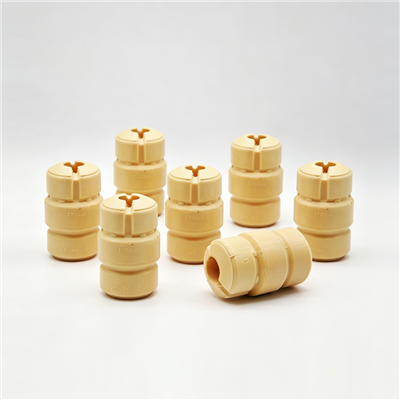
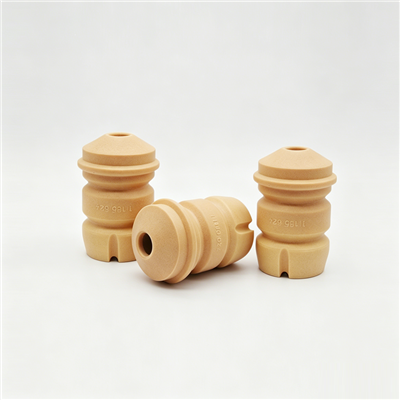
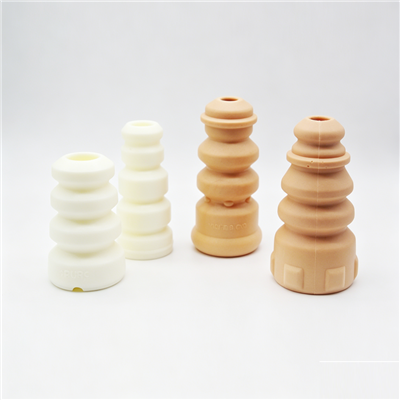
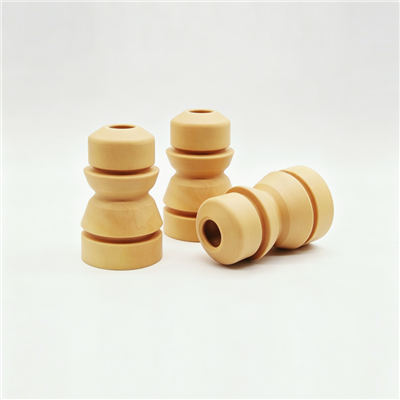
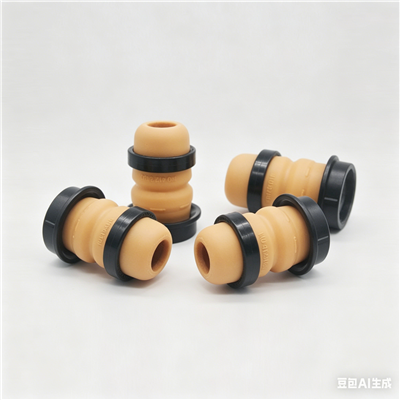
A jounce bumper, also known as a bump stop, bump rubber, rubber buffer or strut bumper, is an elastic component typically made of high elasticity polyurethane using an MDI or NDI system. It is installed on the piston rod of a shock absorber to provide progressive auxiliary stiffness at the end of the suspension compression stroke. Because it limits travel and prevents bottoming out, absorbs impact energy, reduces the noise and load that come from metal to metal contact and improves ride comfort under large impacts, the part is a load bearing spring element rather than a buffer, and it has to be manufactured as one.
That is why the specification for the Bonpora range is written around four inspection items: static stiffness curve, compression set, hardness and appearance, under an IATF 16949 quality system. Each item corresponds to a stage in production, and each one can be traced to a decision made on the shop floor long before the part reaches a vehicle.
Polyurethane is produced by reacting an isocyanate with a polyol and a chain extender. The reaction happens in a mould, so the shape of the part is created at the same time as the material. Unlike a rubber bumper that is vulcanised in a compression mould, a cast polyurethane part is poured or injected as a liquid and then cured. The advantage for a bumper is that the formulation can be adjusted over a wide range, so resilience, hardness and dynamic behaviour can be tuned to the application rather than taken as fixed by the material family.
MDI and NDI refer to different isocyanate systems. MDI based polyurethane is the widely used system with a good balance of resilience, tear resistance and cost, and covers the majority of passenger car bumper positions. NDI based polyurethane offers higher resilience and better retention of properties under repeated cycling and heat, and is chosen for demanding positions, heavier vehicles and applications where the bumper works hard. The two systems behave differently in the same mould, so a compound change is a product change and requires the stiffness curve to be re verified rather than assumed.
The polyol, isocyanate and additives are prepared at controlled temperature and degassed before the reaction. Moisture is the critical enemy at this stage, because water reacts with isocyanate and produces carbon dioxide, which appears in the finished part as internal bubbles or surface porosity. Temperature, dosing accuracy and vacuum quality are therefore recorded as process parameters.
The mixed material is introduced into a mould that has been prepared with a release agent and brought to the correct temperature. Cure time and mould temperature control the degree of reaction and the final properties, which is why a shortened cure is not a harmless shortcut: it produces a part that measures close to nominal when it is new and continues to change afterwards. After demoulding, the part is post cured so that the reaction is completed and the properties stabilise.
Demoulded parts are trimmed of flash and, where the drawing requires it, machined to final height or bored to size. Trimming is where a part can be damaged without being rejected, because a cut that runs into the profile becomes a stress raiser in service. Finished parts are cleaned, inspected and marked with the batch identification.
| Stage | Parameter controlled | Effect if uncontrolled |
|---|---|---|
| Compound preparation | Temperature, dosing, degassing | Porosity, hardness variation |
| Mould preparation | Release agent, mould temperature | Surface defects, moulding marks |
| Casting | Pour or injection rate, filling pattern | Knit lines, entrapped air |
| Cure and post cure | Time and temperature | Properties still changing after delivery |
| Trim and machine | Cut position, tool condition | Stress raisers, dimensional error |
| Inspection | Curve, set, hardness, appearance | Non conforming parts reaching the market |
Hardness is the quickest measurable property of the compound and the one most often quoted by buyers. It is measured on the finished part, usually on a flat area rather than on a curved rib, because an unsupported reading on a thin section gives a misleadingly low figure.
Hardness moves with the isocyanate index, with polyol quality, with moisture content and with cure completeness. A small movement within the specification is normal for cast polyurethane. A movement that follows a supplier change of raw material, or that appears when a cure time has been shortened, is a signal rather than a statistical event.
| Observation | Likely cause | Action |
|---|---|---|
| Gradual drift over weeks | Raw material or dosing drift | Re verify compound and dosing |
| Sudden step change | New material lot or supplier | Re qualify the lot before use |
| Hardness low at the surface only | Moisture contamination | Check drying and storage |
| Hardness high with brittle feel | Index outside the target band | Correct the reactant ratio |
Hardness describes the compound; the static stiffness curve describes the product. The curve is produced by compressing the finished part at a controlled rate and recording force against deflection, and it is the measurement that a driver actually feels, because it sets how quickly resistance grows as the suspension reaches the end of its travel.
Two bumpers built from the same compound with slightly different profiles will produce different curves, and a bumper built to the correct profile from a softer compound will produce a curve that rises too slowly. Because the profile and the compound both feed into the result, measuring the curve on the finished part verifies the whole production chain at once, including the mould wear and the trim height.
The release drawing should state the required behaviour, and the first article should demonstrate it. Where a curve from a production batch deviates from the first article reference, the cause is normally found by measuring free height first: a part that has been trimmed short will show a curve that rises early, and a part that has been over cured will show a curve that is stiffer than the reference across the whole range.
| Deviation | First check | Second check |
|---|---|---|
| Curve rises too early | Free height against drawing | Mould wear and trim setting |
| Curve rises too slowly | Hardness and compound identity | Cure completeness |
| Curve shape differs from reference | Profile dimensions | Mould tooling condition |
| Curve inconsistent between samples | Process parameter record | Mould temperature distribution |
Compression set measures how much deformation remains after a part has been held compressed and then released. It is the test that predicts whether a bumper will still have its height after a season of use, and it is the property that most closely matches the design life condition of no excessive permanent deformation.
In service a bumper is compressed for long periods, not cycled endlessly, so the relevant question is how much of that compression stays in the material afterwards. A part with a high set engages late and lets the suspension travel further, which is felt as a car that no longer absorbs the same impacts.
A set result within the agreed limit indicates a compound and cure combination that will hold its shape. A result outside the limit, or a result that varies widely between batches, points to incomplete cure or to a compound change. Because the test is destructive, it is normally run per batch on a sample rather than on every part, and the record is kept with the batch documentation.
| Result pattern | Interpretation | Corrective direction |
|---|---|---|
| Within limit, consistent | Process under control | No action |
| Within limit but drifting upward | Early stage process change | Re check cure and dosing |
| Outside limit for one batch | Isolated process excursion | Contain and re test the lot |
| Outside limit across batches | Compound or cure design issue | Re develop the formulation |
Appearance is the fourth inspection item, and it is sometimes treated as cosmetic. In practice appearance inspection is the quickest screen for the defects that also affect function: porosity, short filling, knit lines and flash that has been cut into the profile.
| Feature | Acceptance consideration |
|---|---|
| Surface porosity | Neither permitted on the sealing or load surface |
| Knit lines | Not permitted in a load bearing section |
| Flash and trim marks | Clean, no cut into the profile |
| Colour consistency | Uniform within the batch and against the approved sample |
| Marking | Reference and batch readable and correctly positioned |
Bonpora states a working range of -40°C to +90°C, which meets standard passenger car requirements, and notes that the material can be adjusted for special conditions. That adjustment is a development activity rather than a stock selection: the compound, the cure and sometimes the profile are reviewed together, and the stiffness curve and compression set are re verified before the new version is released. For buyers in extreme climates, the practical sequence is to state the service condition at the enquiry stage, agree the target curve, and confirm both the first article and the batch records against it.
| Stage | Check | Frequency |
|---|---|---|
| Incoming | Isocyanate, polyol and additive identity and certificates | Every delivery |
| Compound preparation | Temperature, dosing, degassing record | Every mix |
| First off | Appearance, dimensions, hardness | Every production start |
| In process | Dimensions, hardness, visual | At defined intervals |
| Per batch | Static stiffness curve, compression set | Every batch sample |
| Final | Marking, packaging, packing list with batch code | Every shipment |
| Defect | Cause | Correction |
|---|---|---|
| Internal porosity | Moisture or incomplete degassing | Dry the components, improve vacuum |
| Short fill or missing profile detail | Insufficient material or mould temperature | Adjust shot size and mould heat |
| Knit line at a rib | Filling pattern | Change gate position or pour direction |
| Height short of nominal | Trim setting or mould wear | Re set tooling, verify first off |
| Stiffness curve out of band | Compound, cure or height deviation | Re verify against the release drawing |
| High compression set | Incomplete cure | Correct cure time and temperature |
| Surface tack or bloom | Release agent or post cure condition | Review cleaning and post cure |
The Bonpora row for this profile lists references across four brand families, which indicates the breadth of applications that a single verified profile can serve. Where a reference is not covered, the custom route accepts a sample or a drawing, and the matching process is a design exercise rather than a catalogue lookup: the geometry, the free height and the required stiffness behaviour are agreed first, and the compound is then selected or adjusted to deliver that behaviour within the stated temperature range.
| Brand family | References listed on the Bonpora row |
|---|---|
| Volkswagen, Audi, Skoda, Seat | 4A0512131, 4A0412131, 1K0412303G, 1J0412303, 1748393000, 1K0511353M, 7L0512131C, 4M0512131, 8RD512131, 5N0511359A, 5N0412303 |
| BMW, Mercedes Benz, Opel, Volvo, Porsche, Citroen | 98133350401, 99633310502, 99634330102, 9807659680, 31336857729, 33536767334-01, 31336861727, 2463210306, 31336764085, 31336776389 |
| Honda, Toyota, Lexus, Mazda, Mitsubishi | 54052-1VA02, 51722-TET-H01, 51722-T2A-A01, BP4K-34-111, 52722-SM4-9610, 48341-30110, 20371-FJ000, GHP9-34-111, B45A-34-111A |
| Chevrolet, Fiat, Jeep, Chrysler, Dodge, Land Rover | LR001144, LR024487, 96535006, 0344956, 0344651, 5033E7, 5033A7, 5033C2, 46531017, 1044464-00C, 503339, 1351266080, 503341, 503342, 5033A4, 50703131 |
Cast polyurethane can be formulated across a wide range of hardness, resilience and dynamic behaviour, so the same mould can be used for several applications with different stiffness curves. Rubber is also used in suspension stops, but polyurethane gives a more adjustable and more repeatable progressive behaviour for this application.
It proves that the finished part, not only the compound, behaves as designed. Because the curve is measured on the assembled bumper, it reflects the profile, the free height, the hardness and the cure completeness together, which makes it the single most useful acceptance test for this product.
By controlling cure time and temperature, by verifying the compound identity at incoming inspection, and by testing a sample from each batch rather than assuming that a passing hardness reading means the cure is complete. A part can measure correctly for hardness and still carry an incomplete cure that appears later as permanent deformation.
Yes. The standard range is -40°C to +90°C and the material can be adjusted for special conditions. The correct sequence is to state the service condition at the enquiry stage, agree the target stiffness curve, and verify both the first article and the production batch records against it.
Bonpora produces jounce bumpers in high elasticity polyurethane MDI and NDI systems for shock absorber piston rods, providing progressive auxiliary stiffness at the end of the compression stroke and improving ride comfort under large impacts, with a -40°C to +90°C working range, a design life of at least 80,000 km or 2 years under normal use, inspection of static stiffness curve, compression set, hardness and appearance under an IATF 16949 system, and a typical warranty of 1 to 2 years or 50,000 to 100,000 km. Start from the on road range, review the selection criteria in the jounce bumper specification guide, check the sourcing questions in the jounce bumper wholesale guide, compare related stops in polyurethane bump stops, look at custom parts for a new profile, and send your drawing through the contact page.