sales@bonporaparts.com
0086-10-64988621
English
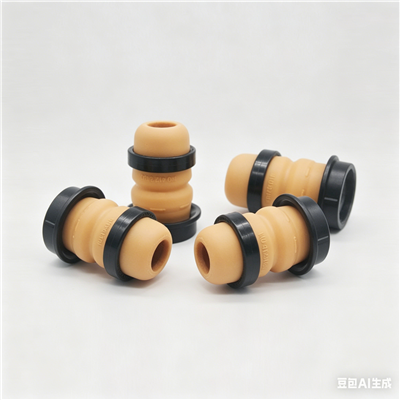
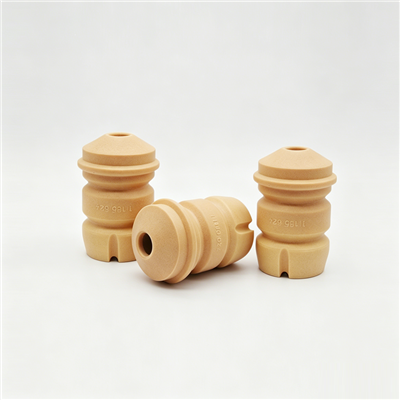
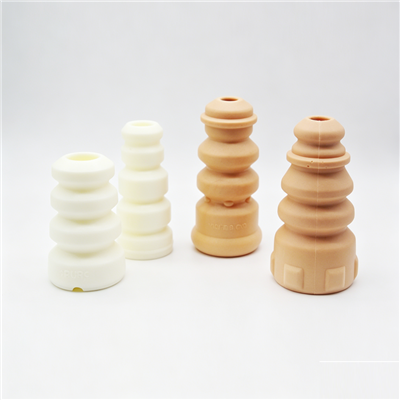
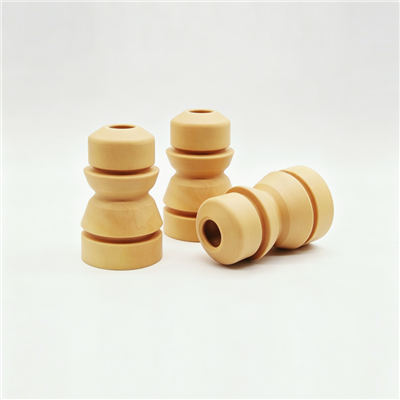
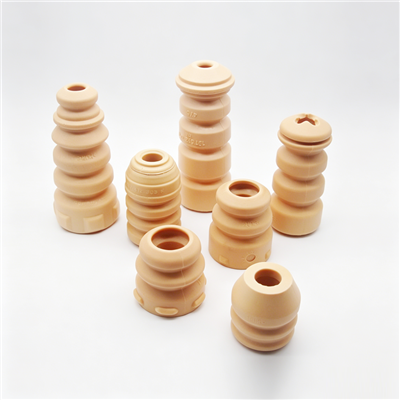
A jounce bumper, also known as a bump stop, bump rubber, rubber buffer or strut bumper, is an elastic component typically made of high elasticity polyurethane in an MDI or NDI system. It is installed on the piston rod of a shock absorber to provide progressive auxiliary stiffness at the end of the suspension compression stroke. It limits travel, prevents bottoming out, absorbs impact energy, reduces the noise and load that come from metal to metal contact, and improves ride comfort under large impacts.
That list of functions is a procurement problem in itself, because the part is bought on a reference number but judged on behaviour. A bumper that fits the rod and the mount perfectly will still generate a complaint if its stiffness curve or its free height is not the same as the original, because the driver feels the difference long before a workshop measures anything. Buyers who succeed with this category treat the reference number as the entry condition and the behaviour data as the acceptance condition.
Jounce bumper, bump stop, bump rubber, rubber buffer and strut bumper are used interchangeably in different markets, and a single enquiry may contain two or three of them in the same paragraph. Wholesale catalogues should carry all of the terms in their search and description fields, because a buyer who cannot find the part under one name usually assumes the part is not stocked rather than trying a second word.
Fitment is confirmed by the bore, the height, the seat and the retaining feature. Behaviour is confirmed by the material system, the profile and the resulting stiffness curve. A quotation that answers only the fitment question leaves the second half of the risk with the buyer, which is why the specification section of this guide is worth as much attention as the reference list.
The fastest way to lose money in this category is to buy a supplier catalogue rather than a market. A bumper that sells in one country may sit on the shelf in another, because the profiles follow the vehicle parc and the parc follows the platforms that were actually sold.
Begin with the vehicle families already present in the workshop and trade sales of the business, then work outward. Because bumpers are commonly replaced during strut repairs, the range that matches the existing damper and mount programme will turn with them, and the same customer order will carry all three lines.
A single brand family is usually covered by a small number of profiles that repeat across several platforms and positions. Grouping the references by profile rather than by vehicle model shows where the volume sits, and often reveals that a handful of profiles carry most of the demand while a long tail of applications is served by the same part.
| Range decision | Approach | Why it works |
|---|---|---|
| Core profiles | The top selling strut positions in the parc | High turnover, predictable demand |
| Grouped profiles | One profile covering several references | Fewer lines, wider coverage |
| Long tail | Order on request or on a slow moving basis | Keeps capital in fast movers |
| Special profiles | Custom route where no reference exists | Serves modification and legacy demand |
The original equipment number is the strongest filter in this category, because it identifies a platform and a position rather than only a shape. The Bonpora row for this profile lists references across four brand families, reproduced below as a starting point for a cross reference programme.
| Brand family | References listed on the Bonpora row |
|---|---|
| Volkswagen, Audi, Skoda, Seat | 1J0512131B, 357412303F, 3B0512131H, 191512131B, 6Q0512131C, 4B0512131B, 6N0512131A, 5Q0511357H, 5Q0511357G, 2K0511155A |
| BMW, Mercedes Benz, Opel, Volvo, Porsche, Citroen | 2043230044, 6383210506, 13367145, 5033.A3, 7L5511149, A2463210206, A6383210506, 2043210006, 1643230044, 95B412131D, 95B512131D, 971512131B, 98733330101 |
| Honda, Toyota, Lexus, Mazda, Mitsubishi | D651-34-111A, KD35-34-111, MB-809285, 48331-33020, 48331-12120B, C100-28-111, 51722-S10-004, 48331-33071, 52722-SR3-003 |
| Chevrolet, Fiat, Jeep, Chrysler, Dodge | 97KB-5K570-BA, 05171137AB, 13356026, 1388271, 96396591, 51755690, 1531648, 5166.90, 96626336, 95214399, 96586890, 13384157, GM23284102 |
Build a cross reference in one direction only, from a confirmed original number to the replacement part, and record the source of every entry. Where a reference supersedes an earlier number, record both numbers so that a customer quoting the older figure can still be served. Where a reference has been inferred from a competitor list, mark it as unconfirmed and treat the first order as a fitment check rather than as routine stock.
A reference list proves that a number has been catalogued, not that the part behaves identically. Adjacent profiles within the same brand family can share a bore and a height while differing in the rate at which they stiffen, and that difference is what a customer notices. Where a list is being used to justify a substitution, ask for the stiffness curve or for a sample comparison rather than relying on the reference alone.
A tender for a bumper programme should be specific enough that two suppliers cannot quote different parts against the same line.
| Field | What to state |
|---|---|
| Reference range | Every reference the profile is expected to serve |
| Material system | Polyurethane, MDI or NDI |
| Hardness | Nominal figure with tolerance |
| Static stiffness curve | The behaviour the application requires |
| Compression set | Maximum permitted after the agreed test |
| Free height | Nominal with tolerance, both ends of the part |
| Temperature range | Stated range, or the special condition to be met |
| Colour and marking | Standard finish and identification requirement |
| Packaging | Unit pack, carton, labelling and quantity |
MDI and NDI polyurethane systems are not interchangeable. MDI covers the majority of passenger car positions with a good balance of resilience and cost, while NDI is chosen where higher resilience and better retention of properties under repeated cycling and heat are needed. A tender that names the system prevents a supplier from substituting a cheaper compound that meets hardness but not dynamic behaviour.
Hardness is easy to quote and easy to measure, which is why it is over used. On its own it does not describe the part, because two bumpers of the same hardness can produce very different force against deflection curves. The stiffness curve and compression set are the two properties that describe behaviour and long term shape retention, and both should appear in the acceptance criteria.
Bonpora states a working range of -40°C to +90°C, which meets standard passenger car requirements, and notes that the material can be adjusted for special conditions. Buyers serving cold climate or hot climate markets should state the range expected in service, because a compound adjustment is a design decision that is best taken before tooling rather than after a complaint.
The Bonpora jounce bumper is produced under an IATF 16949 quality system with inspection of static stiffness curve, compression set, hardness and appearance. For a wholesale programme, the practical question is not whether a certificate exists but whether the records follow the parts.
A quality system is only useful to a buyer if it produces traceable evidence per batch. Ask how a batch is identified, how the inspection record is linked to the packing list, and how long the records are retained. Those three answers decide whether a future complaint can be investigated or only negotiated.
| Document | Purpose |
|---|---|
| Quality certificate | Confirms the management system in place |
| Batch inspection record | Stiffness, set, hardness and appearance per lot |
| Material certificate | Compound identity and system type |
| First article report | Confirms tooling output against the drawing |
| Packing list with batch codes | Links delivered cartons to inspection records |
| Warranty statement | Term, scope and claim procedure |
Send the sample, the references it should cover, the vehicle applications, the annual and first order quantity, and a note of which dimensions are critical. Photographs of the sample beside a rule help, and a measured free height taken from a new part rather than from a used one avoids carrying an existing set into the new design.
Ask whether the quoted price assumes existing tooling, who owns new tooling, how long tooling takes, what the first article process is, and what the minimum first order is for a new profile. Ask also for the packaging drawing before production, so that a private label programme is not held up by artwork approval after the parts are made.
| Item | Requirement |
|---|---|
| Unit pack | Poly bag or printed box with reference and application |
| Protection | No load on the bumper profile in the pack |
| Master carton | Rigid, labelled with reference, quantity and batch |
| Private label | Approved artwork before the production run |
| Documents | Packing list, reference list, inspection record |
| Pallet | Even layers, strapped, no crushing of lower cartons |
Because a bumper is a light part, freight is usually volume limited rather than weight limited. Carton design therefore has a direct effect on landed cost, and a carton that holds more parts without crushing the profile is a genuine cost saving rather than a packaging detail.
| Cost line | What to include |
|---|---|
| Unit price | Quoted incoterm and currency |
| Tooling | Amortised over the first order or the forecast |
| Packaging | Neutral, private label and print setup |
| Freight | Volume based for light parts |
| Duty and clearance | Per destination |
| Claim cost | Expected return rate multiplied by the fitted cost |
| Lost sale | A repeat complaint costs the account, not only the part |
The last two lines are the ones that decide whether a cheap bumper is actually cheap. A bumper is fitted inside a strut, so a failure is measured in labour rather than in part price, and a workshop that has to strip the same strut twice does not reorder on price alone.
The typical warranty on the Bonpora range is 1 to 2 years or 50,000 to 100,000 km, with the exact term confirmed per order, and the design life is stated as at least 80,000 km or 2 years under normal use with no cracking, no excessive permanent deformation and no stiffness loss. Because the failure conditions are defined in material terms, a claim can be assessed on the returned part: free height, evidence of cracking, and comparison of loaded height or stiffness against a reference. Buyers should keep the batch code from each carton and record fitment mileage, so that a claim can be matched to a production lot rather than argued on the basis of a part number alone.
| Question | Evidence to request |
|---|---|
| Is the material system named on the drawing? | Drawing stating polyurethane MDI or NDI |
| Is the stiffness curve part of acceptance? | Inspection record with curve data |
| Is compression set controlled? | Recorded result per batch |
| Is the reference list verified? | Confirmed against the removed part |
| Is custom work supported? | Sample and drawing route in writing |
| Is packaging repeatable? | Approved carton and label artwork |
| Is the warranty procedure clear? | Written term, scope and process |
Quantity depends on whether the profile already uses existing tooling or requires a new mould. Existing profiles are usually quoted at carton or pallet quantities, while a new profile is quoted with tooling and a first order that covers setup. Ask for both figures separately so that the cost of adding a line is visible.
Yes, private label packaging is a normal part of a bumper programme. The practical requirements are approved artwork and a packaging drawing before the production run, plus confirmation of the reference and application text that will be printed on the unit pack, because a mislabelled carton on a fitment critical part creates returns quickly.
Compare them line by line on the same data sheet: material system, hardness, stiffness curve, compression set, free height and temperature range, then on packaging and delivery terms. A quotation that is cheaper but silent on the stiffness curve and compression set is not comparable, because those two properties are what the customer will feel.
Keep the batch code from each carton, the fitment mileage, the reference fitted and, where a complaint involves ride quality, the measured free height of the returned part and its loaded height compared with a reference part. Those records allow a claim to be matched to a production lot and assessed on the same four items the factory already inspects.
Bonpora produces jounce bumpers in high elasticity polyurethane MDI and NDI systems for shock absorber piston rods, providing progressive auxiliary stiffness at the end of the compression stroke and improving ride comfort under large impacts, with a -40°C to +90°C working range, a design life of at least 80,000 km or 2 years under normal use, inspection of static stiffness curve, compression set, hardness and appearance under an IATF 16949 system, and a typical warranty of 1 to 2 years or 50,000 to 100,000 km. Start from the on road range, review the selection criteria in the jounce bumper specification guide, check the fitting procedure in the jounce bumper fitting guide, compare related stops in polyurethane bump stops, look at custom parts for a new profile, and send your reference list through the contact page.