
- 1. What a Remote Factory Audit Can Prove, and What It Cannot
- 2. Before the Call: The Document Pack to Request
- 3. The 30-Minute Video Line-Walk Script
- 4. How to Read a Third-Party Audit Report
- 5. Capacity Questions That Reveal Real Scale
- 6. What a Remote Factory Audit Costs, and Where It Must Stop
- 7. Scoring the Call and Deciding the Next Step
- 8. FAQ
- 8.1. How long does a remote factory audit take from request to decision?
- 8.2. Can a factory fake a live video line-walk?
- 8.3. Does a remote audit work for custom parts, or only catalogue items?
- 8.4. What if the supplier will not show the testing lab on camera?
- 8.5. How often should a remote audit be repeated?
Remote Factory Audit: Vetting a Chinese Suspension Factory
You can qualify a Chinese suspension parts factory without a plane ticket. A remote factory audit combines a document pack, a scripted 30-minute video line-walk, screenshots of eight workstations and cross-checking capacity questions. It cannot replace walking the floor before a large contract, but it filters out unsuitable suppliers cheaply.
What a Remote Factory Audit Can Prove, and What It Cannot
A remote audit is a screening instrument, not a certification. Done properly, it proves three things: the documents exist and agree; the person on camera can walk the line fluently and answer process questions live; and the equipment, records and batch discipline you were promised are physically present. Done badly — a recorded tour and slides — it proves nothing.
It cannot show what happens when the camera is off: gauge calibration, workforce practices, or whether the line you saw is the line your volume will run on. It also cannot substitute for the twelve on-site checkpoints that qualify a jounce bumper supplier — those criteria, including the three veto conditions, are covered in our 12-checkpoint supplier audit. Treat this article as the *how* of seeing those checkpoints through a screen.
The stakes are specific to elastomer parts. A jounce bumper is bought on behaviour, not just dimensions: a progressive stiffness curve, a compression set figure, a hardness value measured on the finished part in an MDI or NDI polyurethane system. None of that is visible in a photo. What a video call *can* expose is process discipline — dated material lots, curing records posted at the oven, batch codes that follow the cartons — and discipline is what keeps those behaviours consistent.
A practical starting point: what the supplier publishes about itself. Bonpora, for example, maintains a company profile stating two manufacturing bases — Luoyang for high-end OE polyurethane work in MDI and NDI systems, Wuxi for large-scale MDI bump stops and rubber parts — both ISO 9001 and IATF 16949 certified, plus a photo album of lines and a testing centre. A supplier should reproduce every published claim live on a thirty-minute call. Where claims and camera evidence diverge, that divergence is your finding.
Before the Call: The Document Pack to Request
Send the request list at least three working days ahead — a factory that cannot assemble these documents in that window has told you something already. Number the requests so they can answer item by item.
Quality certificate. ISO 9001 or IATF 16949, scope visible — it must name the site address and product family. Record the certificate number and issuing body for verification.
Equipment list for mixing, casting or moulding, curing and testing, with models and quantities — the baseline for the capacity questions later.
Sample control plan for the part family, even redacted. It shows whether inspection frequency is defined or improvised.
Two batch traceability records from different months — compound lot to carton. Batch discipline either exists on paper or does not.
One recent test report for a comparable part: hardness, compression set, stiffness curve if available. Test conditions must be stated, not just numbers.
The latest internal audit summary and, if available, the most recent third-party audit report.
A photo pack of line and lab, dated within six months. This becomes the reference set against which you judge the live video.
An equipment ownership statement — owned versus leased or subcontracted. Multi-base groups should state which site would run your part.
Review the pack *before* the call and note three inconsistencies — a capacity figure that does not match the equipment list, a certificate scope that omits the site, a test report with no conditions. Those items open your call. China supplier verification lives or dies on this preparation; the call only confirms it.
The 30-Minute Video Line-Walk Script
Insist on three ground rules: the call must be live, not a recorded tour; the host walks handheld — a fixed camera is a promotional video, not an audit; and process questions go to the workshop or quality person, with sales present but not leading. Then run this script on a 30-minute call.
| Minutes | Segment | What to ask for | What it tests |
|---|---|---|---|
| 0–3 | Gate and yard | Walk from gate toward production, past the finished-goods store. Note vehicles and pallets. | Activity level matches the claimed volume |
| 3–8 | Raw material store | Open the material store: lot labels, dating, the drying zone for moisture-sensitive systems | FIFO and moisture control, which drive compression set |
| 8–14 | Mixing and casting cell | Ask the operator, not the host, to state today's batch number and what is running | Process ownership at operator level |
| 14–20 | Curing and post-cure | Show presses or ovens, the temperature record on the wall or screen, and the deflashing area | Parameter control, records kept where the work happens |
| 20–25 | Testing centre | Walk the lab: hardness tester, compression set oven, stiffness or fatigue rig, projector or CMM. Show a calibration sticker | The lab is real and actually used |
| 25–30 | Packing and dispatch | Carton labels, batch codes on cartons, the loading bay | Traceability survives to the carton you receive |
If the connection fails at a workstation, schedule that segment for a second short call rather than accept a photo. A photo proves a lab exists; a live walk proves the host can navigate and explain it. That difference is the entire value of a remote audit.
Eight Workstations to Screenshot
Screenshot eight specific workstations during the walk. Say at the start that you will take them for your internal report — covert recording poisons the relationship and is unnecessary; a factory with nothing to hide consents instantly.
| # | Workstation | What good looks like | Red flag |
|---|---|---|---|
| 1 | Material drying zone | Sealed containers, dated labels, dryer running | Open drums, no dates, zone used as storage |
| 2 | Mixing and metering | Closed metering unit, batch sheet posted | Hand mixing in open buckets, no batch sheet |
| 3 | Insert preparation | Degreasing or blasting area visible, primers labelled with shelf life | Unlabelled primer tins, inserts re-contaminated by bare hands |
| 4 | Curing oven or press | Temperature chart or digital log at the machine | No record visible; "records are in the office" |
| 5 | Post-cure and deflashing | Dedicated post-cure area; deflashing separated from finished goods | Trimming scrap next to shippable parts |
| 6 | Dimensional lab | Projector or CMM in use, gauges with calibration labels | Broken or unlabelled gauges |
| 7 | Hardness and compression set | Durometer and compression set oven in use | Lab equipment exists only in the brochure |
| 8 | Packing and batch coding | Printed labels tying carton codes to batch numbers | Hand-written dates, no code linkage |
Two rows deserve emphasis. Row 3, because insert bonding failures — the delamination family of complaints in rubber-to-metal parts — usually begin at surface preparation, invisible in the finished part. Row 8, because when a field complaint arrives months later, the carton batch code is the only thread back to the compound lot and curing record. No row 8, no closable complaint loop.
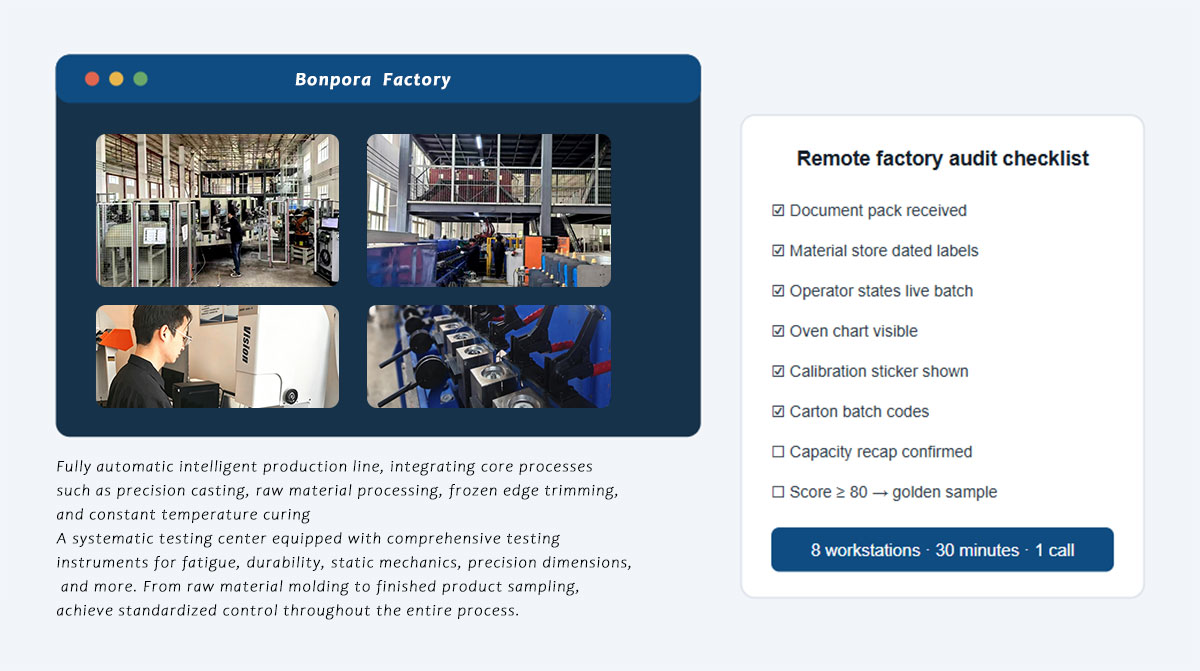
To see this checklist run against a working line, request a specification sheet or a golden sample and ask us to walk the Luoyang or Wuxi line on camera — the eight workstations map onto our published photo album.
How to Read a Third-Party Audit Report
Many suppliers will offer a third-party audit report instead of a live call. Accept it — then read it properly. Reports range from rigorous multi-day audits to half-day photo inspections arranged and paid for by the factory, and the difference is not always on the cover page.
Who commissioned it. A report the supplier arranged is a marketing document with a logo. A report a previous buyer commissioned is evidence. Neither is disqualifying; weight them differently.
Duration and auditor. A one-day "inspection" covers far less than a two-to-three-day full-scope audit. Check the auditor's qualification and days on site.
Scope and site address. The audited address must match the site that will cast your parts — the most common gap, since multi-plant groups often circulate the report of their strongest site.
Findings classification. Count the majors and check whether closure evidence is attached with dates. Twelve minors with no closure record describes a factory that does not fix things.
Photo evidence pages. Compare them with your screenshots — same rooms, same equipment models as the equipment list. A mismatch is a finding in itself.
Sample handling. Auditor-drawn samples carry weight; factory-supplied samples are marketing.
Date. Older than twelve to eighteen months, treat as indicative only and demand a live segment on the areas it covers.
Cross-check with the call. Verify one claim from the report — a machine, a headcount, a lab capability — during your walk. One verified anchor calibrates how much of the rest to trust.
Capacity Questions That Reveal Real Scale
The last segment is a set of questions whose answers must agree with each other, with the document pack, and with what you just saw. A factory running at its claimed scale answers in seconds, in numbers. Hesitation is not dishonesty — but specific answers are hard to fake across eight interlocking questions.
| # | English question | 中文对照 | What the answer must agree with |
|---|---|---|---|
| 1 | How many casting or moulding lines are running today, and how many operators per shift? | 今天有几条浇注线在开?每班几名操作工? | Equipment list; what you counted on the walk |
| 2 | What is the mould change time on a typical bumper mould? | 换一套缓冲块模具通常需要多久? | Lead-time quotes in the MOQ and tooling discussion |
| 3 | What was last month's output for this part family, and the scrap rate? | 上个月这个系列的产量和报废率是多少? | Claimed capacity × utilisation; near-zero scrap is not credible |
| 4 | If we order 20,000 pieces, which line and which week? | 如果我们订两万件,排在哪条线、哪一周? | Answers 1 and 3; a real scheduler commits to a line |
| 5 | Which batches shipped in the last 48 hours, and to which region? | 最近 48 小时发了哪些批次?发到哪个区域? | The cartons and loading bay you just walked past |
| 6 | Which machines are owned and which are leased or partner-run? | 哪些设备是自有的,哪些是租赁或合作方的? | The ownership statement in the document pack |
| 7 | Who signs off first articles, and where is the golden sample kept? | 首件由谁签核?金样封存在哪里? | The sample approval workflow for your parts |
| 8 | What happens when an oven chart drifts out of limits mid-shift? | 烘箱曲线中途超差时怎么处理? | The reaction plan section of the control plan document |
After the call, send a written recap within 24 hours and ask the supplier to correct any errors. A real plant corrects numbers promptly — it knows its own output. An engineer correcting a figure is normal; a salesperson re-issuing a brochure is a signal.
Reconcile capacity against what you are buying. The question is not only "can they make 20,000" but "will a 20,000-piece order be visible or lost" — so choose the Bonpora jounce bumper range you plan to build and the supplier scale together.
What a Remote Factory Audit Costs, and Where It Must Stop
The cost case is why remote auditing has become standard practice in China supplier verification. The numbers are an illustrative model for a European or North American buyer vetting a mid-size moulding factory — adjust the rates to your own loaded labour costs.
Remote audit, per supplier (illustrative):
| Item | Basis | Cost |
|---|---|---|
| Buyer time | 6 h preparation, call and report at 40 USD/h | 240 USD |
| Interpreter (if needed) | 2 h at 30 USD/h | 60 USD |
| Report and scoring | Template scoring, 2 h at 40 USD/h | 80 USD |
| Total | ≈ 380 USD |
On-site audit, one trip (illustrative): flights 1,200 USD; hotel three nights 450 USD; visa 150 USD; inland transport 200 USD; interpreter two days 300 USD; five working days away at 40 USD/h loaded ≈ 200 USD — total ≈ 2,500 USD, plus five to eight calendar days out of the office.
The ratio is roughly 6.6 to 1: for the cost of one trip you can screen six or seven suppliers remotely, then spend the trip on the two or three that deserve it. The break-even is sharper still, because what the audit protects against is not the trip but the wrong-source award: on the illustrative model used elsewhere in these guides, re-cutting a single bumper mould means several thousand dollars of tooling plus four to six weeks of lost calendar time, before a single defective carton ships.
Where the remote method must stop, be explicit with yourself:
Before an annual contract — walk the floor. Screening asks whether the factory is disciplined; a contract asks whether it stays disciplined under your volume.
Before a new mould is cut — tooling locks in geometry, draft and insert strategy. Review it on a call with the mould designer, but sign after a sample.
When one part family exceeds roughly a third of the supplier's visible capacity — who else is in the queue is a question answered reliably only in person.
After a significant field complaint — a 20-minute unannounced video on the specific batch records replaces a formal re-audit at a fraction of the cost.
Scoring the Call and Deciding the Next Step
Score the audit the same day, while the screenshots are fresh. The sheet is weighted for what a remote audit can actually observe; it sits alongside the 100-point on-site sheet rather than replacing it.
| Section | Points | What earns points |
|---|---|---|
| Document pack completeness and coherence | 25 | All eight documents supplied; figures agree; scope names site and product |
| Line-walk fluency | 20 | Live handheld walk; operator-level answers; no segment dropped without follow-up |
| Workstation evidence | 20 | Eight screenshots captured; each matches the document pack; no red flags |
| Capacity question consistency | 15 | Answers specific, numeric, consistent; recap confirmed within 24 h |
| Third-party report verification | 10 | Report current, scoped to the casting site, findings closed, one claim verified live |
| Responsiveness | 10 | Right people on the call; consent to screenshots; recap answered by quality, not only sales |
| Total | 100 |
Decision thresholds: 80 or above, proceed to a golden sample request with your drawing or OE reference. 60 to 79, send a gap list and book a 15-minute follow-up video on the failed sections within two weeks. Below 60, pause and move on — the pipeline you built by screening remotely is what makes walking away cheap.
Three veto conditions end the process regardless of score: the certificate scope does not name the site that will cast your parts; the supplier refuses a live walk of the casting or curing area but offers a recorded tour instead; or the packing-area cartons carry no batch codes. The consequences are direct — paperwork that cannot be traced to the site, a line that cannot be shown, a complaint loop that cannot close.
The remote audit is the first thirty minutes of a sourcing relationship, not the last. Run it before sampling, repeat a short version after the first shipments, and reserve the plane ticket for suppliers that survive both. For the document pack request list as a template, or to compare a scored remote walk against our published line photos, get a quotation and we will share the pack and schedule the call.
FAQ
How long does a remote factory audit take from request to decision?
About one working week: three to five days for the document pack, a 30-to-60-minute call, and one to two days for scoring and the recap. Custom projects add a parallel DFM call with an engineer.
Can a factory fake a live video line-walk?
Staging a live walk is harder than it looks, because the script forces continuity: one take from yard to packing, an operator stating the live batch number, the same rooms reappearing in your screenshots. Residual risks — borrowed equipment, a model line — are exactly why capacity questions and document cross-checks matter, and why an unannounced follow-up after first shipments is cheap insurance.
Does a remote audit work for custom parts, or only catalogue items?
It works for both, with one addition. For custom polyurethane or rubber parts, include the drawing review in the call: ask how draft, wall thickness and insert bonding will be handled, and confirm the golden sample workflow. The audit then covers the process that will make *your* part, not just the parts on the shelf.
What if the supplier will not show the testing lab on camera?
Ask for the reason once — sometimes the lab is in another building and the call runs long. If refusal persists, treat it as a gap: request dated lab photos matching the equipment list plus a third-party test report, and score the workstation section down. A lab existing only in brochures is a finding.
How often should a remote audit be repeated?
Before the first purchase order, a short unannounced follow-up after the first significant shipments, then annually for active suppliers — full on-site visits reserved for strategic volume or contract renewals. Between audits, the batch code on every carton is the ongoing audit trail.