
- 1. What a Jounce Bumper Supplier Audit Should Prove
- 2. The 12 Jounce Bumper Supplier Checkpoints
- 3. Three Veto Conditions That End the Audit Early
- 4. How to Score the Audit: A 100-Point Sheet
- 5. Auditing a China Factory Remotely: What Video Can and Cannot Prove
- 6. What the Audit Costs, and What a Failed First PO Costs
- 7. From Score to First PO: A 30-Day Sequence
- 8. FAQ
How to Audit a Jounce Bumper Supplier: 12 Checkpoints Before the First PO
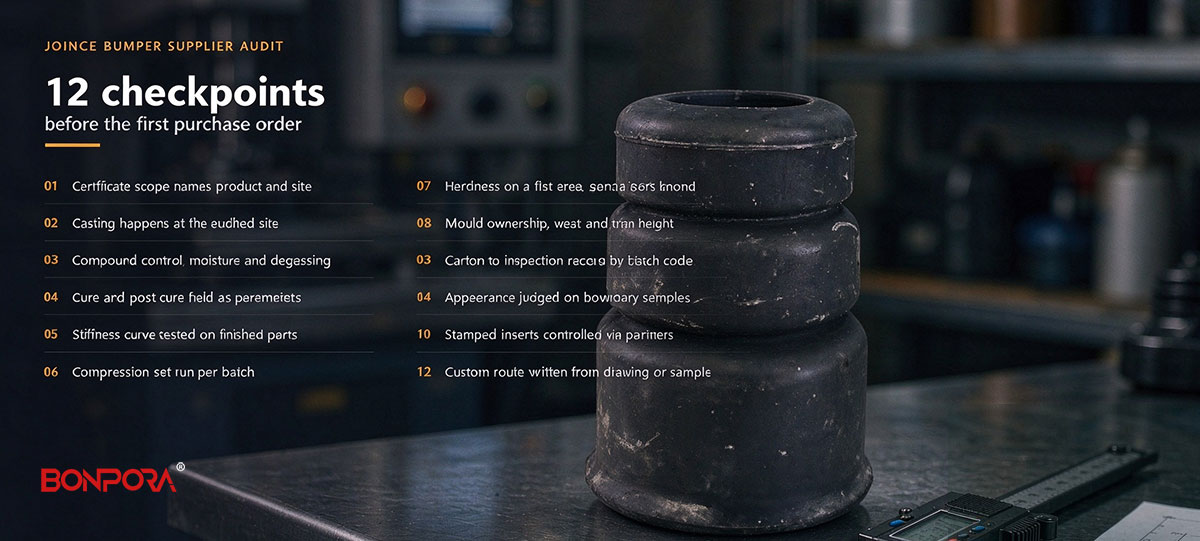
A jounce bumper supplier is qualified on four things: a certificate scope that names the product and the site, casting control at that site, batch records that follow the cartons, and stiffness curve data measured on the finished part. The 12 checkpoints below test those four. Three of them can end an audit on their own.
That framing matters because this part is bought on a reference number and judged on behaviour. A bumper can fit the rod and the mount perfectly and still generate a complaint three months later, because the driver notices a stiffness curve long before anyone measures one. An audit that only confirms "they make bump stops" answers the wrong question.
What a Jounce Bumper Supplier Audit Should Prove
A jounce bumper is an elastic component, usually cast from high elasticity polyurethane in an MDI or NDI system, installed on the shock absorber piston rod. It provides progressive auxiliary stiffness at the end of the compression stroke, limits travel, prevents bottoming out and takes the metal to metal load out of the end of the stroke. It is a non linear spring that works only when the suspension runs out of travel.
Because it is a spring, it has to be manufactured as one. The four inspection items stated for the Bonpora range are the static stiffness curve, compression set, hardness and appearance, all held under an IATF 16949 quality system. Each item maps to a production stage rather than to a final sort: hardness to compound preparation and cure, the curve to profile, free height and compound together, compression set to cure completeness, appearance to mould condition and trim.
The audit therefore has one job: to establish whether those four results are produced by the process, or produced by inspection at the end of it. A factory that finds its quality at final inspection is a factory that will ship the parts it did not catch.
| Document | What it confirms | What the audit must add |
|---|---|---|
| IATF 16949 certificate | A management system is certified | That the scope covers this product family and the site you are buying from |
| ISO 9001 certificate | Documented process control and corrective action | Whether the loop is closed on this product line, not only at company level |
| Material certificate | Compound identity and system type, MDI or NDI | That the certificate is tied to the lot used for your parts |
| Batch inspection report | Curve, set, hardness and appearance were measured | That the report can be retrieved from a carton number on a shipment |
A note on certificate reading: certification bodies publish valid certificates, and the IATF oversight structure is described at iatfglobaloversight.org. A certificate number that cannot be found in the issuing body's register is not evidence, and a group certificate that names a sales office rather than a plant is a different document from the one a buyer needs.
The 12 Jounce Bumper Supplier Checkpoints
Run these in the order a site visit normally moves through the building, from the certificate file to the packing area. Each one produces a document or an observation, so nothing depends on the impression the meeting room creates.
Certificate scope names the product and the site. Ask for the certificate plus the scope page, then ask which building the parts will be made in. A scope written for "rubber and plastic components" at another address does not describe the plant in front of you.
Casting happens at the audited site. Cast polyurethane is poured or injected into a prepared mould and then cured, so the casting cell, the mould store and the cure ovens should be visible on the same walk. If casting is subcontracted, the audit has moved to a factory you have not seen.
Incoming compound control is recorded. Polyol, isocyanate and additives should arrive with identity certificates, and temperature, dosing and degassing should be logged per mix. Moisture is the critical variable: water reacts with isocyanate, produces carbon dioxide, and appears in the finished part as porosity.
Cure and post cure are controlled as parameters. Cure time and mould temperature decide how far the reaction has progressed. A shortened cure produces a part that measures close to nominal when new and keeps changing afterwards, which is exactly the failure a buyer discovers in the field.
The static stiffness curve is an acceptance test on the finished part. This is the single most informative checkpoint in the list. The curve is measured by compressing the finished bumper at a controlled rate and recording force against deflection, so it verifies profile, free height, hardness and cure together.
Compression set is tested per batch on samples. The test is destructive, so it runs on a sample rather than on every part, and the result belongs in the batch record. A supplier who can only quote a typical value, and cannot show a per batch result, is quoting a brochure.
Hardness is measured on a flat area with a known gauge capability. An unsupported reading on a thin rib reads low. Ask where the reading is taken, and ask what the gauge R&R is; a gauge that cannot repeat itself within a fraction of the tolerance cannot police that tolerance.
Mould ownership and condition are documented. Ask who owns the tooling, how mould wear is tracked, and how the trim height is set and verified. Mould wear and trim setting are the two most common physical causes of a curve that rises too early or too late.
A batch code links carton to record, and the retention period is stated. Take a carton from the finished goods area and ask for its inspection record. If that takes an hour, a field complaint will take a week.
Appearance criteria exist as boundary samples, not adjectives. Porosity, short fill, knit lines in a load bearing section, and flash cut into the profile are functional defects wearing cosmetic clothes. Ask to see the rejected sample set, which is more informative than the accepted one.
Stamped metal parts and inserts are controlled through the partner. Bonpora supplies stamped components such as steel shims, piston rods and brackets through strategic metal parts partners under unified quality standards, so the audit question is how that partner is qualified, how its lots are identified, and whether its certificate covers the process used.
The custom route is written down. Development from a drawing or a sample should have a defined sequence: drawing or sample review, tooling proposal, first article, dimensional and hardness check, then approval. Ask who signs the first article and what happens to the golden sample afterwards.
If the programme covers more than one platform, look at the polyurethane jounce bumper specification route as well, because a reference list proves that a number has been catalogued, not that two profiles behave the same.

Three Veto Conditions That End the Audit Early
Most checkpoints can be fixed with a corrective action plan. These three cannot, because each of them removes the evidence a buyer would need later. A jounce bumper supplier can fail checkpoints 8 to 11 and still be recoverable; it cannot recover from a missing scope, a missing curve test, or a missing batch trail inside one PO lead time.
The certificate scope does not cover the product or the site. Without that, every downstream quality claim is a verbal assurance. It is also the one item a supplier cannot remediate inside a PO lead time.
The stiffness curve is not measured on the finished part. A factory that controls hardness only is controlling the compound, not the product. Two bumpers of the same hardness and different profiles give different force against deflection curves, and the customer feels the difference at the end of the stroke.
No batch linkage between cartons and inspection records. Traceability is not a filing system, it is the ability to answer a claim. A supplier without it can negotiate a complaint but cannot investigate one, and the cost of that gap lands on the buyer's warranty line.
State these three in the audit opening meeting. A supplier who knows the rules of the visit prepares differently from one who is guessing at them.
How to Score the Audit: A 100-Point Sheet
Weights matter less than fixing them before the first visit, so that two jounce bumper supplier candidates are measured with the same ruler. The allocation below puts 60 points on the two areas that decide field behaviour and 25 on the two that decide whether a problem can be resolved.
| Section | Points | What earns full marks |
|---|---|---|
| Certificate and scope | 15 | Scope names the product family and the audited site; certificate verifiable in the issuer's register |
| Process control | 30 | Compound prep logged per mix; cure and post cure recorded; mould and trim condition tracked |
| Behaviour data | 30 | Curve measured on finished parts per batch; compression set per batch; hardness with a known gauge R&R |
| Traceability | 15 | Carton to inspection record retrieved during the visit; retention period stated in writing |
| Custom and commercial | 10 | Written drawing and sample route; first article sign off; warranty term, scope and claim procedure in writing |
| Total score | Reading | Practical consequence |
|---|---|---|
| 85 and above | Approved | Standard first order, routine incoming inspection |
| 70 to 84 | Conditional | First order with agreed containment, 100 per cent curve check on the first two lots, re-audit within six months |
| Below 70 | Not approved for a first PO | Either re-audit after corrective action or move the enquiry |
Two rules keep the sheet honest. Score what you saw, not what was described, and record the evidence next to every score, because a score without a document behind it is an opinion with a decimal point.
If you want the specification fields that sit behind these scores, the Bonpora on-road jounce bumper range page lists the applications, and a specification sheet or sample can be requested through the contact page.
Auditing a China Factory Remotely: What Video Can and Cannot Prove
A remote audit is a reasonable first filter and a weak substitute for a site visit. It works when it is scripted, and it fails when it becomes a tour. When the jounce bumper supplier is several thousand kilometres away and the first order is small, the scripted version is often the difference between an informed first PO and a hopeful one.
A 30 minute route that produces evidence: incoming store and compound store, the mixing and degassing station with its parameter screen, the mould store, the casting cell, the cure ovens, the trim and inspection bench, then the packing area with cartons and labels. Ask the camera to stop at each control panel and read the screen, and ask for the batch record of one carton chosen by you, not by the supplier.
What video cannot prove: who owns the moulds, whether the parts are cast in that building or bought in, how long records are kept, and how a metal parts partner is controlled. Those four need documents, and the documents need a follow up question that references a specific number.
The observable difference between a controlled and an uncontrolled casting area is small on camera. Look for parameter screens that are lit and current rather than blank, moulds stored with identification, trimmed parts segregated from untrimmed, and an inspection bench that has a curve test record within reach rather than in an office.
What the Audit Costs, and What a Failed First PO Costs
Audit cost is easy to count. Failure cost is not, which is why the first number gets argued about and the second one gets discovered.
Illustrative audit budget for one supplier, one auditor plus one quality engineer, one day on site: three travel days, flights and hotel at about 2,600 USD, three internal person days at about 420 USD each, plus report time. Total in the region of 3,900 to 4,300 USD. Replace these rates with your own; the structure is the point, not the figures.
Now the other side. Take a first order of 6,000 pieces at 0.85 USD, an order value of 5,100 USD, and assume an out of specification rate of 8 per cent found after the parts have been fitted. That is 480 vehicles. If a bumper sits inside a strut, the recovery is labour, not part price: at an illustrative 1.5 hours of workshop time and 95 USD per hour, the labour exposure alone is about 68,000 USD, before replacement parts, freight, credits and the account conversation.
| Line | Audit | Failed first PO, 8 per cent at 480 vehicles |
|---|---|---|
| Direct spend | About 4,000 USD | About 68,000 USD in workshop labour at illustrative rates |
| Timing | Before tooling and PO | 3 to 9 months after the parts ship |
| Who absorbs it | Buyer, as a programme cost | Buyer, as a warranty and reputation cost |
| Recoverable from supplier | Not applicable | Partly, and only if batch records exist |
The ratio is not the argument. The argument is the timing: the audit is the only point in the programme where the evidence is still cheap to obtain, and the only point where a jounce bumper supplier can be asked to change a process without a shipment already in transit.
From Score to First PO: A 30-Day Sequence
A first purchase order does not need a long programme, it needs an order of operations.
Days 1 to 3: mutual NDA, then a document pack request covering certificate and scope, control plan outline, batch record sample, typical warranty terms and the custom route description.
Days 4 to 7: desk review. Score the documents against the five sections of the sheet and list the gaps as questions rather than as findings.
Days 8 to 12: audit, on site or scripted remote, with the opening meeting stating the three veto conditions and the closing meeting limited to evidence that was actually seen.
Days 13 to 17: containment agreement. For a conditional score, define what is checked at 100 per cent, for how many lots, and who pays for the check. This is also the point to fix the batch coding format, because a jounce bumper supplier that has never printed a lot code on a carton will not adopt one at the first shipment.
Days 18 to 24: sample or first article. Confirm free height, hardness and, where the drawing requires it, the curve, against the released drawing rather than against a competitor sample.
Days 25 to 30: PO terms. Put the warranty term, the claim procedure, the batch coding requirement and the packaging drawing into the order, so the quality conversation does not restart at the first complaint.
For the production sequence behind checkpoints 3 to 6, the jounce bumper manufacturing guide walks through compound preparation, casting, cure and the defect patterns worth auditing.
FAQ
How long does a jounce bumper supplier audit take?
One day on site covers a single product family at one plant for most buyers, plus half a day of desk review before and after. Add a second day when the supplier runs two sites, because the certificate, the tooling and the casting cell have to be checked where the parts will actually be made.
Is a certificate enough without an audit?
A certificate confirms that a system exists and has been assessed; it does not tell you whether the stiffness curve is measured on finished parts or whether a carton can be traced to its inspection record. For a first order on a safety related chassis part, the two questions worth a visit are the curve test and the batch linkage.
What sample size should I check on the stiffness curve?
Draw the sample from the lot you will receive rather than from a presentation tray, and agree the acceptance band from the drawing before you look at results. The useful audit question is not how many parts were tested but whether the test is part of the release decision for every batch.
Can a trading company pass the same audit as a factory?
Only if the manufacturing site is audited too. A trading partner can hold the certificate, the export paperwork and the packaging programme, but checkpoints 2 to 8 live in the casting building, so the audit route has to include that building and the certificate scope has to name it. Where a jounce bumper supplier is a sourcing office with partner plants, treat the plant as the audited entity and the office as the contract holder.
What belongs in the first PO quality clause?
The four inspection items with their acceptance criteria, the batch coding requirement, the retention period for records, the containment terms agreed after the audit, and the warranty term with its claim procedure. Anything agreed in a meeting but left out of the order tends to be renegotiated at the first complaint.
Is a remote audit acceptable for a first order?
It is acceptable as a filter and as a re-audit tool for an existing supplier. For a first order, treat it as provisional: score it, then confirm the mould ownership, the batch record retrieval and the metal parts partner control with documents before tooling is released.
A jounce bumper supplier that scores well on this sheet is not thereby a partner. It is a supplier whose claims can now be checked against documents, which is the only durable basis for a first order.
Ready to compare a quotation against the specification behind it? Send the reference list, the drawing or the sample, and ask for a quotation with the inspection items and the packaging defined: request a quotation.
- Prev.:Family Car Off-Road: Which Chassis & Suspension Parts Get Damaged Most?
- Next.:Ford F-150 Suspension Durability and Off-Road Protection Guide