
- 1. Why the Suspension Defines the F-150
- 2. How the 2015-2020 Front Suspension Is Built
- 3. The Components That Take the Abuse
- 4. What Wear Looks Like on a High-Mileage Truck
- 5. OEM Replacement or Upgrade: a Buyer Framework
- 6. Specification Notes for Lifted and Loaded Trucks
- 7. Inspection and Service Planning
- 8. Sourcing Suspension and Protection Parts from Bonpora
- 9. Frequently Asked Questions
- 9.1. How often should the front suspension of a 2015-2020 F-150 be inspected?
- 9.2. Does installing a lift kit change the bump stop requirement?
- 9.3. What causes front-end clunking on a high-mileage F-150?
- 9.4. Are stamped steel lower arms and aluminum knuckles durable enough off-road?
- 9.5. How should a distributor specify F-150 suspension parts in volume?
Ford F-150 Suspension Durability and Off-Road Protection Guide
Why the Suspension Defines the F-150
The Ford F-150 has been the best-selling pickup in the United States for more than four decades, and a large share of that fleet works far beyond paved roads: job sites, ranch land, forest tracks and overland routes. Owners and fleet managers often talk about the aluminum body or the towing ratings, but the component group that decides whether the truck keeps working after years of washboard roads is the suspension and its protection hardware. The body panels get the praise; the bushings, ball joints, jounce bumpers and shock protection parts absorb the abuse.
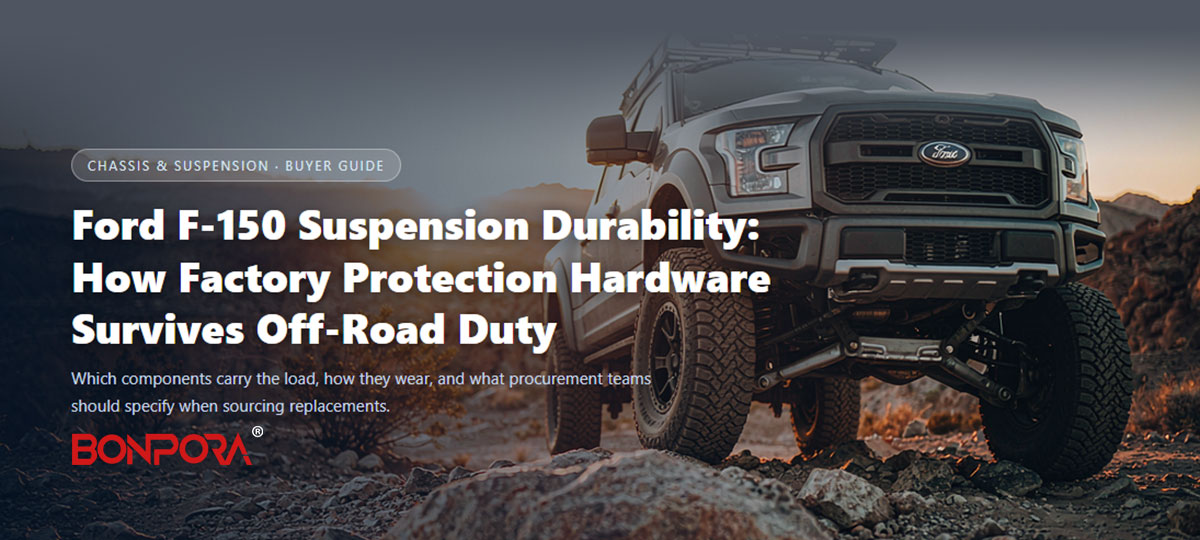
For parts buyers, this is one of the most attractive segments of the pickup market: a huge installed base, a well-documented service pattern, and a replacement cycle driven by real wear rather than cosmetic trends. This guide explains how the 2015-2020 F-150 suspension is built, where the protection actually comes from, which parts wear first, and how to specify replacement and upgraded components with a supplier such as Bonpora Parts.
How the 2015-2020 Front Suspension Is Built
Double-wishbone geometry with coil-over struts
The thirteenth-generation F-150 uses an independent double-wishbone (short-long arm) front suspension. Each corner carries a coil-over strut assembly, a stamped steel lower control arm with two rubber-bushed pivots and a pressed-in lower ball joint, an upper control arm, a cast aluminum steering knuckle, and a stabilizer bar connected through end links. The body panels above this hardware are aluminum alloy, while the ladder frame underneath remains high-strength steel - a combination chosen to cut mass without giving up the structural base the suspension bolts to.
This layout is well suited to a work truck. The two pivot bushings on the lower arm isolate road noise while still controlling fore-aft loads under braking, and the coil-over package keeps the spring and damper working through a compact envelope that leaves room for skid protection underneath.
The protection layer most owners never see
Off-road durability is not only about arms and knuckles. Several quieter components do the protective work:
Jounce bumpers (bump stops). Microcellular urethane cushions inside the suspension travel. When the truck bottoms out after a hard hit, the jounce bumper is the sacrificial component that stops metal-to-metal contact between the arm, the strut and the frame. On the F-150, degraded jounce bumpers are a classic hidden cause of harsh bottoming and clunks.
Shock guards and dust covers. The piston rod of a damper is precision-ground and chrome-plated, and its seal is the life of the shock. A guard or boot that keeps grit off the rod can extend effective damper life substantially on gravel roads.
Skid plates. Off-road packages for the F-150 add steel shields over vulnerable underbody points such as the front differential area, the transfer case on 4WD models and the fuel tank. They do not change suspension geometry - they protect it from direct impact.
Understanding this division of labor matters for buyers: the parts that fail visibly (arms, links) and the parts that fail silently (bump stops, boots) usually wear on different schedules and should be quoted as separate line items.
The Components That Take the Abuse
The table below summarizes the main front suspension and protection components of a 2015-2020 F-150, the duty each one performs, and the first symptom owners typically report when it wears.
| Component | Material / Type | Protective or Structural Duty | Typical Wear Symptom |
|---|---|---|---|
| Lower control arm assembly (incl. FL3Z-3078-A / FL3Z-3079-A type parts) | Stamped steel arm, rubber pivot bushings, pressed-in ball joint | Locates the knuckle, carries braking and cornering loads, isolates road input | Clunking over bumps, steering wander, uneven tire wear |
| Lower ball joint | Forged stud, pressed into the arm | Pivoting connection between arm and aluminum knuckle | Play at the joint, clunks, failed inspection |
| Coil-over strut assembly | Coil spring, twin-tube or monotube damper | Controls spring motion and body roll | Nose dive, floaty ride, oil film on the body |
| Jounce bumper / bump stop | Microcellular (foamed) polyurethane | Final travel limiter; prevents metal-to-metal bottoming | Harsh bottoming, new knocking after hard hits |
| Stabilizer bar link | Steel stud with ball or bushing ends | Links the bar to the arm, limits body roll | Rattle over small bumps, loose front end |
| Shock guard / dust cover | Rubber or polymer boot | Keeps grit and water off the piston rod and seal | Torn boot, then accelerated damper seal wear |
| Pivot bushings | Bonded rubber | Isolate vibration while controlling arm movement | Squeaks, vague steering, clunk on direction change |
What Wear Looks Like on a High-Mileage Truck
Bushing and ball joint symptoms
Most 2015-2020 F-150 trucks enter the suspension-repair window somewhere between 80,000 and 150,000 miles, earlier for trucks that see regular gravel or off-road use. The pattern is consistent: pivot bushings crack and delaminate first, ball joint boots split next, and only then does the arm itself need replacing. Because Ford services the lower arm as a complete assembly - arm, bushings and ball joint together - a worn bushing effectively becomes an arm job, which is why complete assemblies are the standard purchasing unit for this platform.
Bump stops and shock protection
Jounce bumpers fail differently. A microcellular urethane bumper ages through compression set: the open-cell foam structure slowly loses its ability to rebound, and the material may crumble at the surface long before anyone inspects it. A truck with collapsed bumpers still drives acceptably on pavement, which is exactly why the part is so often overlooked until a hard off-road hit produces a metallic bang. Damper protection tells a similar story - a torn dust cover is inexpensive, but the contamination it allows shortens the life of a far more expensive strut.
OEM Replacement or Upgrade: a Buyer Framework
Not every truck needs an upgraded part, and honest suppliers say so. The framework below matches the owning scenario to the sensible purchasing decision.
| Owning Scenario | Sensible Choice | What Changes | Buyer Note |
|---|---|---|---|
| Highway and light-duty use, stock height | OEM-spec replacement assemblies | Restores original ride and handling | Quote complete arms with pre-installed ball joints and bushings |
| Regular gravel or trail use, stock height | OEM arms + quality jounce bumpers and boots | Restores travel protection, protects dampers | Check bump stop condition at every damper change |
| Modestly lifted or heavily loaded trucks | Application-matched polyurethane bump stops, HD links, spec-matched arms | Compensates for reduced up-travel and higher loads | Verify engagement height against the actual lift, not the kit marketing |
| Fleet renewal at scale | Consolidated kits per platform | One SKU set covers both front corners | Agree reference numbers, material grades and sample approval up front |
The common thread is that upgrades should respond to a measured condition - reduced up-travel, added load, documented wear - rather than to catalog marketing. A correctly specified OEM-replacement part almost always outperforms a randomly chosen performance part.
Specification Notes for Lifted and Loaded Trucks
Lift kits deserve a specific warning. Raising the ride height does not add suspension travel; on a leaf-sprung rear axle and a strut-type front end, a typical lift actually reduces up-travel, which means the jounce bumper engages sooner and must absorb more energy per hit. Trucks that keep the original bumpers after a lift commonly report harsher bottoming, not because the lift failed, but because the protective element was never respecified. Buyers sourcing for the aftermarket in this segment should therefore treat bump stop length, material density and engagement height as primary specifications, not accessories.
The same logic applies to polyurethane selection. Polyurethane bump stops resist compression set better than standard foam and hold their rebound characteristics longer under repeated hits, which is why they are the default recommendation for lifted and loaded applications. The trade-off is a firmer engagement, so the density grade should match the vehicle weight class rather than default to the hardest compound on the shelf. Bonpora supplies jounce bumpers and related protection parts in defined material grades and can support custom hardness selection for specific vehicle applications.
Inspection and Service Planning
For fleet operators, suspension failures are cheapest when they are scheduled. A practical service plan for a working F-150 looks like this:
Every oil service: visual check of ball joint boots, dust covers and jounce bumpers for splits or crumbling.
Every 50,000 miles or after a heavy off-road season: measured play check at the ball joints and stabilizer links, bushing condition review, damper leak inspection.
At any strut or arm replacement: replace the associated protection parts (boots, bump stops) at the same time - the labor is already paid for.
Documenting these checks against mileage lets a fleet forecast its suspension parts spend by quarter instead of reacting to roadside failures.
Sourcing Suspension and Protection Parts from Bonpora
Bonpora supplies chassis and suspension components - including control arms, ball joints and links, shock guards, dust covers and off-road protection parts such as jounce and bump stops - to distributors and fleet buyers worldwide. For F-150 platform procurement, the practical workflow is:
Identify by OE reference number. Reference numbers remove almost all fitment ambiguity. Where a superseding number exists (as with the -A to -C revisions on several F-150 arm numbers), the supplier confirms the current valid form.
Confirm material and finish expectations. Bushing compound, bumper density, coating type and hardware grade all affect service life on gravel roads; state them in the RFQ rather than discovering them in the field.
Approve by sample. A first-article sample against the removed OE part settles geometry and engagement questions before volume production.
Plan the kit, not the part. For the F-150 platform, quoting arms, ball joints, links and bump stops as one consolidated kit simplifies both procurement and warehouse handling.
For the broader catalog context, the chassis and suspension section lists the component families relevant to pickup applications.
Frequently Asked Questions
How often should the front suspension of a 2015-2020 F-150 be inspected?
A visual check of boots, bump stops and bushings at every oil service is enough to catch most developing problems. A measured play check at the ball joints and links every 50,000 miles - and after any season of heavy off-road use - will catch the rest before they become safety issues.
Does installing a lift kit change the bump stop requirement?
Yes. A lift reduces up-travel, so the jounce bumper engages earlier and absorbs more energy per hit. Trucks that are lifted without respecifying the bump stops commonly report harsher bottoming. Buyers should match bumper length and density to the actual ride height change.
What causes front-end clunking on a high-mileage F-150?
The most frequent causes, in order, are worn lower control arm pivot bushings, ball joint play, worn stabilizer bar links, loose strut mounts and collapsed jounce bumpers. Because several produce similar sounds, a play measurement rather than a guess prevents parts from being replaced unnecessarily.
Are stamped steel lower arms and aluminum knuckles durable enough off-road?
The design has proven itself across a very large fleet. The arm castings and knuckles are not the usual wear points; the rubber bushings and ball joints are. Maintaining those wear items - and the jounce bumpers that protect the structure from bottoming - is what keeps the layout durable off-road.
How should a distributor specify F-150 suspension parts in volume?
Specify by OE reference number, state the material expectations (bushing compound, bumper density, coating, hardware grade), and request a first-article sample against the removed part. Bonpora supports this workflow with quotation, samples and consolidated platform kits.
- Prev.:How to Audit a Jounce Bumper Supplier: 12 Checkpoints Before the First PO
- Next.:OEM vs Aftermarket Bump Stops: What Changes in the Drawing