
- 1. Why Is a Family Car More Vulnerable to Off-Road Damage?
- 2. The Five Most Damaged Parts in Family Car Off-Road Driving
- 3. Important Limitations of Family Car Off-Road Use
- 4. How to Identify Possible Chassis and Suspension Damage
- 5. How to Reduce Off-Road Damage to a Family Car
- 6. Light Off-Road vs Heavy Off-Road: What Is Practical?
- 7. FAQ
- 7.1. Q1: Can a family car be used for off-road driving?
- 7.2. Q2: What is the most common off-road damage to a family car?
- 7.3. Q3: How can I tell if my shock absorber is damaged after off-road use?
- 7.4. Q4: Should I do four-wheel alignment immediately after off-road damage?
- 7.5. Q5: Can chassis guards protect a family car during off-road use?
- 8. Source Chassis and Suspension Parts from Bonpora
Family Car Off-Road: Which Chassis & Suspension Parts Get Damaged Most?
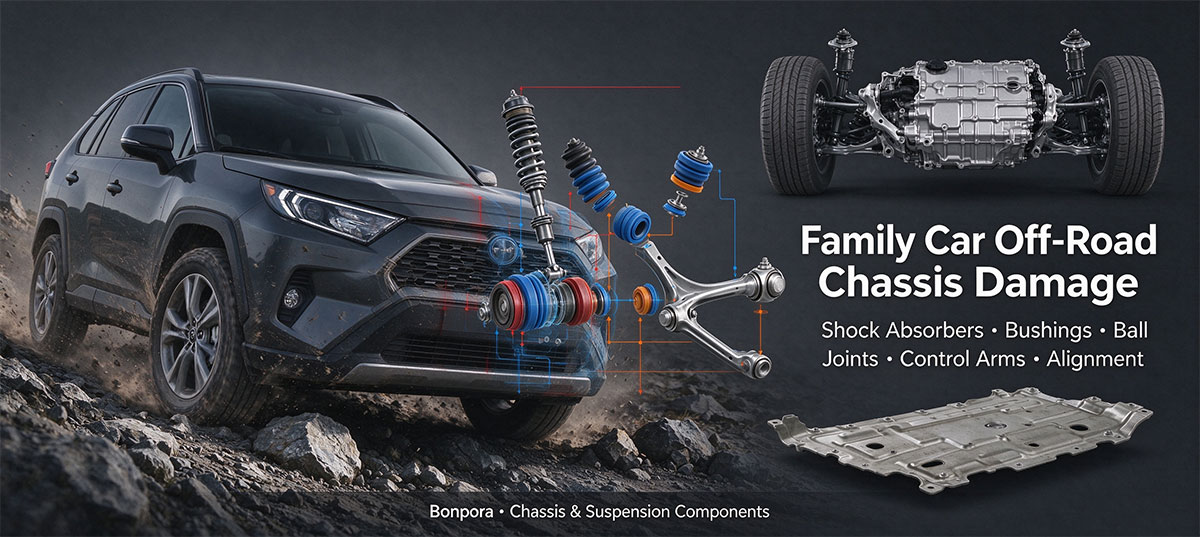
Many family cars are occasionally used on unpaved roads, gravel trails, or light off-road routes. However, a family car chassis and suspension are mainly engineered for paved roads, not for repeated heavy impacts. When a regular passenger car is driven off-road, the parts most affected are usually the shock absorbers, suspension rubber bushings, ball joints, control arms, four-wheel alignment settings, and underbody components such as the oil pan. Understanding these common damage points can help vehicle owners and repair businesses reduce unexpected repair costs and improve safety.
Why Is a Family Car More Vulnerable to Off-Road Damage?
Family cars are typically tuned for comfort, stability, and predictable handling on paved surfaces. Their suspension strength, component durability, and underbody protection are not designed to the same level as hardcore off-road vehicles. Even a single heavy impact may not show obvious damage immediately, but it can create hidden stress that leads to oil leaks, loose parts, incorrect geometry, or premature wear later.
The Five Most Damaged Parts in Family Car Off-Road Driving
1. Shock Absorbers
During off-road driving, wheels frequently compress and rebound over uneven terrain. This rapid movement increases stress on the shock absorber piston rod, seals, and internal components. In heavy or repeated impacts, the instantaneous load on the piston rod can reach several times the normal driving load, increasing the risk of oil seal damage and oil leakage.
Once a shock absorber leaks, the vehicle may experience uneven body height, reduced damping control, excessive body movement over bumps, clunking noises, and unstable handling. In these cases, the shock absorber should be inspected and replaced if necessary.
2. Suspension Rubber Bushings and Ball Joints
Severe impacts and long-term abnormal stress can accelerate aging, cracking, and deformation in suspension rubber bushings. When clearances increase, the chassis may feel loose, and abnormal noises may appear during driving. Ball joints are also critical: excessive wear can affect steering precision, wheel alignment, and overall vehicle stability.
3. Suspension Linkages and Control Arms
When one wheel strikes a pothole, rock, or steep edge, the impact is transferred through the suspension linkage and control arms. This load can bend or deform control arms, lower arms, and related components. If the geometry changes, the vehicle may develop pulling, uneven tire wear, steering wheel offset, or incorrect wheel alignment.
4. Four-Wheel Alignment Parameters
Frequent bottoming or hard single-wheel impacts can disturb suspension geometry. Studies and repair statistics suggest that a significant portion of incorrect four-wheel alignment cases is related to curb strikes, rough road impacts, and off-road-style load conditions. Misaligned geometry can increase tire wear by 50 percent or more in severe cases, while also reducing handling stability.
5. Oil Pan and Underbody Components
Under off-road conditions, the oil pan and chassis components are exposed to direct impact risk. Many aluminum alloy oil pans are only 3–5 millimeters thick, so a hard bottom strike can cause cracking, perforation, and oil leakage. Repair costs can range from moderate to expensive depending on vehicle model and damage level.
Electric vehicles require additional attention. The battery pack and its protective structure are usually located under the vehicle body. Damage to the protective plate may not always show immediate serious issues, but it can create risks to battery cell protection, water intrusion, and structural integrity.
Important Limitations of Family Car Off-Road Use
A family car chassis is not designed for repeated heavy impact. Minor occasional rough-road use may not cause immediate failure, but frequent high-intensity off-road driving increases the probability of shock absorber leakage, bushing degradation, ball joint wear, control arm deformation, and alignment problems. Many of these damages are hidden at first and become noticeable only after they have developed into more serious issues.
How to Identify Possible Chassis and Suspension Damage
Clunking noises over bumps: This may indicate worn shock absorbers, damaged mounts, loose ball joints, or degraded suspension bushings.
Unstable body movement: If the vehicle continues to bounce or sway after passing a bump, shock absorber performance may be weakened.
Steering wheel offset or pulling: These symptoms may suggest deformed suspension components or incorrect wheel alignment.
Uneven tire wear: Irregular wear patterns often indicate alignment issues or suspension geometry problems.
Visible oil leaks: Oil stains around shock absorbers suggest possible seal failure.
Tire sidewall damage: Bulges or cracks on the sidewall may result from hard impacts.
How to Reduce Off-Road Damage to a Family Car
1. Reduce Speed on Rough Terrain
When encountering potholes, speed bumps, rocky sections, or uneven roads, slow down. Passing obstacles at low speed reduces the instantaneous impact force transmitted to the chassis and suspension. Avoid rushing through rough sections.
2. Choose the Best Route
Where possible, plan the route to reduce underbody contact. Try to allow one side of the vehicle to follow higher ground rather than letting the undercarriage strike the center of an obstacle. When climbing or descending steep edges, use careful approach and departure angles to reduce scraping.
3. Add Appropriate Protection
For roads that frequently cause wear or impact, chassis guards can help protect vulnerable components. A properly installed guard may reduce damage to the oil pan, control arm bushings, and related underbody parts during bottoming. Electric vehicle owners should also check battery protection requirements before adding additional guards.
4. Inspect the Chassis Regularly
After off-road driving, especially if the vehicle has been subjected to hard impacts, inspect the shock absorbers, suspension bushings, ball joints, control arms, oil pan, and protective plates. Early detection can prevent minor damage from developing into major repairs.
5. Check Wheel Alignment After Heavy Impact
If the vehicle pulls, the steering wheel is offset, or tire wear has become irregular, check the suspension components first, then perform four-wheel alignment if necessary. Do not perform alignment without checking for bent or worn parts.
Light Off-Road vs Heavy Off-Road: What Is Practical?
For occasional light off-road use, damage can be reduced by choosing thicker sidewall tires with an aspect ratio of 55 or higher, maintaining slow speed, and selecting routes carefully. These habits help reduce impact severity and protect the chassis and suspension.
However, family cars have limits. For frequent or heavy off-road use, a hardcore off-road vehicle with stronger suspension, higher ground clearance, better underbody protection, and more durable components is a more practical choice. Pushing a family car beyond its design limits will accelerate chassis and suspension wear and may lead to early scrapping.
FAQ
Q1: Can a family car be used for off-road driving?
A: It depends on intensity. A family car may handle occasional light unpaved roads, but it is not designed for repeated heavy off-road impacts.
Q2: What is the most common off-road damage to a family car?
A: Shock absorber oil leakage, suspension bushing wear, ball joint wear, control arm deformation, incorrect alignment, and oil pan damage are among the most common issues.
Q3: How can I tell if my shock absorber is damaged after off-road use?
A: Look for oil leaks around the shock absorber, clunking noises over bumps, excessive body movement, unstable handling, or uneven vehicle height.
Q4: Should I do four-wheel alignment immediately after off-road damage?
A: Not immediately without inspection. First check shock absorbers, ball joints, control arms, and bushings for damage, then align if the geometry is incorrect.
Q5: Can chassis guards protect a family car during off-road use?
A: Chassis guards can reduce damage to the oil pan and related components in some bottoming situations, but they do not make a family car equivalent to a hardcore off-road vehicle.
Source Chassis and Suspension Parts from Bonpora
If you are sourcing replacement shock absorbers, suspension bushings, ball joints, control arms, four-wheel alignment service parts, or underbody protection components for family car maintenance and light off-road repair projects, Bonpora can support your procurement with a range of chassis and suspension components. For our full product catalog, visit:
https://www.bonporaparts.com/en/products/
For quotations, sample requests, technical support, or component recommendations, please contact our sales team at sales@bonporaparts.com.
- Prev.:Heavy-Duty PU Bump Stop Kits for Off-Road & Desert Driving
- Next.:How to Audit a Jounce Bumper Supplier: 12 Checkpoints Before the First PO