
- 1. What a bump stop actually does
- 2. Why off-road, heavy-duty and desert driving is harder on them
- 3. Material matters: microcellular polyurethane (MDI / NDI) versus rubber
- 4. What a "heavy-duty kit" means: a system, not a single part
- 5. How to spec the right kit
- 6. Why factory-direct and customization matter
- 7. Request a quote
- 8. FAQ
Heavy-Duty PU Bump Stop Kits for Off-Road & Desert Driving
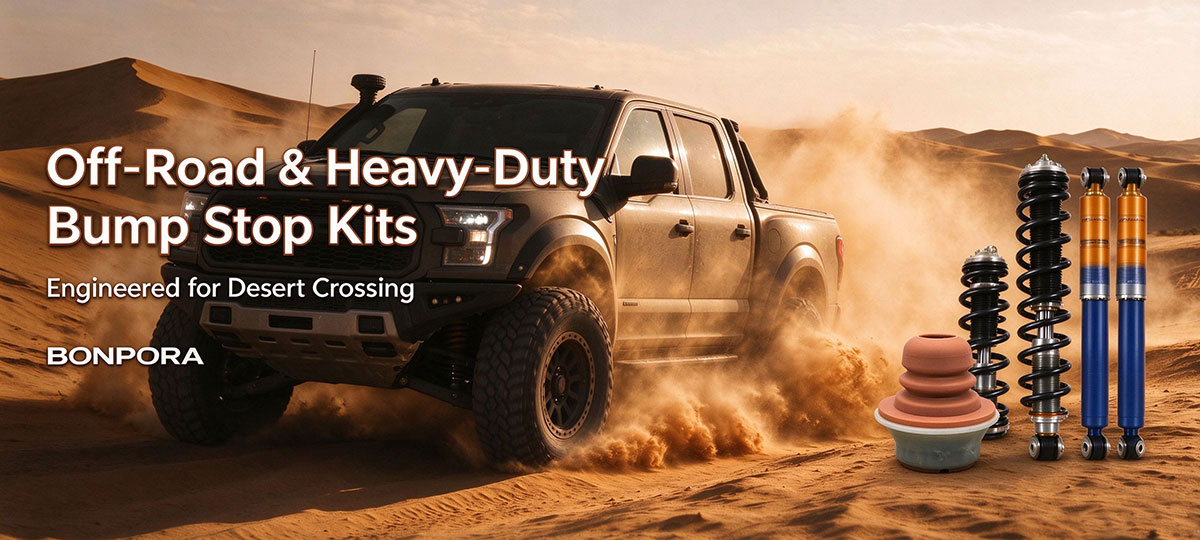
If you run a parts distributor, an off-road shop, or an OE-grade replacement program, the suspension components you stock need to do more than fit. In desert and heavy-duty use, they have to survive sustained heat, deep sand, heavy payloads, and long, punishing suspension strokes. This guide explains how a properly specified polyurethane bump stop kit protects the vehicle — and what to check before you buy.
What a bump stop actually does
A bump stop (also called a jounce bumper or buffer block) is the final-stage cushion in the suspension. When the suspension compresses fully — over a large obstacle, under load, or at speed across open desert — the bump stop absorbs the remaining travel before metal meets metal. It protects the shock absorber, the spring, and the strut mount from hard bottoming-out.
Its job is progressive: it resists gently as the suspension approaches the end of its stroke, then stiffens quickly to absorb impact. Get this wrong and you get harsh top-out, noise, or premature component failure.
Why off-road, heavy-duty and desert driving is harder on them
Three factors accelerate bump stop wear in this use case:
Heat. Sustained high ambient temperatures plus hot desert surface temperatures put continuous thermal load on the compound.
Overload and payload. Loaded trucks and trailers sit closer to the suspension limit more often, so the bump stop is engaged more frequently and more firmly.
Sand and abrasion. Fine sand is abrasive to a degraded rubber surface and accelerates fatigue once a part begins to crack.
In these conditions, a rubber bump stop that serves a passenger car on tarmac is often out of its depth.
Material matters: microcellular polyurethane (MDI / NDI) versus rubber
The material decision is the single biggest factor in durability. Microcellular polyurethane (MCU) is the industry standard for OE jounce bumpers because it delivers a progressive stiffness curve and high energy absorption in a compact part.
MDI systems — the common workhorse grade, offering a strong balance of performance and value.
NDI systems — higher load-bearing and temperature resistance, typically specified for heavier or higher-performance applications.
Rubber — cheaper and adequate for light, low-temperature use, but it tends to take a compression set (lose height over time) and degrade faster under heat and UV.
Bonpora produces bump stops in both MDI and NDI microcellular systems, with a working range of about -40°C to +90°C and a design life of at least 80,000 km or two years under normal use — figures you should ask any supplier to confirm.
What a "heavy-duty kit" means: a system, not a single part
Desert and heavy-duty upgrades rarely stop at one component. A complete kit bundles the parts that share the same service interval and failure mode:
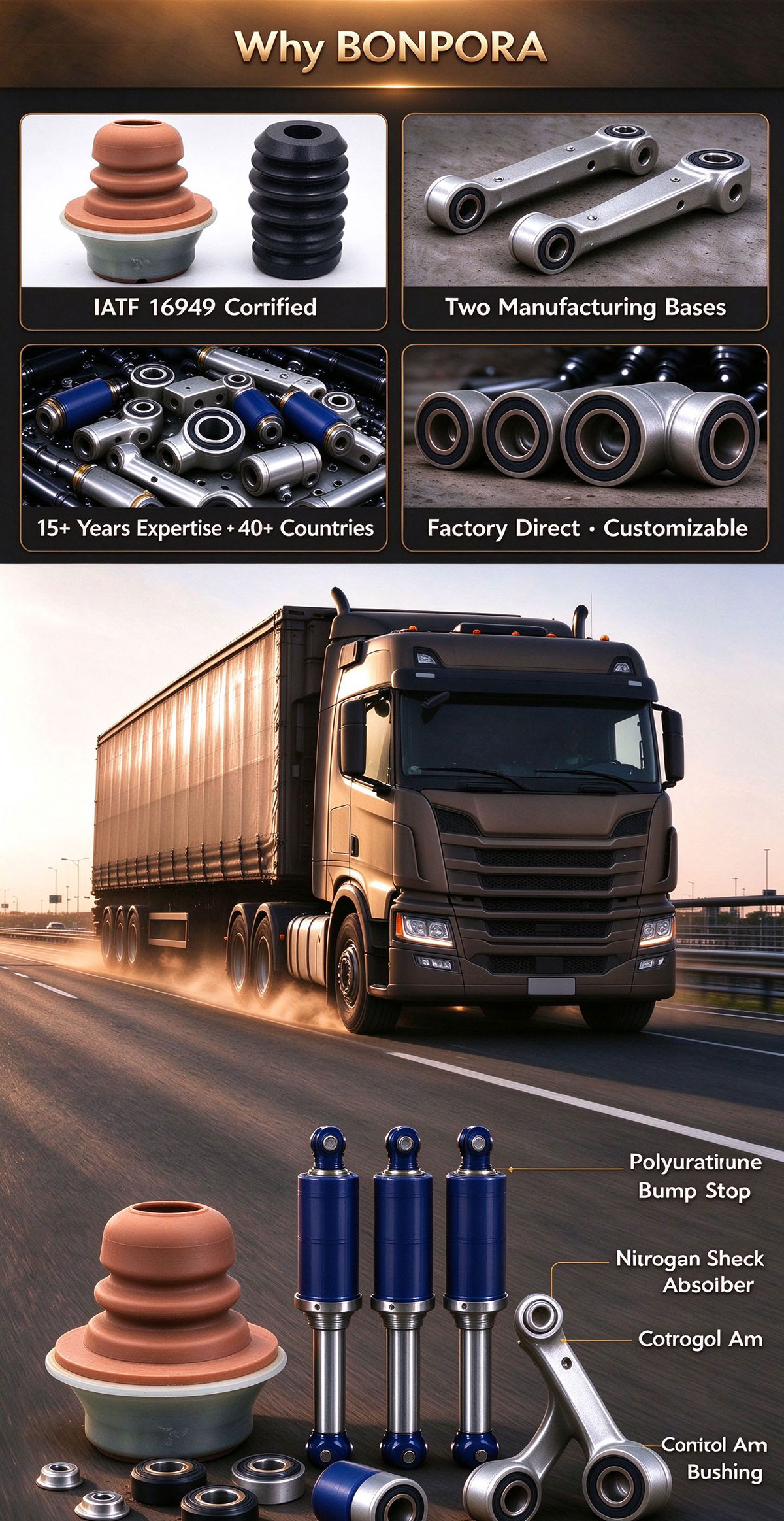
PU buffer block / bump stop — the final-stage cushion
Nitrogen shock absorber — the damping element
Control arm bushing — keeps geometry and noise, vibration and harshness (NVH) in check
Buying as a system gives you matched materials, matched hardness, and a single source for warranty and support. Bonpora supplies this as a one-stop, factory-direct set covering OE, aftermarket, off-road and tuning programs.
How to spec the right kit
When you are specifying, ask for these — not just "a bump stop":
Hardness (Shore A) and the stiffness curve — the progressive rate
Material system (MDI / NDI) and the working temperature range
Compression set and UV / heat resistance data for hot climates
The exact application (make, model, year) or an OE cross-reference
Quality control — is it produced under IATF 16949 with batch inspection?
Suppliers who cannot answer these clearly are usually not doing the engineering.
Why factory-direct and customization matter
For a distributor or a program, OE-grade quality at factory-direct pricing — with the option to customize formula, hardness, color or private label, and a reliable supply chain — decides whether the program is sustainable. Bonpora runs two manufacturing bases (Luoyang and Wuxi), holds IATF 16949 certification, has 15+ years of export experience, and ships to 40+ countries.
Request a quote
Send your OE part number or vehicle details to sales@bonporaparts.com for a quote, samples, or a custom specification. Browse the full line of suspension components here: https://www.bonporaparts.com/en/products/
FAQ
What is the difference between a bump stop and a jounce bumper?
No functional difference — jounce bumper, bump stop, bumper block and buffer block all describe the same end-of-travel cushion; the terms are used interchangeably.How often should bump stops be replaced on an off-road vehicle?
Under normal use, design life is roughly 80,000 km or two years; heavy, loaded, desert use can shorten it. Inspect for cracks, flattening (compression set) and metal-contact noise, and replace as a pair or set.Which is better for desert use — rubber or polyurethane?
Microcellular polyurethane (MDI / NDI) is generally the better choice for heat, load and longevity; rubber suits lighter, cooler applications. Share your application and we can recommend a grade.Can I order with my OEM part number?
Yes. Provide the OE number or vehicle make / model / year and we will match it, including custom hardness or color.What are the MOQ and lead time for wholesale?
They vary by item and quantity — contact sales@bonporaparts.com with your part list for exact figures.
- Prev.:Diagnosing and Replacing Worn Bushings: The Cure for Mystery Creaks and Clunks on High-Mileage Vehicles
- Next.:Family Car Off-Road: Which Chassis & Suspension Parts Get Damaged Most?