
- 1. Why a Bump Stop Range Is a Portfolio, Not a Catalogue
- 2. The Three Inputs Behind Every SKU in a Bump Stop Range
- 3. Building the Range in Three Waves: 40 / 40 / 20
- 4. How to Group OE References Before You Score Them
- 5. A Worked Example: Twelve References and 9,432 USD of Stock
- 6. Where a Bump Stop Range Loses Money
- 7. A Twelve-Point Launch Checklist
- 8. FAQ
- 8.1. How many SKUs should a first bump stop range carry?
- 8.2. Should the range be organised by OE number or by vehicle model?
- 8.3. Is a left and right pair two SKUs?
- 8.4. How do we estimate failure rate with no warranty history?
- 8.5. What does a supplier need in order to quote twelve references at once?
Building a Bump Stop Range: SKU Choice by Vehicle Population
A bump stop range is built backwards from the vehicle population: rank every OE reference by installed population, failure rate and selling price, then buy the top of that list first. Twelve references chosen this way will outsell sixty chosen for catalogue symmetry, because a catalogue describes what can be made, not what a market consumes.
The mistake is easy to make. A factory sends a long list, the shortest route to a "complete range" looks like two cartons of everything, and six months later a third of the lines have never moved twice while the five that carry the workshop are out of stock.
Why a Bump Stop Range Is a Portfolio, Not a Catalogue
The supply side is rarely the constraint. The auto parts catalogue by OE number currently runs to 238 part entries across twelve pages, searchable by car brand or OE number and by vehicle model, and the families behind it stretch from the Volkswagen Group through BMW, Mercedes-Benz, Opel, Volvo, Porsche and Citroën to Honda, Toyota, Lexus, Mazda, Mitsubishi, Chevrolet, Fiat, Jeep and Chrysler, plus BYD, Nissan and the Chinese-market Volkswagen names. A distributor can order from a list that long in one email.
Carrying it is a different decision, because every reference added to a bump stop range spends money twice: once on the first order, and again whenever the forecast behind that order turns out to be wrong. Three costs follow, and only one of them appears on the invoice.
Dead stock. Capital, shelf space and a carrying charge that runs whether or not the part sells.
Stock-out on a mover. Lost margin, and the counter conversation where a workshop is told to come back next week and does not come back at all.
Wrong reference shipped. Return freight, handling and a credit note that costs more to process than the part was worth.
A reference becomes a SKU at the moment it has a position, a quantity and a forecast. Before that it is a part number on a list, and lists are free. That distinction is the discipline: the range is not a subset of the catalogue, it is a set of purchase decisions with dates attached.
The Three Inputs Behind Every SKU in a Bump Stop Range
Three numbers decide whether a reference earns a place, and they multiply rather than add. Population without failure rate produces a shelf of parts that never wear out. Failure rate without population produces a shelf of parts for vehicles that are not on the road. Either one without a margin produces work with no return.
| Input | How to estimate it without buying data | What distorts the estimate |
|---|---|---|
| Installed population | Parc by platform and model year, cross-checked against what workshops see in the bay | Counting model years still inside the dealer warranty window; treating a global parc as a local one |
| Failure rate | Warranty returns per 1,000 units, replacement ratio at the counter, roadworthiness inspection failures | Parts replaced in pairs or with the strut inflate the count; climate and road surface move the rate by market |
| Price and margin | Your landed cost against the local shelf price band for the same fitment | Comparing landed cost with a competitor's retail price; leaving freight, duty and returns out of the cost |
Population is a filter, not a ranking. A platform that sold well for four years and then stopped still has a parc, and that parc is now entirely out of warranty, which is when bump stops start being replaced. A platform that sold well last year has a parc too, but most of it is still inside the dealer network.
Failure rate has to be read against the service life the part was designed for. The specification published for the Bonpora jounce bumper states a design life of at least 80,000 km or 2 years under normal use, and the typical warranty in this category runs 1 to 2 years or 50,000 to 100,000 km with the exact term confirmed per order. Those two numbers set the window in which a failure becomes a claim.
Margin is the multiplier that decides what a mistake costs. A reference with a wide population and a thin margin ranks below a mid-volume reference that fails twice as often at a normal margin. The arithmetic is not subtle, but it is skipped constantly, because population is the easiest of the three to look up.
Where the margin side needs a base, the bump stop cost breakdown by volume sets out how material, moulding and tooling amortisation move between a 5,000 and a 100,000 piece order, which is the same curve that decides whether a slow line is worth holding at all.
Building the Range in Three Waves: 40 / 40 / 20
A range bought in one pass is a range bought evenly, and even buying is the wrong shape for a market where a few references carry most of the demand. Three waves keep the ranking honest and put a different stock rule behind each group.
| Wave | Share of SKUs | Share of forecast units | Stock rule | What earns a place |
|---|---|---|---|---|
| Core | 40% | 60% | Stocked, three months of cover | Top of the ranking, used in at least two positions |
| Coverage | 40% | 30% | Stocked, three months of cover | Completes a platform family for a whole repair |
| Specialist | 20% | 10% | To order against enquiry | Legacy platforms, premium niche, low repeat rate |
The core wave exists to protect the counter. These are the references where a stock-out is visible the same day and where the workshop's decision to call you next time is made. Three months of cover is not optimism; it is roughly the shortest cycle in which a replacement order can arrive and clear, given the 15 to 30 day delivery window published on the product records.
The coverage wave is where ranges are won or wasted. Its job is not volume but the second line on a quotation: a workshop replacing a front strut often wants the dust cover and spring seat at the same time, and the parts catalogue groups those lines under shock absorber parts for that reason. A coverage SKU that never appears on the same order as a core SKU is not coverage, it is inventory.
The specialist wave should mostly not be stocked. Legacy references and premium niche fitments have real demand, but it arrives as single enquiries, and holding three months of a reference that sells forty pieces a year funds someone else's convenience. The catalogue separates jounce bumpers into On-Road, Off-Road and Commercial lines, and for most distributors the off-road and commercial lines belong here: quoted from stock when available, ordered against the enquiry when not.
How to Group OE References Before You Score Them
Scoring is only as good as the list it runs on, and the list a bump stop range is built from is usually wrong in the same three ways.
One number is one SKU, even when it serves four brands. A single reference in the Volkswagen Group family is commonly listed across Volkswagen, Audi, Skoda and Seat applications. Built by brand label, the same physical part is forecast four times and bought four times, and the resulting overstock looks like popularity.
Position and quantity per vehicle belong in the unit forecast. A bump stop is fitted on each strut, so a front axle repair consumes two pieces and a four corner job consumes four. Demand estimated per vehicle rather than per piece understates the buy.
A near miss is not a supersession. European references usually encode the platform in the leading characters and the variant in the trailing ones; Japanese references use a group and a dash, with a suffix that changes by model year; North American references are often short numeric strings where one digit separates two profiles. Group by the complete number, and treat a supersession as a documented fact from the supplier.
The reference families published for the Bonpora jounce bumper range show the shape of the problem: four brand families, roughly forty references, and not one of them safely interchangeable with its neighbour on appearance alone.
A Worked Example: Twelve References and 9,432 USD of Stock
Take a distributor with a European and Asian mix, 24,000 pieces of annual demand across twelve references, and a landed cost between 1.45 and 1.90 USD a piece. The figures are an illustrative model built to show the arithmetic, not a quotation or a market forecast.
Score each reference on four criteria before ranking it. These weights suit a distributor that holds stock; a fleet with its own workshops would move weight from margin to population.
| Criterion | Weight | Score 5 | Score 3 | Score 1 | Source |
|---|---|---|---|---|---|
| Population index | 40 | Platform common in the 6 to 12 year band | Mid-size parc, mixed age | Legacy or niche parc | Parc data, workshop observation |
| Failure index | 30 | Replaced routinely with the strut | Replaced on inspection | Rarely replaced | Counter history, warranty returns |
| Margin index | 20 | Normal margin at shelf price | Thin but workable | Below the cost of carrying | Landed cost against shelf price |
| Sourcing risk | 10 | Two positions, stable reference | Single position, current | Single position, supersession risk | Supplier reference data |
Ranked on that basis, the twelve references fall into the three waves:
| Rank | Reference | Position listed on the site | Units a year | Landed cost | Wave | First order |
|---|---|---|---|---|---|---|
| 1 | 8K0412131F | Front, Audi A4 / A5 / A6 / A7 | 3,200 | 1.90 | Core | 800 |
| 2 | 3C0511359A | Rear, Passat B6 / B7 / B8, Sharan | 3,000 | 1.85 | Core | 750 |
| 3 | 5Q0511357M | Rear, Golf VI and MQB models | 2,900 | 1.80 | Core | 725 |
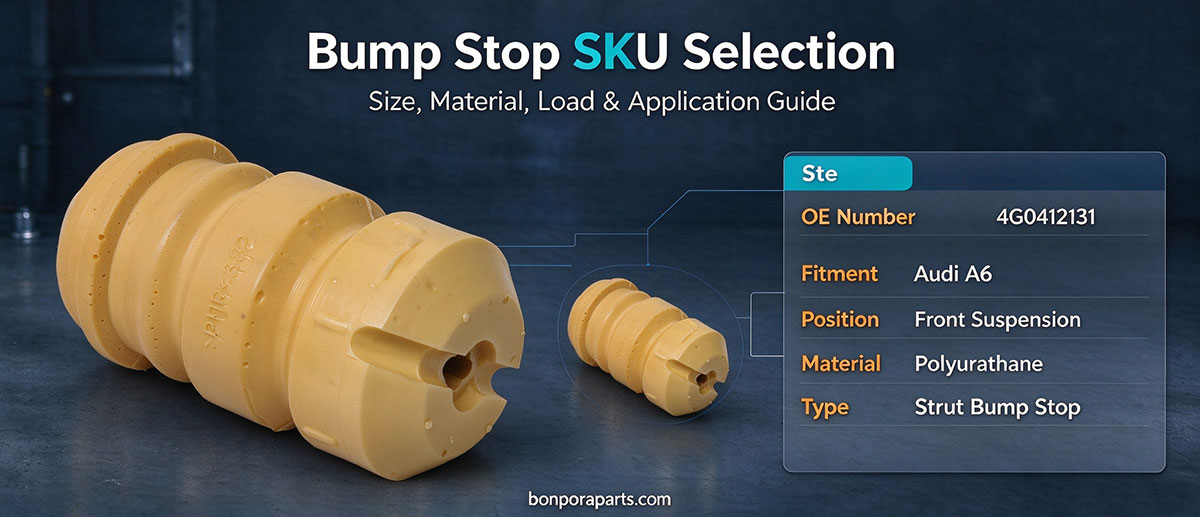
| 4 | 4G0412131 | Front, Audi A6 C7, A7, Q5, Q8 | 2,700 | 1.75 | Core | 675 |
| 5 | 8J0511353F | Rear, Audi TT 8J, A3 8P | 2,600 | 1.85 | Core | 650 |
| 6 | 5N0511359B | Rear, Tiguan 5N | 1,700 | 1.65 | Coverage | 425 |
| 7 | 5Q0511357P | Rear, Golf, Jetta, Leon | 1,600 | 1.60 | Coverage | 400 |
| 8 | 3C0412303C | Front, Volkswagen and SEAT | 1,500 | 1.55 | Coverage | 375 |
| 9 | 2K0511153B | Rear, Caddy 2K | 1,300 | 1.50 | Coverage | 325 |
| 10 | 2Q0511351B | Rear, Polo, T-Cross | 1,100 | 1.55 | Coverage | 275 |
| 11 | 8D0412131E | Front, Audi A4 B5, Passat B5 | 1,400 | 1.45 | Specialist | To order |
| 12 | 4M0512131 | Rear, Audi Q7, Q8 | 1,000 | 1.45 | Specialist | To order |
The capital arithmetic is what changes behaviour. Twelve references at 24,000 pieces a year is 41,210 USD of annual purchase; the first order in this shape is 5,400 pieces and 9,432 USD of stock, turning 4.4 times a year. Core takes 26,385 USD of the annual spend and 6,597 USD of opening stock, coverage 11,345 and 2,836, and the two specialists 3,480 and nothing.
Now run the same 9,432 USD through an even split, which is what a range bought without a ranking becomes. Each reference gets 786 USD. On the fastest one that buys 414 pieces, about seven weeks of cover at 267 pieces a month, so the line runs dry inside the first quarter. On the two specialists it buys 542 pieces each, close to five months of a reference that was meant to be ordered against enquiry, and 1,572 USD sits in lines that were never meant to be stocked, costing roughly 393 USD a year in carrying charges at a 25% planning rate.
Put a margin figure on the stock-out and the comparison stops being abstract. At a 1.00 USD contribution per piece, a three week gap on a core reference forgoes about 200 USD; five core references with two gaps a year is 2,000 USD, more than twice the annual cost of the stock the even split tied up in the wrong place. Same money, different shape.
If the scoring needs a specification baseline before the numbers mean anything, request a specification sheet or a sample for the references at the top of the list and check dimensions, hardness and stiffness curve against the part coming off the vehicle.
Where a Bump Stop Range Loses Money
The ranking is half of the discipline. The other half is refusing four habits that quietly rebuild the even split.
Buying the tail first. A range that starts with legacy and niche references looks broad in a catalogue and empty at the counter.
Counting brand labels as demand. One reference under four brands is one SKU. Scoring it four times overbuys the strongest line.
Treating a kit as a SKU. A bump stop and dust cover sold together is a sales unit, not an inventory unit; stocking it both ways funds the same demand twice.
Ignoring the compound variant. A second hardness for the same fitment can be a legitimate SKU for a hot or cold market, and a duplicate that halves the turn rate of both lines.
A fifth failure is not a habit but a reading error: treating a low price as a low cost. A reference bought at 1.45 instead of 1.75 saves 0.30 a piece, and if it fails earlier than the specification allows, the claim, the freight and the counter time are charged to the account that booked the saving. That break-even is closer than the quotation suggests, which is why the failure index carries 30 points rather than sitting outside the score as a comment.
A Twelve-Point Launch Checklist
Fix the unit of analysis: one OE reference equals one SKU, however many brand labels list it.
Convert demand from vehicles to pieces, using the quantity fitted per axle and per vehicle.
Build the parc list by platform and model year, marking the years still inside dealer warranty.
Attach a failure estimate from counter history or warranty returns, and state the source beside the number.
Attach a landed cost including freight, duty and an allowance for returns.
Score all four criteria, with the weights written down before the first reference is scored.
Rank, then cut the list at the number of SKUs the working capital can carry at four turns.
Assign each survivor to a wave, and give the specialist wave a to-order rule rather than a stock level.
Set the opening order at three months of cover for core and coverage, and zero for specialists.
Confirm the supplier reference, dimensions and compound for every line before the purchase order.
Agree the reorder trigger in units, not in weeks, so a forecast change cannot silently extend cover.
Review the ranking after two quarters against actual issues, moving at most two references between waves.
FAQ
How many SKUs should a first bump stop range carry?
Twelve to twenty is workable for a distributor serving one or two brand families, because that is roughly what four turns of working capital supports at three months of cover. A range that begins at sixty usually begins with a third of them never turning.
Should the range be organised by OE number or by vehicle model?
Both, in that order. OE number is the purchasing key, because it ties the part to a platform and a position. Vehicle model is the selling key, because that is how a workshop asks for the part. A range searchable both ways is a range that gets reordered.
Is a left and right pair two SKUs?
Usually not. Many bump stops use one reference for both sides, so the pair is a quantity of two rather than two lines. Where a platform genuinely uses different front and rear references, those are two SKUs, and each should be estimated from the axle it serves.
How do we estimate failure rate with no warranty history?
Start with the replacement ratio a workshop reports: how often the part is changed when the strut is off the vehicle. Two or three workshops on the same platform converge on a usable number within a season. Replace the estimate with your own returns data after two quarters.
What does a supplier need in order to quote twelve references at once?
The complete OE number for each line, quantity per reference, target market and packaging requirement, since neutral export packaging is the default on the product records and private labelling is a separate approval. A supplier that confirms dimensions and compound per reference shortens the comparison more than a lower price does.
A bump stop range is a forecast you can walk around. Twelve references, four criteria, three waves and a reorder trigger in units will beat a longer list bought evenly, because the longer list is not a range at all, it is a catalogue with a purchase order attached.
Request a quotation with your reference list, annual quantities and target market, and the reply can be structured line by line against the ranking you have already built.
- Prev.:Steel Shims: Size Chart, Materials and Applications for Bike, Motorcycle, Passenger Car, Off-Highway and 4x4
- Next.:...