
- 1. What a Bump Stop Cost Is Made Of
- 2. The Five Pools, and What Actually Moves Each One
- 3. A Worked Model at 5,000, 20,000 and 100,000 Pieces
- 4. Why Bump Stop Cost Falls With Volume, and Where It Stops Falling
- 5. Freight and the Landed Cost Line Buyers Underestimate
- 6. Where the Money Actually Is: Eight Moves in Order
- 7. The Bump Stop Cost Sheet to Send With Every RFQ
- 8. FAQ
- 8.1. Why is the 5,000 piece price nearly double the 100,000 piece price for the same part?
- 8.2. Should we pay for tooling separately or accept a higher unit price?
- 8.3. Does a softer compound make the part cheaper?
- 8.4. How do we compare a CIF quotation with an FOB quotation on a light part?
- 8.5. Where does packaging cost actually sit, and when is a printed box worth it?
Bump Stop Cost Breakdown: Material, Mould, Tooling, Freight
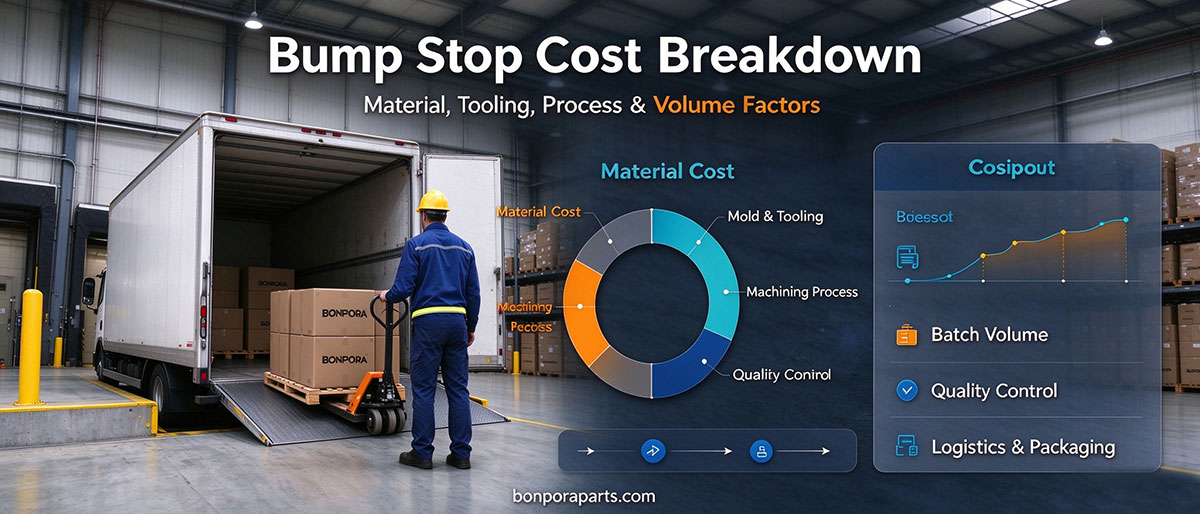
A bump stop cost is not one number. It is a compound line, a moulding line, an insert line, a tooling line that disappears as volume rises, and a freight line that depends on how well a carton fills a container. Buyers who compare only the unit price on the quotation usually compare two different volumes without knowing it.
What a Bump Stop Cost Is Made Of
A cast polyurethane bump stop leaves a factory with five costs attached to it, and only one of them behaves like a material cost.
Compound. The isocyanate and polyol system, plus colour, release agent and any additive package, consumed per shot including sprue and scrap.
Moulding. Machine time, energy, operator time, demoulding, deflashing and trimming to height.
Insert. Where the drawing calls for a stamped plate, washer or sleeve, the metal part and its surface treatment.
Tooling. The mould and its fixtures, recovered either as a separate invoice or inside the unit price.
Packaging and freight. Unit pack, master carton, pallet, and the space the part occupies from the factory door to your warehouse.
The first two scale with the part. The third is a purchased item. The fourth scales with the order, not the part, which is why the same bumper can be quoted at one figure for a trial order and at less than half that figure for a programme. The fifth is decided by geometry and packing discipline rather than by any factory rate. A quotation with a single unit price has compressed all five into one number, and an unreadable quotation cannot be compared with a second one.
The Five Pools, and What Actually Moves Each One
Compound: the system decides the rate, the weight decides the bill
Two decisions sit behind the compound line: which polyurethane system the drawing names, and how much material each shot consumes.
The Bonpora jounce bumper range is described on the site as high elasticity polyurethane in MDI or NDI systems. MDI covers the majority of passenger car positions with a balance of resilience and cost. NDI is chosen where higher resilience and better retention of properties under repeated cycling and heat are required, and the trade-off the site states is a higher material cost and a more demanding casting process. In a cost model both lines move at once: the compound rate rises, and the moulding line follows, because a tighter process window costs cycle time and scrap.
Weight is the second lever, and it is the one buyers can influence. A 120 g finished bumper is not a 120 g shot: sprue and start-up scrap are paid for at compound price and thrown away, so the ratio between shot weight and part weight belongs in the cost discussion.
Moulding: cycle time, cavity count and the trimming operation
Moulding cost is not an overhead spread over parts. It is the time a mould spends closed plus the time a part spends being finished, multiplied by the cost of the cell.
Cavity count. Four cavities at a twelve minute cycle produce one part every three minutes. One cavity produces one part every twelve from the same machine.
Cycle time. Set by wall thickness, mould temperature and cure. A shortened cure shows up later as compression set, so it is not a free saving.
Trimming to height. A part trimmed short produces a stiffness curve that rises early, so trimming is a quality operation with a cost, not a cosmetic one.
Scrap and start-up. Every production start consumes first-off parts for appearance, dimension and hardness checks.
Insert: a purchased part inside your part
Where a stamped insert is specified, its cost behaves like any bought-in component: material grade, thickness, coating and stamping volume. Ask for the insert specification separately, because it is the one line a supplier can change without touching the polyurethane.
Tooling: the line that is really a deposit
Tooling is quoted as one figure, and inside it sit cavity count, mould material, core and bore design, profile complexity, trial shots and first-article measurement. The site's wholesale guide notes that a new profile is quoted with tooling and a first order that covers setup, while an existing profile is quoted at carton or pallet quantities. The mechanics of how MOQ and tooling are quoted are worth reading before the first comparison, because a quotation that quotes volume and a quotation that quotes a project are not the same document. The mould does not become cheaper for a small order; it is simply divided by fewer parts.
Packaging and freight: a light part is a volume problem
Because a bumper is light, freight is usually volume limited rather than weight limited, a point the site makes in its packaging guidance. A carton that holds more parts without crushing the profile is a freight saving, not a packaging preference, and a carton packed loose is a permanent tax on every shipment.
| Cost pool | What drives it | Falls with volume | Question to ask before quoting |
|---|---|---|---|
| Compound | System (MDI / NDI), shot weight, scrap ratio | Marginally, through less start-up scrap | Shot weight against part weight, and scrap allowance |
| Moulding | Cavity count, cycle time, trimming, cell rate | Yes, up to the cavity and cycle limit | Cavities, cycle, and the cell rate used |
| Insert | Metal grade, thickness, coating, stamping volume | Yes, but slowly | Is the insert quoted to a drawing, and is the coating named |
| Tooling | Cavities, mould material, core design, trial shots | Sharply, because it is divided by volume | What the mould price includes, and who owns the tool |
| Packaging | Unit pack, carton strength, pallet pattern | Yes, through carton engineering | Parts per carton, and carton cube |
| Freight | Cartons per container, mode, incoterm | Sharply, through container fill | Is freight quoted per carton or per shipment |
A Worked Model at 5,000, 20,000 and 100,000 Pieces
The model below is a teaching example of how a bump stop cost is assembled, not a Bonpora price list. It uses one MDI profile with a stamped insert, a four-cavity mould at USD 9,000, a 120 g part, a 135 g shot, a cell rate of about USD 10.5 per hour and sea freight to a European port. Change an assumption and the shares change; the order of magnitude does not.
| Cost line, illustrative model (USD per piece) | 5,000 pcs | 20,000 pcs | 100,000 pcs |
|---|---|---|---|
| Compound, 135 g shot at 5.8 per kg | 0.78 | 0.78 | 0.78 |
| Moulding: machine, energy, operator, trim | 0.52 | 0.46 | 0.42 |
| Stamped insert | 0.14 | 0.14 | 0.14 |
| Packaging | 0.09 | 0.08 | 0.07 |
| Tooling amortisation, 9,000 divided by volume | 1.80 | 0.45 | 0.09 |
| Freight, sea to a European port | 0.14 | 0.10 | 0.04 |
| Unit cost, excluding duty and clearance | 3.47 | 2.01 | 1.54 |
| Compound share of unit cost | 22% | 39% | 51% |
Two patterns in that table pull in opposite directions.
First, the compound share of bump stop cost moves from about a fifth to about half of the unit price without the compound price changing at all. Nothing about the material improved; the other lines shrank around it. On a 20,000 piece run the compound sits near 39 percent, which is where the 35 to 45 percent band quoted in trade discussions of cast polyurethane parts comes from. That band describes a mature order rather than a property of the material, so a buyer who checks a small-order quotation against it will conclude, wrongly, that the compound is overpriced.
Second, the order value rises as the unit price falls, from about USD 17,350 at 5,000 pieces to 154,000 at 100,000, which is why a trial order is a poor place to test a supplier's pricing.
If you need the compound and stiffness figures for your own application, request the specification sheet or a sample against your drawing rather than working from generic values.
Why Bump Stop Cost Falls With Volume, and Where It Stops Falling
Tooling amortisation is simple arithmetic, and it is the only line in the model that a buyer can restructure by choosing a different commercial route.
A buyer-owned tool at USD 9,000 with a unit price of 2.01 has a total cost of 9,000 plus 2.01 multiplied by the quantity. A supplier-owned tool with no tooling invoice and a unit price of 2.43 costs 2.43 multiplied by the quantity. The two routes cross where 9,000 equals 0.42 multiplied by the quantity, about 21,400 pieces. Below that volume the supplier-owned route is cheaper in total; above it, the paid tool wins by a margin that grows with every order. At 1,500 pieces a month the crossing point is roughly fourteen months of demand, which is a more useful way to present the decision than a tooling price on its own.
The site's wholesale guide sets out the same logic in procurement terms: existing profiles are quoted at carton or pallet quantities, while a new profile carries tooling and a first order that covers setup.
Where the curve flattens is equally important:
Compound batch minimum. A non-standard hardness, a colour or a flame-retardant grade usually forces a full compound batch even on a small order. That cost does not vanish when the quotation omits it; it moves into the unit price or appears as a setup line.
Cavity and cycle limit. Once the mould runs at its designed cavity count and cure time, extra volume buys scheduling convenience, not a lower moulding rate.
Inspection load. Per-batch stiffness curve and compression set testing is a fixed sample cost per lot, which is why a supplier may resist splitting one order into four deliveries.
Freight and the Landed Cost Line Buyers Underestimate
On a light part, freight behaves unlike every other cost in the model: it is bought in cubic metres, and the rate per cubic metre improves in steps rather than gradually.
Take a master carton of 100 pieces at 0.058 m³. A 5,000 piece order is 50 cartons, about 2.9 m³, which ships as LCL with a minimum charge and fixed documentation and consolidation fees. At USD 130 per cubic metre plus USD 300 of fixed charges, the shipment costs about USD 677 and the freight line is roughly 0.14 per piece. At 20,000 pieces the same maths gives 11.6 m³, about 1,808 plus 300, or 0.10 per piece. At 100,000 pieces the volume reaches 58 m³, a full container becomes possible at around 2,700, and the line falls to about 0.04. The lesson: the freight inside a small-order bump stop cost is mostly fixed charges, and no unit-price negotiation removes them.
Landed cost is where the five pools finally meet:
Landed cost per piece = unit price + (tooling divided by quantity) + packaging + freight + duty and clearance + claim provision
The claim provision is the line most often left out and the one that decides whether a low quote was actually low. A bumper is fitted inside a strut, so a failure is paid for in labour. At a workshop rate of USD 65 per hour and 1.2 hours to strip and refit a strut, one failure costs about 78 in labour before the part is counted. One hundred failures across a 5,000 piece shipment come to roughly 8,100, which is close to the entire tooling bill for the programme. A supplier who is 15 percent cheaper per piece and twice as likely to generate a claim is not cheaper.
Where the Money Actually Is: Eight Moves in Order
Most bump stop cost programmes start with the unit price because it is the only number on the page. These eight moves are ordered by how much they return for the effort, and the first four ask the supplier to concede nothing.
Fix the drawing before the quote. Material system, hardness and free height with tolerances, bore, insert specification, target stiffness curve. An incomplete drawing produces a padded price, because the supplier prices the uncertainty.
Consolidate references onto one profile. Where two part numbers differ only in catalogue history, one verified profile can serve both. That cuts tooling, batch minimums and stock, and it is the pattern the whole Bonpora on-road range is built around.
Relax tolerances no function depends on. A tolerance on a non-seating surface that forces an extra trimming pass is a purchased habit. Removing it is free; removing one that sets the stiffness curve is not.
Engineer the carton. Parts per carton and carton cube decide the freight line on a light part. It is the lowest-cost saving available and the least often attempted.
Specify the compound system the application needs, not the one above it. MDI covers the majority of passenger car positions. NDI belongs where the drawing requires it, and paying for it elsewhere raises both the material and the moulding line.
Place the tooling decision correctly against 21,400 pieces. Below the crossing point, keep the capital and accept the supplier-owned tool. Above it, buy the tool and take the lower unit price for the life of the part.
Ship full containers. Consolidating references into one shipment turns LCL fixed charges into container fill, which changes the freight line by a factor rather than a percentage.
Fund the first article properly. A measured first article that includes the stiffness curve prevents the expensive outcome in this category: a tool correct in every dimension except the one that decides how the car feels.
The Bump Stop Cost Sheet to Send With Every RFQ
The table below is the hard asset of this article: a cost sheet that can be copied into a spreadsheet and sent with the drawing, so that three suppliers fill the same cells rather than three different ones.
| # | Field | Unit | Supplied by | Notes |
|---|---|---|---|---|
| 1 | Drawing revision quoted | text | Buyer | A price against a superseded drawing is not a price |
| 2 | Material system | MDI / NDI | Buyer | Named on the drawing, not agreed verbally |
| 3 | Shot weight / part weight | g | Supplier | The ratio is the scrap you pay for |
| 4 | Compound rate assumed | USD/kg | Supplier | Ask whether colour and additive are included |
| 5 | Cavity count | pcs | Supplier | Sets the tool price and the cycle |
| 6 | Cycle time | min | Supplier | Compare with the cure needed for compression set |
| 7 | Cell rate used for moulding | USD/h | Supplier | Makes two moulding lines comparable |
| 8 | Insert specification and cost | USD/pc | Supplier | Grade, thickness, coating named |
| 9 | Tooling: total, items included, owner | USD | Supplier | Ownership in writing, tool marked |
| 10 | First order quantity, new profile | pcs | Supplier | Separate from the carton quantity |
| 11 | Carton quantity and carton cube | pcs / m³ | Supplier | Drives the freight line |
| 12 | Unit pack and print setup | USD | Supplier | One-off cost per artwork |
| 13 | Freight per carton, by mode | USD | Supplier | Per carton is comparable, per shipment is not |
| 14 | Duty classification stated | code | Supplier | Confirm with your own broker as well |
Send it with the RFQ and ask for the sheet back with the quotation. A supplier who fills all fourteen rows has a process; one who returns a unit price and a lead time has given you a starting position, not a cost.
If you would rather start from your own drawing, request a quotation with the reference numbers, the annual quantity and the critical dimensions marked, and the response can be structured along the same lines as the sheet above.
FAQ
Why is the 5,000 piece price nearly double the 100,000 piece price for the same part?
Because the tooling line is divided by volume. In the model above, a USD 9,000 mould is 1.80 per piece at 5,000 and 0.09 at 100,000. Freight compounds the effect, since a small order ships as LCL with a minimum charge while a large one fills a container.
Should we pay for tooling separately or accept a higher unit price?
Compare the total, not the unit price. If the supplier-owned route is 0.42 per piece more expensive, a 9,000 tool pays for itself at about 21,400 pieces. Below that volume the higher unit price is the cheaper route; above it, buy the tool and keep the ownership document.
Does a softer compound make the part cheaper?
Rarely in the way buyers expect. Cost follows the system and the shot weight more than the hardness number, and a softer compound usually needs a different profile to deliver the same stiffness curve, which means a new tool or a re-cut one. A hardness change is a design change with a validation cost attached.
How do we compare a CIF quotation with an FOB quotation on a light part?
Add the freight and the clearance to the FOB price before comparing, and do it at the same quantity and carton specification. On a light part the difference between the two terms is mostly fixed charges at low volume and container fill at high volume, so a CIF price on 5,000 pieces and an FOB price on 100,000 pieces are not two prices for the same thing.
Where does packaging cost actually sit, and when is a printed box worth it?
Packaging is a small line per piece and a large line per container. A printed unit box adds a print setup per artwork and usually a minimum print run, so it pays where the box carries a brand that supports the price. For a distributor range, a neutral poly bag with a clear reference label and a strong master carton is often the lower total cost, because the saving lands in freight.
- Prev.:IATF 16949 vs ISO 9001: What Buyers Actually Verify
- Next.:304 Stainless Steel Serrated Lock Washer Internal External Tooth for Automotive Earthing Anti Loosening