
- 1. Why One Jounce Bumper MOQ Figure Is Never Enough
- 2. What Drives Tooling Cost on a Cast Polyurethane Bump Stop
- 3. Tooling Ownership: Four Structures and What Each One Costs You
- 4. Five Segments Inside a Quoted Lead Time
- 5. Why a 30-Day Quote Costs More Than a 60-Day Quote
- 6. Air or Sea: The Crossover for a Light, Bulky Part
- 7. First-Order Landed Cost: A Jounce Bumper MOQ Worksheet
- 8. FAQ
Jounce Bumper MOQ, Tooling Cost and Lead Time: What a Chinese Factory Quote Really Contains
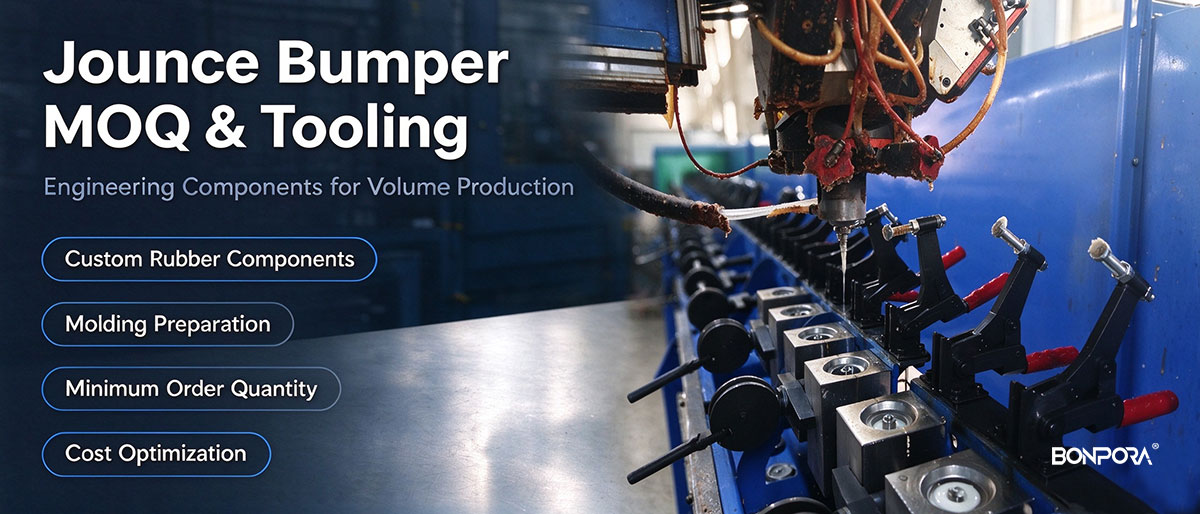
A jounce bumper MOQ is three numbers, not one: the carton quantity for a profile already tooled, the first-order quantity that covers setup for a new profile, and the compound batch size under both. Tooling cost and lead time follow whichever you ask about, which is why two quotes for the same part can land far apart.
Most buyers get one integer next to the word MOQ and compare unit prices. The tooling invoice, the trial-shot charge and the gap between a 30-day and a 60-day schedule then arrive as separate conversations.
This guide reads a jounce bumper MOQ quotation the way a factory builds it: what each figure covers, what a mould costs and why, who should own it, how a lead time decomposes, and what a first order lands at. Figures below are illustrative models, not a price list.
Why One Jounce Bumper MOQ Figure Is Never Enough
A jounce bumper is an elastic component cast from high elasticity polyurethane in an MDI or NDI system and fitted on the shock absorber piston rod, where it provides progressive auxiliary stiffness at the end of the compression stroke. It is a spring element rather than a cushion, and it is inspected as one: static stiffness curve, compression set, hardness and appearance under an IATF 16949 quality system.
That route is why a single figure cannot be honest. A profile with a mould on the rack is a picking operation. A profile with no mould is a development project that happens to end in a shipment. Both get quoted as "MOQ".
The distinction is stated in the wholesale guide for this range: existing profiles are usually quoted at carton or pallet quantities, while a new profile is quoted with tooling and a first order that covers the setup.
| What the number refers to | Usual basis | What sets the figure | How to ask for it |
|---|---|---|---|
| Existing profile, mould in place | Cartons or pallets | Pack quantity, minimum carton count, whether references can be consolidated | "What is the minimum in cartons, and can it ship mixed with other references?" |
| New profile, mould to be made | First order covering setup | Cavity count, trial shots, first-article measurement, material kit size | "What first-order quantity does the setup need, quoted separately from tooling?" |
| Compound batch | Kit or drum of isocyanate and polyol | The casting system's batch size, plus any colour or hardness change | "What is the smallest batch for this hardness, and what does a part-batch cost?" |
The third line is the one buyers forget. A non-standard hardness, a coloured part or a flame-retardant grade usually forces a full compound batch even when the order is small. That cost does not vanish because the quotation omits it; it is absorbed into the unit price or charged as a setup line, and the buyer should know which.
So treat jounce bumper MOQ as three lines on one sheet: the carton quantity, the new-profile first order and the minimum compound batch. A factory that answers all three knows its process.
What Drives Tooling Cost on a Cast Polyurethane Bump Stop
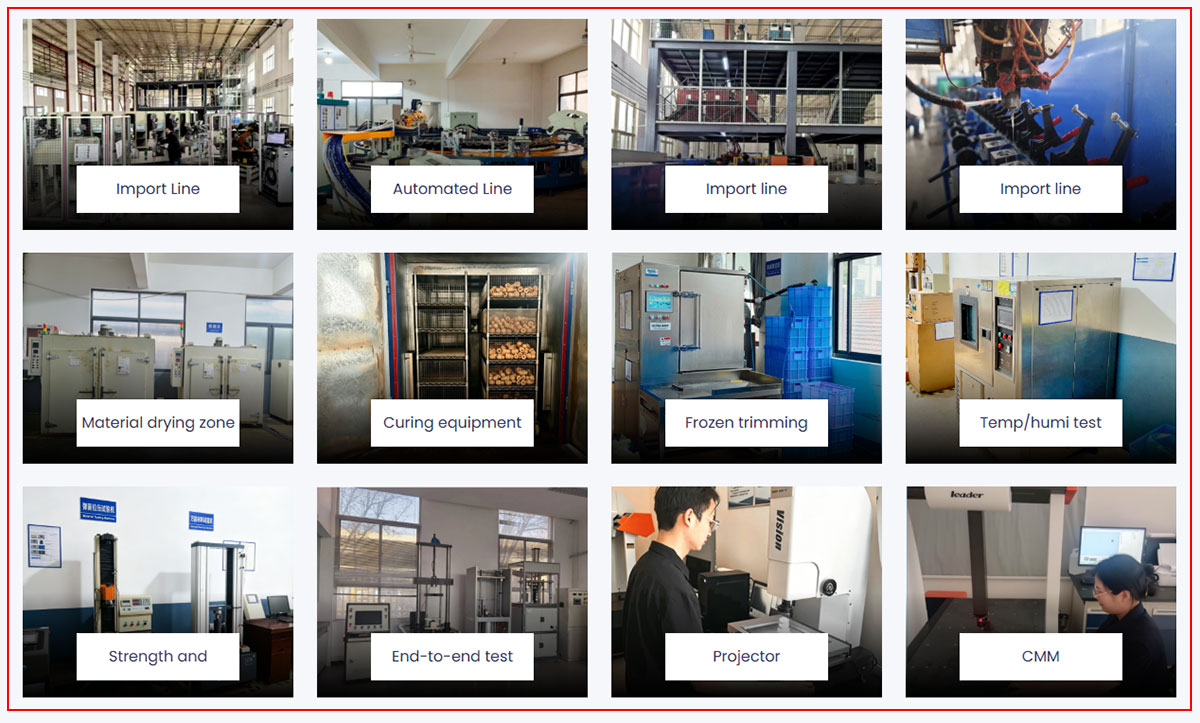
Tooling is a mould plus the fixtures around it, and quotations compress all of it into one figure called "mould cost". Seven decisions sit inside it.
Cavity count. One cavity makes one part per cycle, four make four, with a larger mould and a higher price. The right number follows annual volume and cycle time.
Mould material. Aluminium is quicker to machine and cheaper, and suits prototype or low-volume tools. Steel holds dimensions over a long production life, at a higher price and a longer build.
Core and bore. A through-bore for the piston rod needs a core that is located, vented and extracted without tearing the bore. A stepped bore is not a simple core.
Profile complexity. The waisted, ribbed and tapered sections that create the progressive curve are what make the part work, and what make the mould expensive. Undercuts add split lines or inserts, and each is a cost line.
Prototype versus production tool. A single-cavity aluminium tool for samples and a hardened multi-cavity production tool are different purchases. Pricing one and delivering the other is a common first-order dispute.
Trial shots and first article. The tool cost should include the shots needed to stabilise the process and the measurement of the first article against the drawing, stiffness curve included.
Post-cast fixtures. Where the drawing calls for trimming to height or boring to size, a fixture holds the part for that operation. Small money, frequently omitted.
Commonly quoted ranges in the trade put a single-cavity cast polyurethane mould in the low thousands of US dollars, with multi-cavity tools a multiple of that. Treat those figures as a sanity check, not a quotation. When two quotes for "the same" mould differ by 40 per cent, the difference is usually cavity count, mould material or whether trial shots were included.
Tooling Ownership: Four Structures and What Each One Costs You
Who owns the mould decides what happens when the relationship ends, the volume falls, or the profile changes. Four structures are in common use.
| Structure | How it appears | Who holds the mould | Your exit position | Effect on unit price | What to watch |
|---|---|---|---|---|---|
| Paid upfront, buyer-owned | Separate tooling line, invoiced before build | Factory, on your behalf | Strong: you can request the tool or move it | Lowest unit price | Ownership document, mould marking, storage terms |
| Amortised in the unit price | No tooling line; price falls after an agreed quantity | Factory | Medium: exiting early leaves value behind | Higher at first, lower later | The amortisation quantity and the early-exit rule |
| Buried in the first-order price | One first-order price, no breakdown | Factory | Weak | Highest first-order cost, no visibility | Ask for the split even if it is not offered |
| Supplier-owned, shared | No tooling charge at all | Factory | None | Attractive unit price | Your profile may be one of several the tool serves |
The fourth is not automatically bad. A supplier who has already tooled a similar profile can offer a low price and a short lead time, which for a low-volume aftermarket line can be the right answer. The risk is a change request: if the mould is shared, a revision affects other customers, and the answer to "can you alter the waist by two millimetres" may be no for reasons unrelated to your order.
Three contract items are worth the paragraph. A written ownership statement naming the tool, the part number and the buyer, issued with the tooling invoice. A mould marking requirement, so the tool can be identified in a rack years later. And a maintenance clause: who pays for refurbishment, where the tool is stored, what condition it is in at handover. None of them costs money at signature.
Five Segments Inside a Quoted Lead Time
A lead time quoted as "45 days" is a sum of five segments, and only three belong to the factory. The difference between two suppliers is often not production speed but where the waiting sits.
Drawing freeze and DFM review. The drawing must state the material system, hardness, free height, bore and target stiffness curve. An incomplete drawing restarts this segment.
Tool design and build. The longest factory-controlled segment. It scales with cavity count, mould material and profile complexity, and it is what a second tool can compress.
Trial shots and first article. Casting the first parts, measuring dimensions, hardness and the stiffness curve, and issuing a report against the drawing.
Customer approval. Samples travel, are fitted, and are approved or commented on. This segment belongs to the buyer, and it is where most schedules are lost.
Production, packing and freight booking. The casting run, packing, export documents and space booking. Sea transit is often quoted separately.
Typical industry ranges are worth knowing as a check, though each must be confirmed with the supplier: tooling build commonly runs three to six weeks for a single-cavity stop, first-article turnaround about a week, buyer approval one to two weeks if criteria were agreed in advance, a first run two to three weeks, and sea transit twenty-five to forty days depending on the port.
A 45-day quote that includes 30 days of sea freight describes a factory that will ship in about two weeks. A 45-day quote with air freight describes a factory that needs six weeks. The number is identical and the supplier is not.
Why a 30-Day Quote Costs More Than a 60-Day Quote
Schedule compression is bought with money, and the quotation rarely names the purchase.
| Lever | Time saved | What it adds | When it is worth it |
|---|---|---|---|
| Second tool in parallel | Three to four weeks | A second tooling charge, often 60 to 90 per cent of the first | A fixed launch date or a line-start penalty |
| Overtime and weekend shifts | About one week | A premium on conversion cost, often 10 to 20 per cent | Small orders where tool duplication is disproportionate |
| Air instead of sea | Twenty to twenty-five days | A freight premium per chargeable kilo | When the cost of being out of stock exceeds the premium |
| Partial shipment of the urgent reference | Two weeks on the first cartons | Double handling and a second export document set | One reference blocks sales while others can wait |
| Pre-bought compound kit | Three to five days | Inventory risk carried by the factory, priced in | A hardness or colour not held in stock |
Take an illustrative jounce bumper MOQ order of 3,000 pieces of an existing profile at USD 1.90 ex-works, a goods value of USD 5,700. Buying it four weeks earlier with a second tool at USD 2,400 adds USD 0.80 per piece, 42 per cent of the unit price. Buying the same four weeks with air freight at a premium of about USD 1,620 adds USD 0.54 per piece. At this size air is the cheaper way to buy time, and a second tool only makes sense if the volume continues.
The comparison moves with quantity. Tooling is fixed, so its per-piece effect falls as the order grows, while the freight premium per piece stays roughly constant. At 30,000 pieces the second tool costs USD 0.08 per piece and the air premium is still above USD 0.50, which reverses the conclusion.
Air or Sea: The Crossover for a Light, Bulky Part
A bump stop weighs little and occupies space, so air freight is charged on volume. The arithmetic sets the real crossover.
Take a carton of 100 pieces at 65 g each: 6.5 kg net, about 8 kg gross, in a carton of 50 × 40 × 40 cm, which is 0.08 m³. Under the common air rule of one cubic metre to 167 kg, that carton is charged as 13.3 kg. Gross weight is irrelevant. At illustrative freight rates:
| Item | Calculation | Per 1,000 pieces |
|---|---|---|
| Volume | 10 cartons × 0.08 m³ | 0.8 m³ |
| Air chargeable weight | 0.8 ÷ 0.006 | 133 kg |
| Air freight at USD 5.50 per kg | 133 × 5.50 | USD 732 |
| Sea LCL at USD 95 per m³ | 0.8 × 95 | USD 76 |
| Sea fixed charges | Documentation, terminal, clearance | USD 350 |
| Sea total | 76 + 350 | USD 426 |
The premium is about USD 306 per 1,000 pieces, or USD 0.30 per piece, for roughly 25 days: about USD 12 per day per 1,000 pieces. The question is not whether air is expensive per kilo, because it plainly is. The question is whether a day of delay costs more than USD 12 per 1,000 pieces. If 1,000 pieces represent three weeks of sales at a USD 2 gross margin, a stockout risks USD 2,000 and the premium is 15 per cent of that exposure.
Carton design moves the crossover directly. Ten more pieces per carton at the same external size cuts chargeable weight per piece, which is why the packaging drawing belongs in the first-order negotiation rather than after it.
First-Order Landed Cost: A Jounce Bumper MOQ Worksheet
The unit price is the smallest part of a first order. The worksheet below uses the same 3,000-piece example and copies into a spreadsheet with the illustrative values replaced by quoted ones.
| Cost line | How to calculate | Illustrative value (USD) | Per piece (USD) |
|---|---|---|---|
| Goods | 3,000 × 1.90 | 5,700 | 1.90 |
| Tooling, single cavity, paid upfront | Quoted separately | 2,400 | 0.80 |
| Trial shots and first article | Quoted or included | 350 | 0.12 |
| Packaging artwork and print setup | Private label only | 280 | 0.09 |
| Export packing and inland to port | Per shipment | 190 | 0.06 |
| Sea LCL plus fixed charges | From the previous table | 578 | 0.19 |
| Duty and clearance | Rate per destination tariff | 240 | 0.08 |
| Third-party inspection | Per man-day | 300 | 0.10 |
| Claim allowance | 2 per cent of goods value | 114 | 0.04 |
| Total | 10,152 | 3.38 |
The quoted USD 1.90 lands at USD 3.38, 78 per cent above the number that was compared. None of the added lines is unusual, and all of them are predictable at the quotation stage if they are asked for.
Volume moves the picture more than negotiation does, because most of the gap is fixed cost:
| Order quantity | Fixed costs | Variable per piece | Landed per piece |
|---|---|---|---|
| 1,000 | 3,680 | 2.16 | 5.84 |
| 3,000 | 3,680 | 2.16 | 3.38 |
| 10,000 | 3,680 | 2.16 | 2.53 |
Moving from 1,000 to 3,000 pieces cuts the fixed-cost burden per piece from USD 3.68 to USD 1.23. Arguing 8 per cent off the unit price at 1,000 pieces recovers about USD 0.15 and leaves USD 3.68 of fixed cost per piece untouched. That is the arithmetic behind negotiating quantity structure before price.
A ten-question checklist for the quote
Use these on the quotation itself. Each has a document or a number as its answer, and a jounce bumper MOQ reply that cannot answer three or more is not comparable with anything.
Is the unit price ex-works, FOB or delivered, and which port and incoterm.
What is the MOQ on the existing profile, expressed in cartons rather than pieces.
What first-order quantity does a new profile need, quoted separately from the tooling.
Who owns the mould, and which document states it.
How many cavities, what mould material, and is it a prototype or a production tool.
What are the first-article acceptance criteria: dimensions, hardness, stiffness curve, fitment.
What is the lead time broken into days per segment, tooling through freight.
What is the carton size, quantity per carton and gross weight.
Which inspection record ships with the batch, and what does the batch code look like.
What is the warranty term, and what evidence does a claim require.
The Bonpora range is quoted with the four inspection items named earlier, a working range of −40 °C to +90 °C, a design life of at least 80,000 km or two years under normal use, and a typical warranty of one to two years or 50,000 to 100,000 km confirmed per order. Those statements are specific enough to check against a batch record.
Where the specification needs settling before the commercial discussion: request the specification sheet or a sample with the reference, annual quantity and critical dimensions, and the reply can be built around your application rather than a catalogue line.
FAQ
Is a jounce bumper MOQ negotiable on a first order?
Partly. On an existing profile the quantity is a packing decision, so the negotiation is about cartons, mixed references and consolidation rather than about the part. On a new profile the first order is sized by the setup: trial shots, first-article measurement and a compound batch. A smaller first order usually means paying that setup through a higher unit price.
Who should own the mould for a custom bump stop?
The buyer, where volume justifies it and the profile is proprietary. Ownership lets you move the tool, require a revision, and keep the profile out of a competitor's catalogue. Where volume is small and the profile is close to an existing one, a shared supplier-owned tool can be the better answer, provided the limits on future changes are understood.
Why is the lead time 45 days when production takes 15?
Because the quoted figure covers five segments and the factory controls three. Tooling build, trial shots and the approval loop sit inside the same number as the casting run, and sea transit may or may not be included. Ask for days per segment.
Does a higher MOQ reduce tooling cost?
No. Tooling is a fixed line in a jounce bumper MOQ quote and does not change with order quantity. A larger order reduces the per-piece burden of the tooling and of the fixed freight and inspection charges, which is a different saving and often a larger one.
Can air freight replace a short lead time at the same cost?
It replaces part of it, at a price that scales with volume. Air buys back three to four weeks on a first order for roughly USD 0.30 to 0.55 per piece on a light, bulky part, which is usually cheaper than a second tool at small volumes and more expensive at large ones.
What documents should arrive with the first order?
A batch inspection record covering stiffness curve, compression set, hardness and appearance; a material certificate naming the compound system; the first-article report; and a packing list with batch codes matching the cartons. Those four documents make a later claim arguable rather than negotiable.
A quotation describes a supply chain in numbers. Read line by line, it says which mould will be used, who owns it, how many days belong to the factory and how much of the first order is fixed cost. The Bonpora on-road bump stop range is specified around those four inspection items, and a quotation for it can be built on the three numbers above. Send the reference or the drawing and ask for them separately: request a quotation.
- Prev.:OEM vs Aftermarket Bump Stops: What Changes in the Drawing
- Next.:How to Read a PPAP File for Polyurethane Bump Stops