
- 1. What IATF 16949 Adds Beyond ISO 9001
- 2. Read the Scope Line, Then the Site
- 3. Ten Checks Before You Accept the Certificate
- 4. Why a Valid IATF 16949 Certificate Can Describe a Process That No Longer Exists
- 5. Mapping the Certificate to Shop-Floor Evidence
- 6. Worked Example: One Container, One Scope Gap
- 7. A Scorecard for IATF 16949 Certification Review
- 8. FAQ
- 8.1. Is an ISO 9001 certificate enough to supply suspension parts to an OE programme?
- 8.2. How do I check that an IATF 16949 certificate is real and current?
- 8.3. Does the certificate cover the whole company or one plant?
- 8.4. If the metal inserts come from a partner factory, whose certificate applies?
- 8.5. Can a certified supplier still fail a part approval submission?
- 8.6. What if the certificate expires in the middle of a programme?
IATF 16949 vs ISO 9001: What Buyers Actually Verify
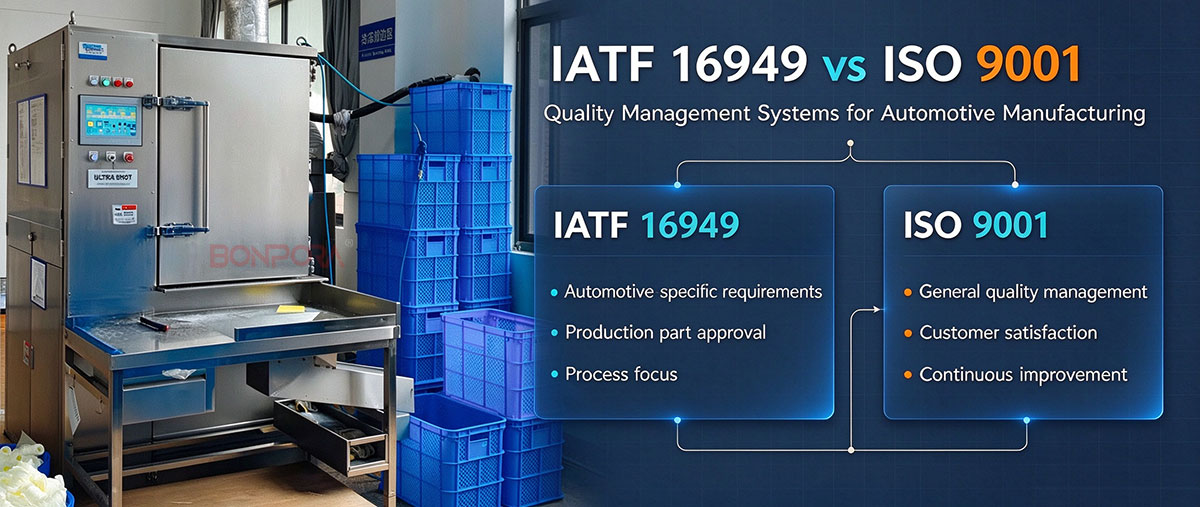
The difference is scope and evidence. ISO 9001 certifies that a quality management system conforms to a generic standard. IATF 16949 adds the automotive requirements a part launch depends on, is issued to a manufacturing site rather than to a brand, and is audited against customer-specific requirements. A certificate of either kind proves less than the scope line printed under it.
This guide is written for the person who approves a suspension parts supplier and signs the first purchase order. It covers what the two standards differ on, which lines of the certificate carry real information, how to test the paperwork against the shop floor in about one working day, and what a missed scope item costs once a container sails. All figures used as examples are illustrative models, not quotations.
What IATF 16949 Adds Beyond ISO 9001
ISO 9001 asks a company to define a quality management system and then conform to its own definition. It is deliberately industry-neutral, so the same clauses work for a bakery and a foundry. IATF 16949 takes that structure as a baseline and adds requirements written for automotive production: the APQP sequence, production part approval, MSA, SPC, maintenance, and the obligation to satisfy each customer's specific requirements on top of the standard.
The distinction lands at the purchase order, not at the brochure. ISO 9001 says a system exists and is reviewed. IATF 16949 says the system was built around part approval and serial production, and that an accredited body examined the evidence. Neither says your parts fall inside the scope.
| Dimension | ISO 9001 | IATF 16949 | What it changes for the buyer |
|---|---|---|---|
| Origin | Generic standard, any sector | Automotive supplement on the ISO 9001 structure | Signals launch and serial-production controls |
| Certification unit | May cover a central function with sites listed | Issued to a manufacturing site, address on the certificate | The address on the certificate must make your part |
| Launch discipline | Not prescribed | APQP and PPAP are part of the requirement set | A PPAP file is a controlled output, not a favour |
| Measurement systems | Implied through equipment control | MSA and gauge capability are explicit | Gauge R&R on your characteristics is a legitimate request |
| Process control | Method open | Control plans, PFMEA and SPC in serial production | The control plan should name your part number |
| Customer specifics | Not addressed | Each customer's requirements must be evidenced | Your drawing notes become auditable obligations |
| Sub-tier | Purchased product control | Stronger supplier development expectations | Compound and insert suppliers enter the conversation |
The scheme and its rules are published by the IATF at iatfglobaloversight.org. Quote that publication, not a supplier's slide, when a discussion about equivalence starts.
Read the Scope Line, Then the Site
Under the certificate number sit three pieces of text that decide relevance: the legal entity, the site address and the scope statement. Buyers skim all three and file the PDF.
The scope statement describes processes and product families in the certification body's language. A scope built around "machining of metal components" does not cover cast polyurethane moulding, however many bump stops the company ships. A scope built around "manufacture of polyurethane and rubber components for automotive suspension" does not automatically cover a stamped insert bought from a partner and bonded into the assembly. Neither case is dishonest: the certificate is accurate and the buyer has read it as a warranty.
The address matters for the same reason. A group may hold certificates at both plants, at one, or at a head office that coordinates quality for several locations. Approving a supplier means approving a building, a set of equipment and a quality organisation, so the certified address should match the shipping documents and the audit report you were shown.
This question applies to every supplier, including this one. Bonpora describes two manufacturing bases, Luoyang for high-end OE polyurethane and precision rubber and plastic parts, Wuxi for large-scale polyurethane and rubber production for mid-range OE, aftermarket and tuning, and states that both are ISO 9001 and IATF 16949 certified. Metal stamping is described separately, as strategic partner factories working to unified quality standards. That split is normal in the industry and is exactly where a buyer should stop and ask which legal entity and which site appear on the certificate for the quoted parts. The arrangement is set out on the dual-base manufacturing and IATF 16949 quality control page.
Ten Checks Before You Accept the Certificate
The sequence takes about one working day when the supplier is responsive, and it turns a PDF into a decision. Each check has an artefact you can request; a supplier working in this system has all ten on file.
Confirm the certificate in the scheme's registry, not on the supplier's website. Match number, site address, scope text and expiry, then save a dated copy.
Read the scope against the part you buy. Look for the material family and the process, not the product name.
Match the certified address to the shipping address and to the address in the last audit report. Three documents, one address.
Compare the expiry date with your delivery window. A certificate expiring before the final shipment is a problem you inherit.
Record the certification body and confirm it is accredited for the scheme. The registry check usually settles this.
Request the latest audit report summary: nonconformities, classification and closure dates. A clean IATF 16949 certificate with three open minors is a different supplier.
Request core-tool documents naming your part: process flow, PFMEA, control plan, and the MSA study for gauges on your critical characteristics. Documents that cannot be tied to a part number are templates.
Follow the sub-tier. Ask which compound and insert suppliers are used, whether each is approved under the same system, and whether a certificate of analysis accompanies each lot.
Run a traceability drill. Pick a carton from the last shipment and ask for compound lot, cure record, inspection record and shift within thirty minutes.
Put change notification in writing: any change of material, process, sub-tier or site requires your written approval before shipment, as a contract clause rather than an email.
A supplier that passes nine and stumbles on the sub-tier question is not necessarily weak; it may simply never have been asked. What matters is the documented answer.
If you are working from a drawing, settle the specification side first: request the specification sheet or a sample and compare the released requirements against the certificate scope before scheduling an audit.
Why a Valid IATF 16949 Certificate Can Describe a Process That No Longer Exists
An IATF 16949 certificate is a statement about a period, not about today. Under the scheme's rules the certificate runs on a multi-year cycle with surveillance audits in between and recertification at the end, and each audit samples the system rather than examining all of it. Between two audits a supplier can change a compound, move a press, retool a mould, add a shift or replace a quality manager, and the IATF 16949 certificate stays valid throughout.
That is not a loophole; it is how third-party certification works everywhere. The buyer's defence is not a longer certificate but a shorter memory of your own evidence.
Date-stamp everything you rely on: the registry screenshot, the audit summary, the control plan revision you reviewed. Eighteen months later, a dated record is the difference between an argument and a conversation.
Re-verify on a twelve-month clock and immediately on any trigger: a new plant in the supply chain, a price cut beyond material index movement, a new compound supplier, a new mould, a first warranty claim. Each signals that the process you approved is not the process you are buying.
Tie the review to part approval. When your own PPAP or first-article process is triggered, the certificate review should be triggered with it, because the same change invalidates the assumptions behind the last approval.
Mapping the Certificate to Shop-Floor Evidence
The fastest test of whether a system is real is to walk one production stage and ask for the record the standard implies. A control plan that exists only as a document is a document. A control plan whose stages each carry a signed record for the batch in front of you is a system.
The table below uses the published control plan for cast polyurethane jounce bumpers, a product where failure modes are visible in the process record: moisture in the compound becomes porosity, a shortened cure becomes compression set, a trim setting becomes a stiffness curve that rises too early.
| Production stage | What is checked | Published frequency | Record to request |
|---|---|---|---|
| Incoming material | Isocyanate, polyol and additive identity and certificates | Every delivery | Incoming sheet with lot numbers and certificate of analysis |
| Compound preparation | Temperature, dosing, degassing | Every mix | Mix record with parameter values and operator |
| First off | Appearance, dimensions, hardness | Every production start | First-off approval signed before the run continues |
| In process | Dimensions, hardness, visual condition | At defined intervals | Interval checks with time stamps, not one end-of-shift entry |
| Per batch | Static stiffness curve and compression set | Every batch sample | Curve against the first-article reference, set result against limit |
| Final | Marking, packaging, packing list with batch code | Every shipment | Packing list that traces a carton back to a mix |
Two details matter more than the rest. The per-batch stiffness curve is measured on the finished part, so it tests profile, free height, hardness and cure completeness at once; a supplier offering only a hardness reading is offering a compound test, not a product test. And the batch code on the packing list is the hinge for everything else: without it, the traceability drill in check nine cannot be completed at all.
For a polyurethane bumper those four inspection items, static stiffness curve, compression set, hardness and appearance, are the ones Bonpora states for its range, with a working range of −40 °C to +90 °C, a design life of at least 80,000 km or 2 years under normal use, and a typical warranty of 1 to 2 years or 50,000 to 100,000 km confirmed per order. The route behind those claims, from compound preparation through cure and trim to batch inspection, is described in the jounce bumper manufacturing and quality control guide. The product view, including MDI and NDI systems, the position on the piston rod and the reference families, is on the Bonpora jounce bumper range. Reading specification and process side by side is what makes an audit question specific enough to have an answer.
Worked Example: One Container, One Scope Gap
The case for spending a day on certification review is usually made in the abstract. Arithmetic makes it faster. The model below uses round numbers and an illustrative structure, not a quotation.
Assume a container of 12,000 jounce bumpers at USD 2.40, an order value of USD 28,800. The scope covered moulding, but the drawing hardness band is narrower than the compound the supplier ran, and 4 per cent of the lot, 480 pieces, sits outside it. Incoming inspection at the customer finds the deviation on a sample and requires a full sort.
| Cost line | Basis | Amount (USD) |
|---|---|---|
| 100 per cent sort at destination | 12,000 pcs × 0.22 | 2,640 |
| Return freight for rejected pieces | Consolidated parcel, 480 pcs | 640 |
| Credit for nonconforming pieces | 480 pcs × 2.40 | 1,152 |
| Claim administration | 6 hours × 45 | 270 |
| Customer chargeback and line disruption | One event, negotiated | 1,800 |
| Total exposure | 6,502 |
That is 22.6 per cent of the order value, on a defect a single hardness check at first off would have caught. Caught before shipment the same defect costs far less: sorting 12,000 pieces at origin at 0.06 is 720, scrapping 480 at a material cost near 1.10 is 528, so 1,248 in total. The gap between the columns, 5,254, is what departure does to the price of a mistake.
Now price the prevention. A desk review of scope, registry entry and last audit report is roughly one auditor-day; a video or on-site walk-through of the control plan is another; write-up takes two internal hours. At an indicative 480 per auditor-day plus 90 of internal time, the review costs about 1,050. Divide by the 6,502 exposure and the break-even probability is 16 per cent: if you believe there is more than a one-in-six chance that a supplier's scope does not cover the part as drawn, the review is cheaper than the risk. Asked about an unvisited factory, most buyers answer well above 16 per cent.
The threshold moves with volume. At 60,000 pieces a year the same escape rate produces five events of this size and the review pays for itself several times over. At 2,000 pieces a year it may cost more than the expected loss, and the right answer is a shortened version of the ten checks rather than none of them.
A Scorecard for IATF 16949 Certification Review
Checklists produce opinions. Scorecards produce a decision you can defend to a colleague. These five criteria carry the weight that matters for a chassis part, where a material or cure deviation surfaces as a ride complaint rather than a failed dimension.
| Criterion | Weight | A 4 looks like | A 1 looks like |
|---|---|---|---|
| Scope and site match | 30 | Scope names material family and process, address matches shipping point | Scope generic, or certificate held at another location |
| Core-tool evidence for your part | 25 | PFMEA, control plan and MSA carry your part number and characteristics | Templates with no part reference |
| Audit and nonconformity history | 20 | Report reviewed, findings closed on time, no repeats | Report refused, or repeat findings across two cycles |
| Sub-tier and material control | 15 | Compound and insert suppliers approved, certificate of analysis per lot | Sub-tier unnamed, or changed without notice |
| Traceability and records | 10 | Carton to compound lot inside 30 minutes | Batch code on the packing list only |
Rate each row 0 to 4, then convert: weighted score = (rating ÷ 4) × weight, summed. At 80 or above, approve. Between 65 and 79, approve with conditions, a named corrective action and a re-review inside 90 days. Below 65 the certificate is not the problem; the evidence is missing, and the order waits.
The arithmetic is instructive. A supplier scoring 4 on scope, 3 on core tools, 2 on audit history, 2 on sub-tier and 3 on traceability totals 30 + 18.75 + 10 + 7.5 + 7.5 = 73.75. That is a conditional approval: genuine certificate, correct scope, but two rows carried by the supplier's word rather than a document. The corrective action writes itself, which is a better use of the next conversation than a general request to improve quality.
Two rules keep the score honest. Score only what you have seen, so an unchecked row is a 0 rather than a 3. And re-score at trigger events instead of annually by default, because the rows that move fastest, sub-tier and traceability, are the ones a plant change disturbs first.
FAQ
Is an ISO 9001 certificate enough to supply suspension parts to an OE programme?
It starts the conversation and rarely finishes it. OE programmes normally expect the automotive supplement and the approval documents that come with it, so an ISO 9001-only supplier will be asked for a development plan, a PPAP route and a timeline before nomination. For aftermarket ranges the customer sets the bar, and a documented control plan plus batch traceability often carries more weight than the certificate class.
How do I check that an IATF 16949 certificate is real and current?
Use the scheme's public registry rather than the supplier's PDF. Match certificate number, site address, scope text and expiry date. If any of the four differs from what you were sent, ask for the difference in writing before filing the document, and keep a screenshot with the date visible, because registry entries change when a certificate is suspended or withdrawn.
Does the certificate cover the whole company or one plant?
For the automotive scheme, certification is tied to a manufacturing site and the address is part of the certificate. A group may hold several, one per plant, and a head-office quality function may not be certified at all. When a supplier quotes from two bases, ask which certificate applies to the base producing your order.
If the metal inserts come from a partner factory, whose certificate applies?
The certificate of the site that moulds and bonds the assembly covers the assembly process, not the partner's stamping. Hence the sub-tier question: whether the partner is approved under the supplier's own system, what incoming inspection is applied to inserts, and whether the coating specification is verified per lot. A supplier that answers specifically is usually controlling it.
Can a certified supplier still fail a part approval submission?
Yes, for reasons unrelated to the certificate: a new mould, a compound change, an unvalidated gauge, or a control plan copied from a similar part. The certificate says the system can produce evidence; the submission proves it did for this part. Treat them as two approvals with two dates.
What if the certificate expires in the middle of a programme?
Record the renewal date with a reminder 90 days ahead, and make the order conditional on a valid certificate at each shipment. A lapse is usually administrative, but it removes the third-party evidence the approval rested on, and the buyer who tracked the date is the one who is not surprised.
When scope, site and records line up, an IATF 16949 certificate stops being a document to file and becomes a reason to shorten qualification. Request a quotation with your drawing, reference numbers and programme volume, and the scope question can be answered against a specific part rather than in general terms.
- Prev.:Oil Drain Plug Gasket: Replace Every Time or Reuse?
- Next.:Bump Stop Cost Breakdown: Material, Mould, Tooling, Freight