
- 1. Sealing Principle: Why the Gasket Matters
- 2. Does the Vehicle Type Change the Replacement Logic?
- 3. What Happens If You Never Replace the Gasket?
- 4. Practical Replacement Advice
- 5. FAQ
- 5.1. Q1: Can I reuse an oil drain plug gasket?
- 5.2. Q2: How often should I replace an oil drain plug gasket?
- 5.3. Q3: What happens if I never replace the drain plug gasket?
- 5.4. Q4: What torque should I use for the drain plug?
- 5.5. Q5: Is a copper gasket better than an aluminum gasket for drain plugs?
- 6. Source Oil Drain Plug Washers from Bonpora
Oil Drain Plug Gasket: Replace Every Time or Reuse?
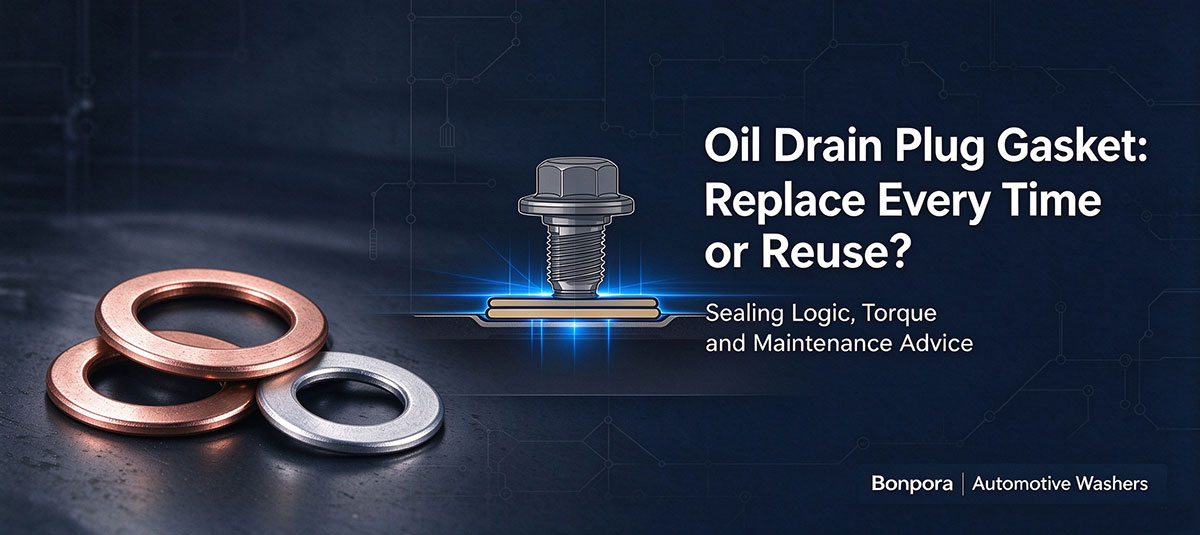
One of the most common questions in vehicle maintenance and parts procurement is whether an oil drain plug gasket must be replaced every time the oil is changed. The answer is not simply “yes” or “no.” It depends on the gasket material, vehicle design, sump condition, tightening torque and service history. For repair shops and wholesale buyers, understanding this logic helps reduce unnecessary part consumption while avoiding oil leaks.
Sealing Principle: Why the Gasket Matters
The oil drain plug gasket sits between the drain plug and the oil sump. When the plug is tightened, the gasket is compressed and deforms to fill small surface gaps, creating a seal between two metal surfaces. This is why gasket selection, surface condition and tightening torque are all critical.
Metallic gaskets such as copper or aluminum are common in automotive applications. After the first compression, they often take a permanent set. If reused repeatedly, their ability to rebound and fit uneven surfaces may decrease, increasing the risk of slow seepage around the drain plug.
Does the Vehicle Type Change the Replacement Logic?
Yes. Different vehicles and sump designs create different replacement requirements.
Many gasoline-powered vehicles, including some Volkswagen and Skoda models, are often recommended with a new gasket at each oil change, though in practice some workshops may reuse them for a limited number of service cycles. Vehicles with plastic oil sumps sometimes use drain plugs with integrated sealing elements, and in those cases the plug-and-gasket assembly may be designed as a one-time service item. Some Japanese vehicles use more deformation-resistant factory gaskets that may be reused under controlled conditions.
Because actual service rules vary by model, buyers and technicians should always check the vehicle manufacturer’s service information before deciding to reuse a gasket.
What Happens If You Never Replace the Gasket?
An aged, deformed or poorly seated gasket may allow slow oil seepage around the drain plug. Over time, that can create a visible oil trace on the oil sump, increase oil consumption and raise maintenance costs. In more serious cases, if leakage becomes significant, it may lead to low engine oil levels and insufficient lubrication.
Industry experience suggests that for metallic gaskets reused beyond a limited number of service cycles, the risk of seepage may rise. However, exact failure rates depend on many factors, including gasket material, surface finish, bolt condition, torque accuracy and service interval.
It is also possible for a vehicle to go many service intervals without leakage, especially if it uses a deformation-resistant factory gasket, the sump surface remains flat, and the drain plug is tightened with consistent torque. Even then, “no leakage” does not automatically mean the gasket is still in ideal condition.
Practical Replacement Advice
Inspect the area around the drain plug after every oil change. If oil traces appear, replace the gasket.
Gasket cost is usually low, so many workshops choose replacement over risk, especially for customer-facing vehicles.
Reuse is sometimes possible within a limited number of service cycles, but only when the gasket remains in good condition and the vehicle manufacturer allows it.
Always verify dimensions, material and vehicle compatibility before purchasing or installing a replacement gasket.
Use a torque wrench. For many drain plugs, common torque values fall in the range of 25–35N·m, but the vehicle-specific service manual takes priority.
FAQ
Q1: Can I reuse an oil drain plug gasket?
A: It depends on the vehicle design, gasket material and service history. Some deformation-resistant factory gaskets may be reused under controlled conditions, while plastic sump plugs with integrated seals may require a new assembly each time. Always follow the vehicle manufacturer’s service information.
Q2: How often should I replace an oil drain plug gasket?
A: There is no universal interval. Many workshops replace it at every oil change to reduce leakage risk, while others may reuse it for a limited number of cycles if permitted by the vehicle manufacturer. Inspect for oil traces and replace when leakage is found.
Q3: What happens if I never replace the drain plug gasket?
A: Over time, the gasket may lose sealing ability and cause slow oil seepage. This can increase oil consumption, create oil stains on the sump, and in severe cases lead to low engine oil and lubrication problems.
Q4: What torque should I use for the drain plug?
A: Torque varies by vehicle. Many drain plugs fall in the 25–35N·m range, but always use the vehicle manufacturer’s specification. Overtightening can damage threads or the oil sump.
Q5: Is a copper gasket better than an aluminum gasket for drain plugs?
A: Copper and aluminum are both used in automotive sealing applications. Copper is often softer and conformable, while aluminum is lighter and may offer good corrosion resistance. Material choice should follow the vehicle specification and operating conditions.
Source Oil Drain Plug Washers from Bonpora
Bonpora supplies a range of automotive sealing washers and related components for maintenance and aftermarket applications. If you need oil drain plug washers for service workshops, distributors or private-label projects, please check our product catalog:
https://www.bonporaparts.com/en/washers/
For quotations, samples and technical support, contact our sales team: sales@bonporaparts.com.
- Prev.:Private Label Bump Stops: Barcodes and Artwork in Six Weeks
- Next.:IATF 16949 vs ISO 9001: What Buyers Actually Verify