
Automotive Suspension Terrain Comparison & Selection Guide
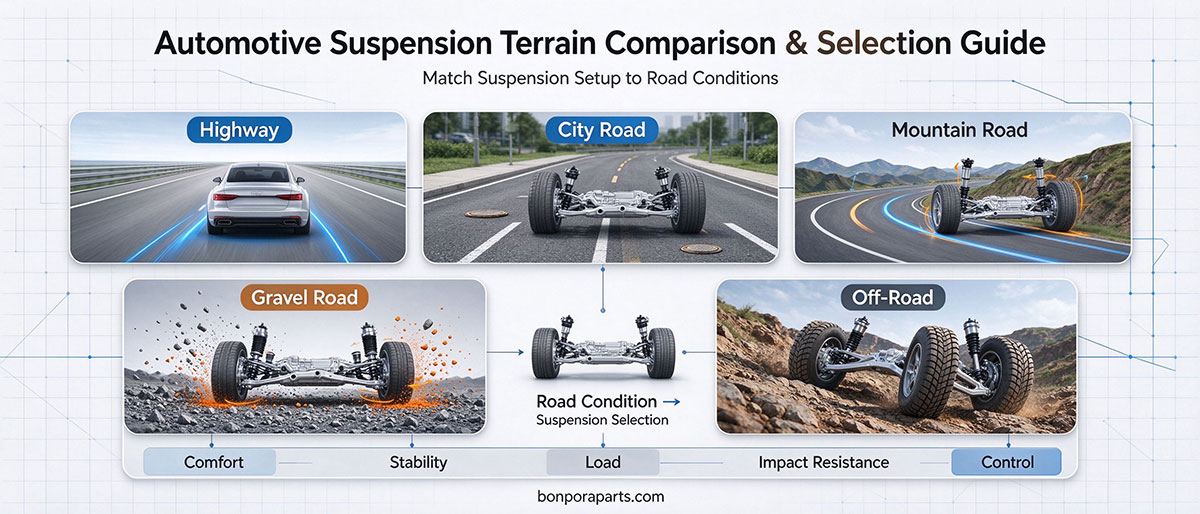
Suspension systems from Germany, Japan, USA and China adopt different structural designs and tuning philosophies. German five-link, Japanese torsion beam / lightweight multi-link, American solid axle with leaf spring, and Chinese premium double wishbone + five-link air suspension are developed for local road conditions. Their pros and cons vary greatly on muddy roads, shallow water, pavement, off-road trails and desert. This article compares terrain performance first, then gives clear selection rules to match suspension with your main driving terrain.
Terrain Performance Comparison by Country
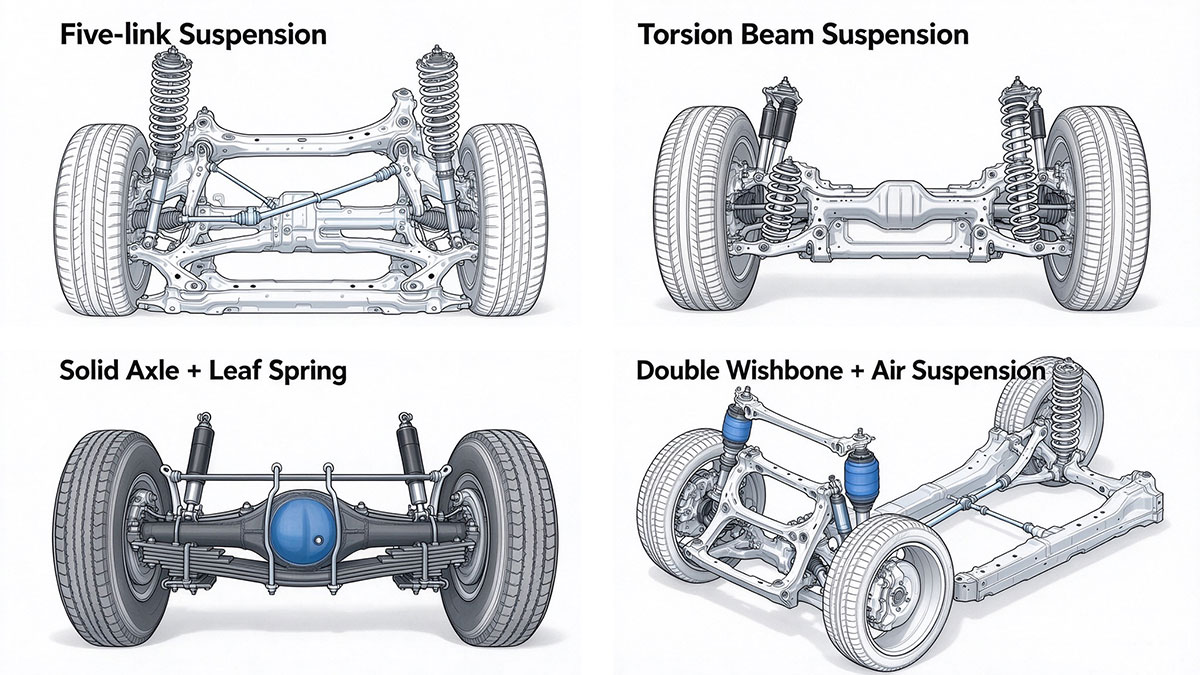
🇩🇪 Germany|Five-link suspension
Muddy road: Pros: Independent wheel movement maintains traction when one wheel sinks; stable wheel alignment; well-sealed joints resist mud jam temporarily. Cons: Multiple linkages trap silt; abrasive mud speeds up bushing and ball joint wear; limited stroke leads to bottoming on deep ruts.
Shallow water: Pros: Reliable sealing for mechanical joints during short wading. Cons: Air suspension versions are vulnerable to silt, water damage on airlines, height sensors and compressors; mud may bind control arms.
Pavement: Pros: Best highway performer. Precise wheel geometry, strong lateral support and excellent body control during braking and lane changes. CDC adaptive damping offers wide sport/comfort range. Cons: Firmer response to small low-speed bumps, less supple than Japanese tuning.
Off-road: Pros: Comfortable on mild unpaved tracks; air suspension can lift ground clearance. Cons: Limited articulation, easy to lift a wheel on extreme cross axle; delicate linkages risk rock damage; high repair cost, not for heavy rock crawling.
Desert: Pros: Stable chassis for desert highway and light sand touring. Cons: Insufficient stroke for big dune impacts; air suspension risks overheating and leakage under repeated heavy compression; low unsprung mass reduces floatation on deep loose sand, not for aggressive dune running.
🇯🇵 Japan|Torsion beam / lightweight multi-link suspension
Muddy road: Pros: Simple structure with fewer mud traps; durable rubber bushings, low failure rate and low service cost; light unsprung mass reduces sinking tendency. Cons: Linked axle movement, hopping on one side disturbs the other wheel; poor cross-axle traction, easy to lift a wheel; short stroke causes bottoming.
Shallow water: Pros: Compact layout without air lines or complex sensors; simple sealing, low repair cost after wading. Cons: Low standard ground clearance; beam structure accumulates silt and speeds up corrosion.
Pavement: Pros: Soft initial damping absorbs small urban bumps smoothly, light steering and good fuel efficiency. Cons: Moderate lateral support; obvious body roll in hard cornering; less stable under strong crosswind at high speed.
Off-road: Pros: Reliable for light country dirt roads. Cons: Not suitable for medium or heavy off-road; short stroke and linked geometry lose traction easily on cross axle and deep ruts.
Desert: Pros: Light unsprung mass helps slow crawling on shallow sand. Cons: Very limited stroke, heavy bottoming risk on dunes; poor control over continuous sand undulations, not designed for desert crossing.
🇺🇸 United States|Solid axle + leaf spring suspension
Muddy road: Pros: Large suspension articulation, excellent wheel contact on cross axle; solid axle housing protects differential and shafts; robust design keeps working even covered with mud, cheap field repair; strong load capacity. Cons: Linked wheel movement causes more chassis shake; leaf spring pockets trap silt and corrode quickly; noticeable empty-load bounce.
Shallow water: Pros: Sealed axle housing protects drivetrain; almost no electronic sensors, very tolerant of wading and silt. Cons: Leaf spring hangers and shackles collect water and mud, prone to corrosion; higher center of gravity.
Pavement: Pros: Excellent long-wave absorption for relaxed interstate cruising, stable under heavy load. Cons: Poor independent wheel control; bumps on one side disturb the opposite wheel; heavy body roll in fast cornering, obvious bounce when unloaded.
Off-road: Pros: Best for heavy off-road, superior articulation and traction on rock crawling and cross axle; impact resistant, easy to modify, affordable spare parts for remote repair. Cons: Rough ride; heavy unsprung mass may overheat dampers under repeated fast hits.
Desert: Pros: Preferred for serious desert running. Long stroke and heavy unsprung mass help maintain traction on loose sand; leaf springs withstand continuous dune impacts reliably, great for dune climbing and high-speed desert trails. Cons: Harsh empty ride; high fuel consumption; poor on-pavement comfort.
🇨🇳 China|Double wishbone + 5-link air suspension (premium EV)
Muddy road: Pros: Independent double wishbone + five-link geometry; adjustable air spring raises ground clearance; CDC active damping suppresses body motion. Cons: Most complex assembly; air bags, airlines and sensors are easily damaged by sharp rock and abrasive silt; very high repair cost, hard to fix in remote areas.
Shallow water: Pros: Raised mode delivers generous wading clearance with electronic protection logic. Cons: Critical weakness: air compressor, solenoid valves and height sensors are sensitive to prolonged silt-laden water immersion; leakage can disable the suspension quickly.
Pavement: Pros: Widest adjustment range. Lowered for stable high-speed handling; raised for soft bump absorption; active pitch and roll control blends German stability, Japanese smoothness and American cruising comfort, optimized for mixed road conditions. Cons: Final performance depends on brand tuning; more wearable electronic components than pure mechanical suspension.
Off-road: Pros: Adjustable height and damping deliver good comfort and capability for moderate off-road and pothole tracks. Cons: Not built for extreme rock crawling; air bags and lines are vulnerable to puncture; physical stroke is less than solid axle; expensive and hard to service off-grid.
Desert: Pros: Adjustable ride height and active damping make it the most comfortable choice for light desert sightseeing. Cons: Major limitation: repeated high-frequency dune impacts fatigue air springs and overheat the air compressor; not suitable for long-distance aggressive desert crossing.
How to Select the Right Suspension for Different Road Conditions
Core rule: Match suspension design to your dominant terrain (the terrain you drive on over 70% of the time). Avoid over-specifying complex systems. Four key factors: primary terrain distribution, maintenance access, load requirement, total cost of ownership.
Terrain-by-terrain Recommendation
Paved highway & city road: Recommended: Five-link independent suspension. Torsion beam is a budget-friendly option for low-speed city commuting. Not recommended: solid axle leaf spring. Air suspension works well but brings extra cost for pure pavement driving.
Muddy rutted roads: Recommended: Solid axle with leaf spring. Mechanical five-link is a good alternative. Not recommended: air suspension. Torsion beam is weak in cross-axle traction.
Shallow wading & seasonal flooded roads: Recommended: Solid axle leaf spring or mechanical five-link. Torsion beam is acceptable with low repair cost after wading. Avoid air suspension.
Off-road, rock crawling & cross axle tracks: Recommended: Solid axle leaf spring for heavy rock crawling. Mechanical five-link for moderate off-road if ride comfort is prioritized. Air suspension with CDC fits mild trails only. Torsion beam is not suitable for off-road.
Desert & dune running: Recommended: Solid axle leaf spring for aggressive dune climbing and long-distance desert crossing. Mechanical five-link suits desert highway and light sand touring. Air suspension delivers comfort but risks air bag fatigue and compressor overheating. Torsion beam is not recommended.
Mixed road conditions: Recommended: Double wishbone + five-link suspension with CDC and air spring. It requires reliable local service support and higher maintenance budget. Not suitable for remote areas.
Quick Reference Table
City & highway: Five-link / Torsion beam | Avoid solid axle
Muddy ruts: Solid axle / Mechanical five-link | Avoid air suspension
Frequent wading: Solid axle / Mechanical five-link | Avoid air suspension
Heavy off-road & rock crawling: Solid axle leaf spring | Avoid torsion beam and air suspension
Desert dune crossing: Solid axle leaf spring | Avoid torsion beam and air suspension
Mixed roads with comfort demand: CDC air suspension (only with local service)
Important Reminders
Air suspension is a comfort-oriented electronic system, not built for extreme off-road.
Torsion beam is designed for budget urban commuting with limited off-road potential.
Solid axle excels at off-road and load carrying, but compromises on-pavement comfort and handling.
Independent suspension does not equal off-road capability; its natural advantage is highway handling.