
- 1. What a Nitrogen Gas Bladder Does in a Piggyback Reservoir
- 2. Rubber Grade Selection: NBR vs HNBR Compared
- 3. Permeation and Charge Retention: The Spec Most Buyers Leave Out
- 4. Nitrogen Gas Bladder Testing: Burst, Flex and Pressure Hold Evidence
- 5. The 12-Field Sourcing Specification (Copy Before You Quote)
- 6. Ten Questions to Send a Nitrogen Gas Bladder Supplier Before the Pilot Order
- 7. Cost Model: When the HNBR Upgrade Pays for Itself
- 8. Frequently Asked Questions
- 8.1. A bladder passed our pressure hold test but lost precharge within months. Where do we look first?
- 8.2. Is it acceptable to buy bladders without a drawing by sending used samples?
- 8.3. Should we stock NBR and HNBR versions of the same reference?
- 8.4. What packing format protects bladders in a sea container?
- 8.5. How is a bladder marked for traceability, and can we private label it?
Nitrogen Gas Bladder Sourcing: Rubber Grade, Burst Test
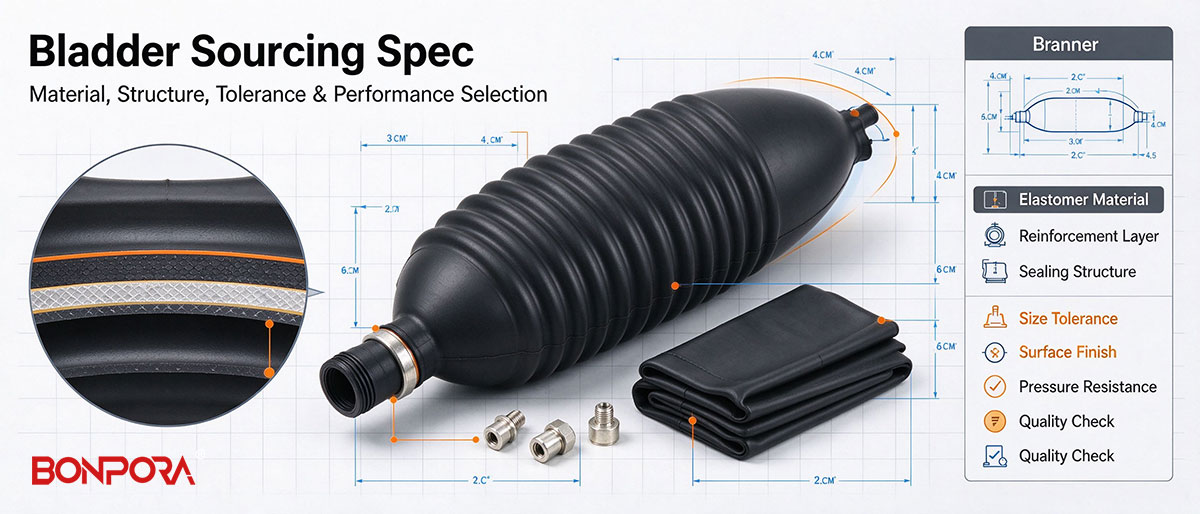
A nitrogen gas bladder is the rubber membrane inside a piggyback or remote reservoir that separates pressurised nitrogen from damper oil. Sourcing one well comes down to four decisions: the NBR or HNBR grade, wall and neck geometry, a permeation limit, and burst or flex test evidence you can verify.
What a Nitrogen Gas Bladder Does in a Piggyback Reservoir
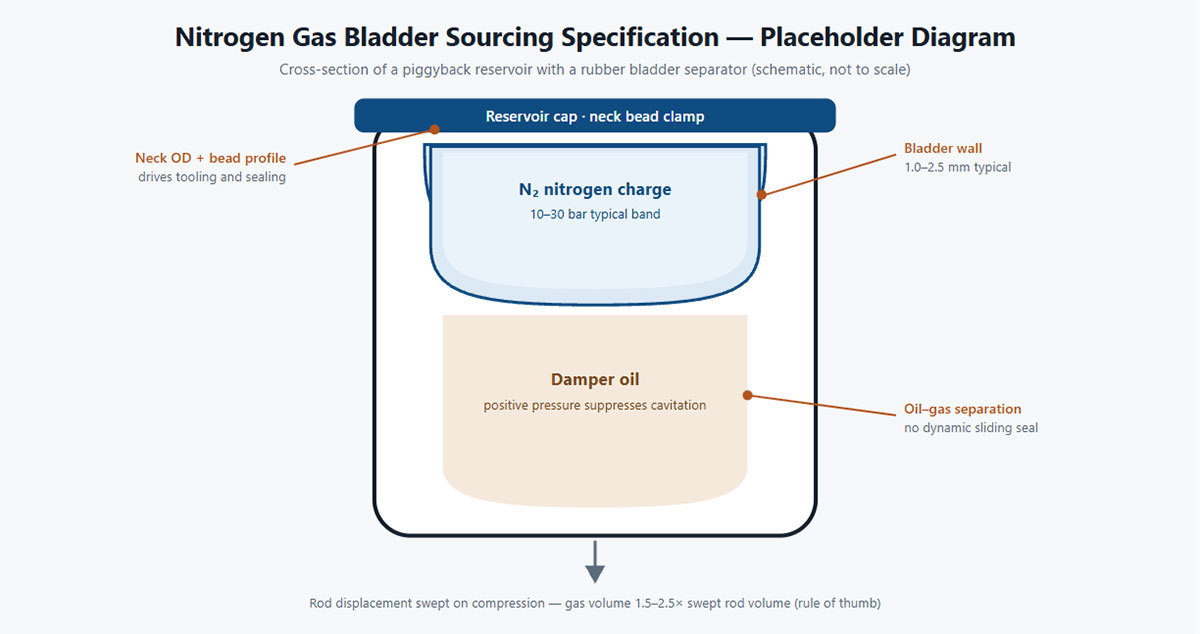
Inside a gas-charged damper, oil volume changes as the piston rod moves in and out of the body. Something has to absorb that change while keeping the nitrogen charge away from the oil. Two designs do this job. An internal floating piston uses a rigid piston with a dynamic seal sliding in a machined bore. A bladder reservoir uses a flexible rubber membrane clamped at the reservoir head, expanding and contracting as oil enters.
The bladder has one practical advantage for replacement programmes: it has no dynamic sliding seal, so there is one less path for nitrogen to escape into the oil and one less bore surface whose finish must be controlled. When the membrane works as intended, it keeps oil and gas separated so the charge does not foam, maintains positive pressure on the oil column to suppress cavitation, and holds damping consistent over repeated bumps. Those are the three functions Bonpora lists for its nitrogen gas bladder range, alongside extending shock absorber service life.
| Aspect | Bladder reservoir | Internal floating piston |
|---|---|---|
| Separation principle | Flexible rubber membrane | Rigid piston with a dynamic seal |
| Dynamic sealing points | Static clamp area only | Sliding seal along the bore |
| Bore finish sensitivity | Low, membrane separates the gas side | High, scratches can pass gas |
| Service behaviour | Bladder replaced during a rebuild | Piston and seal replacement, possible bore rework |
| Typical applications | Off-road, utility and heavy-duty dampers | Compact monotube and piggyback designs |
Neither design is universally superior, and the commercial takeaway is simple: keep bladder part numbers and floating-piston kit numbers separate in your catalogue, because ordering a rebuild kit against the wrong reservoir type is an avoidable return.
Rubber Grade Selection: NBR vs HNBR Compared
The compound fixes the temperature window, the oil compatibility, and how quickly nitrogen migrates through the membrane wall. Nitrile rubber (NBR) is the standard choice for general-purpose dampers. Hydrogenated nitrile (HNBR) is produced by hydrogenating the butadiene backbone of NBR, leaving a more saturated polymer with substantially better heat ageing, lower compression set, and higher mechanical strength. The trade-off is cost, so HNBR should be specified where the duty justifies it rather than applied to every part number.
| Property | NBR | HNBR |
|---|---|---|
| Typical service temperature | About −30 °C to +100 °C | About −40 °C to +150 °C |
| Oil and additive resistance | Good, improves with higher acrylonitrile content | Very good, more stable over time |
| Heat ageing | Moderate; hardening accelerates with exposure | Strong; retains elasticity at the same exposure |
| Compression set at temperature | Acceptable for moderate duty | Low, keeps the neck bead sealing |
| Gas permeation | Higher, so more precharge loss over years | Lower, helps hold precharge |
| Relative cost | Baseline | Higher |
Two notes worth writing into a specification. First, within a family, formulation changes hardness, permeation, and low-temperature behaviour, so the grade name alone does not define performance. NBR properties are set largely by acrylonitrile content: a higher ACN grade resists oil better and permeates less, but stiffens at low temperature. Second, an HNBR compound still needs the correct cure system and a post-cure step to reach its full property set, so ask the supplier to state the cure system on the batch record rather than only the compound name. Avoid suggestions to substitute EPDM or silicone here: both look attractive on temperature ratings, but neither tolerates mineral damper oil.
For drawings and fit data on the standard range, see the nitrogen gas bladder product page, which sets out the specification fields Bonpora fixes on a drawing.
Permeation and Charge Retention: The Spec Most Buyers Leave Out
Permeation describes how quickly nitrogen migrates through the bladder wall. It cannot be eliminated, only reduced, and its practical effect is gradual precharge loss between services. If the damper specification allows only a small pressure drop over a long interval, permeation is the property to test and to quote a limit for. A bladder that measures perfectly on a bench can still bleed pressure for years through a wall that is 0.2 mm too thin.
Wall thickness is the lever. Bonpora's product guide puts typical bladder walls at 1.0 mm to 2.5 mm: thinner walls flex easily but permeate gas faster, while thicker walls add stiffness and cost. The other lever is compound choice, as the HNBR column in the table above shows.
Charge retention also depends on sizing. A common rule of thumb quoted in Bonpora's wholesale sourcing guide is to target a gas volume of roughly 1.5 to 2.5 times the swept rod volume for a monotube or piggyback layout, then validate on a damper dynamometer. A bladder that is folded against itself at full compression cannot supply the gas volume the damping curve assumes, no matter how good the compound is.
| Application | Typical precharge range (starting points) | Note |
|---|---|---|
| Passenger car monotube | About 10 to 20 bar | Comfort-biased, low rod force |
| Off-road and utility | About 15 to 30 bar | Higher pressure resists fade |
| Heavy-duty truck and bus | About 25 to 40 bar | Confirm with the damper developer |
Treat these bands as the supplier's published starting points, not as acceptance limits. Precharge interacts with the valve stack, rod diameter, and vehicle mass, so the final value belongs to the damper engineer. What belongs in the purchasing file is a retention requirement: for example, a maximum pressure drop over a stated interval at a stated temperature, measured on sampled parts. The exact figure should be agreed with your damper developer and the supplier, because no generic number fits every reservoir.
Nitrogen Gas Bladder Testing: Burst, Flex and Pressure Hold Evidence
A bladder burst test is the fastest way to find a weak wall, a thin crown, or a moulded void before the part reaches a customer's vehicle. In common industry practice, buyers ask for the burst pressure to be expressed as a multiple of the maximum working pressure of the reservoir, with the multiplier and the acceptance level stated on the drawing; verify the exact target with your supplier rather than assuming a figure. Alongside burst, three tests carry most of the acceptance weight:
Pressure hold test. Air or water pressure applied to sampled parts for a defined time, with no leakage or distortion accepted. This is the production-facing check that catches voids and short fills.
Cyclic flex endurance. Bench cycling of sample parts to confirm the compound still meets its fatigue expectation, run periodically or whenever the compound or mould changes. Stress whitening along the fold pattern after cycling is an early warning.
Compression set. Measured by the constant-deflection method after a defined heat soak. A high set value means the neck bead takes a permanent flattened shape, and a flattened bead leaks even though the rubber looks intact.
Bonpora's materials and quality control guide publishes the sample inspection plan it expects a supplier to document, reproduced here as a reference structure for your own incoming agreement:
| Check | Method | Frequency | Acceptance |
|---|---|---|---|
| Compound batch record | Document review | Every batch | Batch, cure date, and cured test slab retained |
| Hardness | Durometer on cured sample | Every batch | Within drawing tolerance |
| Wall thickness and neck dimensions | Gauge or optical | Per sampling plan | Within drawing tolerance |
| Visual defects | Inspection against photo standard | Every part | No voids, nicks, or short fills |
| Pressure hold | Air or water test at defined pressure | Per sampling plan | No leakage or distortion |
| Compression set | Constant deflection, heat soak | Per batch or periodic | Below the stated limit |
| Cyclic flex endurance | Bench cycling on sample parts | Periodic or on change | No cracking before target cycles |
An inspection plan is only useful if the records travel with the shipment. Ask for a certificate of conformity that references the batch numbers actually delivered, not a generic statement covering the product family.
The 12-Field Sourcing Specification (Copy Before You Quote)
Bladder dimensions are not interchangeable between shock families, and a supplier cannot quote accurately from a vehicle model alone. The table below is the field set worth locking on the drawing before a quotation is requested; it consolidates the dimensional and compound data published across Bonpora's bladder guides.
| # | Field to fix on the drawing | Why it matters commercially |
|---|---|---|
| 1 | Elastomer family and grade, including acrylonitrile content for NBR | Defines the temperature window and permeation behaviour |
| 2 | Hardness in Shore A with a stated tolerance | Balances seating flexibility against extrusion resistance |
| 3 | Minimum tensile strength and elongation at break | Elongation matters as much as strength across fold radii |
| 4 | Compression set limit, method and conditions stated | Protects the neck bead seal, the most common leak point |
| 5 | Temperature window for the target market | Cold climates need an explicit low-temperature requirement |
| 6 | Permeation or precharge-retention requirement | The property most often left out, and most often missed later |
| 7 | Neck outer diameter, neck length and bead or flange profile | Controls sealing in the reservoir cap and drives tooling |
| 8 | Overall length, relaxed and installed | Sets gas volume and reservoir packaging |
| 9 | Maximum inflated diameter | Sets bore clearance and fold pattern |
| 10 | Wall thickness at crown and at neck | Controls fatigue life and extrusion resistance |
| 11 | Marking: size code, cure date, private-label number position | Traceability, stock rotation, and brand programmes |
| 12 | Packaging format and shipment documents | Prevents set creases in transit; batch-referenced CoC |
Two of these fields deserve a note. On hardness, the site's drawing guide quotes about 55 to 75 Shore A as the working band, while common acceptance requirements in the trade sit at 60 to 80 Shore A with a tolerance stated on the drawing; agree the exact figure and tolerance band with your supplier. On storage, require that bladders travel relaxed, lightly dusted, in sealed bags away from sunlight, with desiccant where transit humidity is high, and marked with a cure date so your warehouse can rotate first in, first out.
If the original part is undocumented, a 2D drawing plus a 3D scan of a used sample is usually enough for a quotation. Send at least two used samples from different service mileages so the supplier can see permanent set and confirm relaxed dimensions.
Ten Questions to Send a Nitrogen Gas Bladder Supplier Before the Pilot Order
A pilot order costs little and reveals tooling or compound issues before they become field problems. These ten questions, drawn from the audit areas Bonpora publishes for bladder sourcing, turn the specification above into a supplier conversation:
Which IATF 16949 or ISO 9001 certificate covers this bladder product family, and what is its stated scope?
Will you provide a compound batch record with polymer type, acrylonitrile content, cure system, cure date, and a retained cured test slab per batch?
Which moulding route do you use for this part, compression, transfer, or injection, and how are cure time and temperature logged?
What is your pressure hold test method, test pressure, and hold duration, and at what sampling rate?
Do you run a bladder burst test and cyclic flex endurance on batch samples, and at what frequency and acceptance level?
What compression set method and limit do you hold this compound to, and under what conditions?
Can I see the photo standard used for visual inspection of voids, blisters, flow lines, and short fills?
Can you mould or print our part number on the neck, and has that marking been proven against oil contact?
How will the parts be packed for sea transit, and will desiccant be included for humid routes?
What is your change notification rule if the compound batch, mould, or processing site changes?
Question 10 is the one buyers skip and later regret. A workable clause states that any change of compound batch, mould, or processing site triggers prior written approval and a fresh sample submission. That single sentence prevents silent substitutions, one of the most common sources of a part that passes on the bench and fails in the field.
Cost Model: When the HNBR Upgrade Pays for Itself
The HNBR premium is easiest to judge against warranty exposure. The model below is an illustrative planning exercise, not a quotation: a programme of 30,000 bladders per year, a warranty claim fully costed at 38.50 USD per unit including part, labour, and freight, and assumed field failure rates of 0.9% for NBR and 0.3% for HNBR on a hot-climate, high-duty application.
| Line (illustrative) | NBR programme | HNBR programme |
|---|---|---|
| Annual volume | 30,000 | 30,000 |
| Assumed unit price | 0.52 USD | 0.71 USD |
| Annual part cost | 15,600.00 USD | 21,300.00 USD |
| Assumed field failure rate | 0.9% | 0.3% |
| Expected claims per year | 270 | 90 |
| Claim cost at 38.50 USD | 10,395.00 USD | 3,465.00 USD |
| Annual total | 25,995.00 USD | 24,765.00 USD |
On these assumptions the HNBR programme runs 1,230.00 USD lower per year despite the 5,700.00 USD parts premium, because 180 avoided claims at 38.50 USD return 6,930.00 USD. The breakeven is a failure-rate gap of about 0.49 percentage points: if HNBR improves field performance by less than that on your application and climate, the upgrade does not pay for itself, and NBR remains the rational choice for moderate-duty passenger car dampers. Run the model with your own claim cost and duty profile before deciding; the structure matters more than the specific numbers.
Frequently Asked Questions
A bladder passed our pressure hold test but lost precharge within months. Where do we look first?
Start by separating leak paths from permeation. A hold test catches gross leaks through voids or a damaged bead, but slow diffusion through the wall never fails a hold test. Review the wall thickness at the crown against the drawing, the compound grade against the permeation requirement, and the storage history of the batch, because an aged or wrongly cured compound can permeate faster than its specification suggests.
Is it acceptable to buy bladders without a drawing by sending used samples?
For undocumented applications, a 2D drawing plus a 3D scan of a used sample is generally sufficient for a quotation. Send at least two samples from different service mileages, because a single heavily set part would mislead the supplier on relaxed dimensions and bead geometry. Confirm the supplier will treat the scanned dimensions as the datum set for tooling.
Should we stock NBR and HNBR versions of the same reference?
Only if your markets differ sharply in climate or duty. For most distributors the cleaner approach is to grade the range by application: NBR for moderate-duty passenger car references, HNBR for off-road, heavy-duty, and hot-climate part numbers. Carrying both compounds for the same reference doubles SKU count for a difference most end customers will never observe.
What packing format protects bladders in a sea container?
Parts should travel relaxed, lightly dusted, and protected from direct sunlight, never folded under load or hung on hooks, which sets a permanent crease. Sealed bags with desiccant are worth requesting on humid routes. On arrival, check the cure date on the label and rotate stock first in, first out so the oldest material reaches the line first.
How is a bladder marked for traceability, and can we private label it?
The standard marking on Bonpora bladders is a size code and cure date, which anchors shelf life monitoring and batch traceability. For private label programmes, suppliers can mould or print your part number on the neck; confirm that the marking method has been proven against oil contact, because a printed code that dissolves in damper oil defeats its own purpose.