sales@bonporaparts.com
0086-10-64988621
English
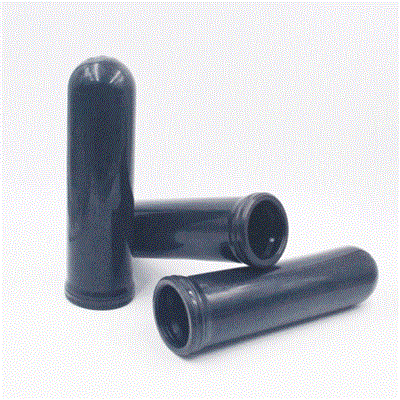
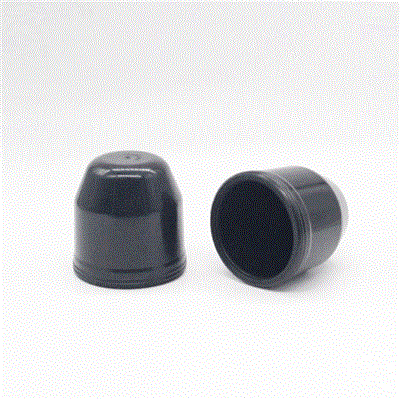
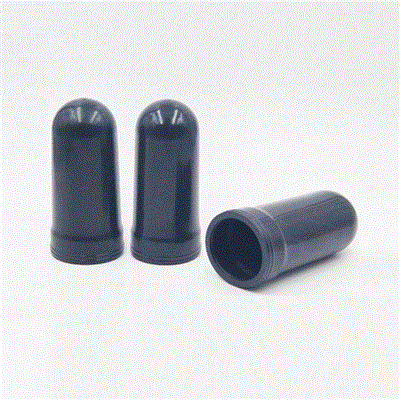
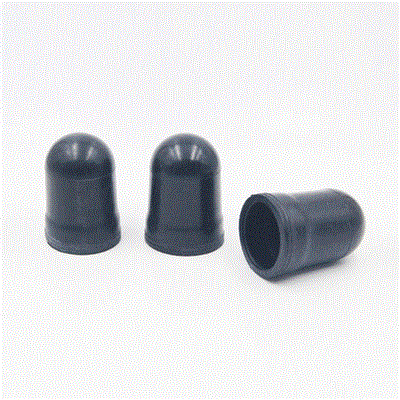
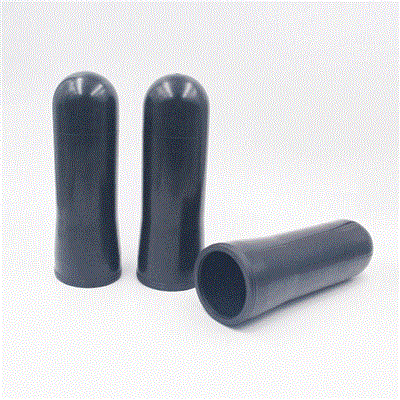
Piggyback shocks sometimes have an internal floating piston that separates oil and nitrogen. But more commonly, a rubber bladder reservoir holds the gas separately. This air bag tank is less likely to leak than a separate piston seal.
Main features:
Ensure oil and gas separation and avoid foaming
Actively prevent cavitation and improve overall impact performance
Provides consistent damping for optimal traction and control
Helps extend shock absorber life
Material: NBR, HNBR
A nitrogen gas bladder is a small rubber component, yet it decides whether a piggyback or remote reservoir shock keeps its damping curve on a long gravel stage or a heavily loaded delivery route. Procurement teams that treat the bladder as an ordinary rubber part usually end up with repeat warranty claims, because the failure modes are chemical and dimensional rather than visible at goods receipt.
This guide is written for purchasing managers, category buyers, and product engineers who need to place repeat orders with confidence. It covers the specification data worth locking into a drawing, the material grades worth paying for, the commercial terms worth negotiating, and the inspection routine worth running at your own warehouse. For the engineering side of bladder versus piston design, see our nitrogen gas bladder selection and specification guide.
Inside a reservoir, hydraulic oil sits on one side of the bladder and pressurized nitrogen on the other. The gas acts as a spring that takes up the volume displaced by the piston rod as it enters the shock body. Keeping the two media apart matters because nitrogen dissolved in oil forms foam, and foam compresses far more easily than liquid. Once the oil foams, the damping force drops, the shock fades, and the vehicle loses grip over repeated bumps.
The bladder also maintains a positive pressure on the oil column. That pressure suppresses cavitation behind the piston and in the rebound chamber, which is why a correctly charged reservoir feels consistent even when the shock works hard and hot.
| Comparison point | Rubber bladder reservoir | Internal floating piston |
|---|---|---|
| Separation method | Flexible rubber membrane | Rigid piston with dynamic seal |
| Typical leak risk | Lower, the membrane has no sliding seal | Depends on seal quality and bore finish |
| Packaging length | Shorter, the bladder folds into the reservoir | Longer, the piston needs travel length |
| Service behaviour | Replaced as a unit during a rebuild | Seal can be renewed, bore wear matters |
| Best fit | Tight packaging, off-road and utility shocks | High pressure, large volume applications |
Neither design is universally better. The commercial point is that a bladder absorbs tolerance stack up, so it often lets a shock builder keep a shorter reservoir and still pass durability testing.
Bladders are supplied in nitrile (NBR) and hydrogenated nitrile (HNBR). Both handle nitrogen and mineral hydraulic oil well. The difference appears when temperature and oil additives become aggressive.
| Property | NBR | HNBR |
|---|---|---|
| Typical service temperature | About -30 C to +100 C | About -40 C to +150 C |
| Ozone and weathering resistance | Moderate, needs antiozonant | Good |
| Compression set at high temperature | Higher | Lower |
| Oil and fuel resistance | Good | Very good |
| Relative cost | Lower | Higher |
| Typical use | Passenger car, light utility shocks | Heavy duty, high temperature, long service |
Ask for the compound record rather than a generic data sheet. The useful items are base polymer type and acrylonitrile content, hardness in Shore A, tensile strength, elongation at break, compression set after hot air ageing, low temperature brittleness point, and the fluid compatibility list. A bladder specified at 70 Shore A behaves very differently from one at 80 Shore A, even at identical dimensions, because a harder compound resists extrusion better but accepts less flexing before fatigue.
Bladder dimensions are not interchangeable between shock families, and a supplier cannot quote accurately from a vehicle model alone. Fix the following values on the drawing so that samples, pilot batches, and mass production stay identical.
| Datum | Why it matters commercially |
|---|---|
| Neck outer diameter and neck length | Controls sealing in the reservoir cap, drives tooling |
| Overall length, relaxed and installed | Sets gas volume and reservoir packaging |
| Maximum inflated diameter | Sets bore clearance and fold pattern |
| Wall thickness at crown and at neck | Controls fatigue life and extrusion resistance |
| Bead or flange profile | Decides whether a clamp or cap seal is used |
| Part marking position | Supports traceability and private label programmes |
Where the original part is not documented, a 2D drawing plus a 3D scan of a used sample is usually enough for a quotation. Send at least two used samples from different service mileages so the supplier can see permanent set and confirm the relaxed dimensions.
Gas volume has to absorb the rod volume swept during full compression without an excessive pressure rise. A common starting target is a gas volume of roughly 1.5 to 2.5 times the swept rod volume for a monotube or piggyback layout, then validated on a damper dyno. Buying a bladder with generous volume is cheap insurance against fade, provided the reservoir envelope allows it.
| Application | Typical precharge range | Note |
|---|---|---|
| Passenger car monotube | About 10 to 20 bar | Comfort biased, low rod force |
| Off road and utility | About 15 to 30 bar | Higher pressure resists fade |
| Heavy duty truck and bus | About 25 to 40 bar | Confirm with the damper developer |
Treat these as starting points only. Precharge interacts with valve stack, rod diameter, and vehicle mass, so the final value belongs to the damper engineer, not to the purchasing file.
Most buyers do not need a bladder for every vehicle. Group the catalogue by reservoir bore and neck geometry, then map each group against vehicle platforms and annual demand. Two or three bladder families often cover a whole regional programme, which keeps tooling cost and stock keeping units manageable. Publish the cross reference in your own catalogue so that resellers can order by platform.
| Cost element | What to clarify in the quotation |
|---|---|
| Unit price tiers | Breaks at pilot, container, and annual volume |
| Mould or tooling charge | One time or amortised, and who owns the tool |
| Sample charge | Free, refundable, or credited against the first order |
| Packaging | Bulk carton or retail box, and who pays for artwork |
| Freight and terms | EXW, FOB, or CIF, and which port |
| Payment terms | Deposit ratio, balance against documents |
Bladders should travel in a shape that prevents permanent set. Suppliers normally pack them relaxed, lightly dusted, and protected from direct sunlight. Ask for a desiccant where humidity is high during transit. For private label programmes, confirm that the supplier will mould or print your part number on the neck, and that the printed number survives oil contact.
For non standard neck profiles or a bespoke reservoir layout, see our custom parts programme and the wider shock absorber parts catalogue.
| Audit area | Evidence to look for |
|---|---|
| Quality management | Certified system such as IATF 16949 or ISO 9001 |
| Compound control | Batch records, hardness and tensile test data |
| Moulding process | Controlled cure time and temperature logging |
| Burr and flash control | Defined trim operation and visual standard |
| Dimensional control | Gauge list, frequency, and capability records |
| Contamination control | Clean moulding area, no mixed material handling |
| Traceability | Batch number linking compound lot to shipping carton |
Never move from quotation to container volume in one step. Order a small pilot quantity, build a few dampers, and run them on the dyno and, where possible, on a vehicle. Check for gas loss over time, neck sealing, and whether the fold pattern shows stress whitening after cycling. A pilot order costs little and usually reveals a tooling or compound issue before it becomes a field problem.
| Check | Method | Acceptance idea |
|---|---|---|
| Part number and batch | Visual against packing list | Matches purchase order |
| Hardness | Shore A durometer on a flat area | Within the drawing tolerance |
| Key dimensions | Caliper or go no go gauge | Neck and overall length in tolerance |
| Surface quality | Visual under good light | No cuts, blisters, or inclusions |
| Age and storage | Cure date on the label | Within the agreed shelf life |
Keep the inspection sample with its carton label. If a field issue appears later, that retained sample lets you and the supplier compare compound and dimensions against the original approval.
Because the part is small, bladders are easy to substitute. A lower grade compound can pass a visual check and still fail within a season. Protect the programme with a written specification, an approval sample signed by both sides, and periodic re testing of production pieces rather than a single first article report.
Rubber ages. Ask the supplier for a cure date and a recommended shelf life, then apply first in first out rotation in your warehouse. Store bladders away from direct sunlight, ozone sources such as electric motors, and oily floors. Where storage time is long, request slightly over cured stock or plan a rotation that keeps the oldest material moving first.
Disassemble a used reservoir and look at the gas side. A flexible rubber membrane that folds into the housing indicates a bladder design. A rigid piston with a seal ring and a machined bore indicates a floating piston. The part number on the reservoir housing and the shock datasheet usually confirm it without disassembly.
Usually yes, because the two compounds are supplied in the same moulded shapes, and the upgrade mainly improves heat and ozone resistance. Confirm that the harder HNBR variant still seals on the existing neck geometry, and re check precharge behaviour on the dyno before releasing a container volume.
It depends on whether the tool already exists. For a standard shape from an existing mould, a pilot order can be small and priced as a sample batch. For a new neck or bead profile, expect a tooling charge and a first order sized to absorb it, then negotiate a schedule that releases volume over several shipments.
Keep them in the original packaging, relaxed and unpressurised, in a cool dry place out of sunlight. Avoid hanging them on hooks, which can set a permanent crease, and avoid storing them next to ozone generating equipment. Apply first in first out rotation and check the cure date before releasing stock to the line.
Send us the reservoir dimensions, the compound requirement, and your target annual volume, and we will return a quotation with tooling, packaging, and sampling options. Our team supports NBR and HNBR bladders for piggyback and remote reservoir shocks, along with related piston rods and chassis and suspension components. Review the full range in our product index or contact our export team to start an RFQ. You can also browse the whole nitrogen gas bladder category.