sales@bonporaparts.com
0086-10-64988621
English
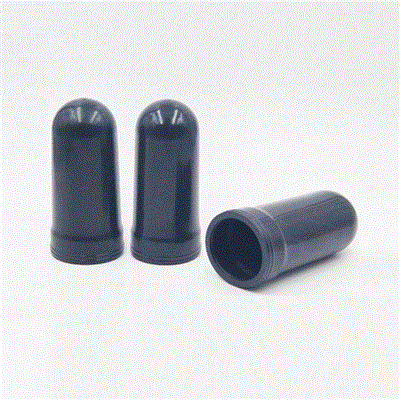
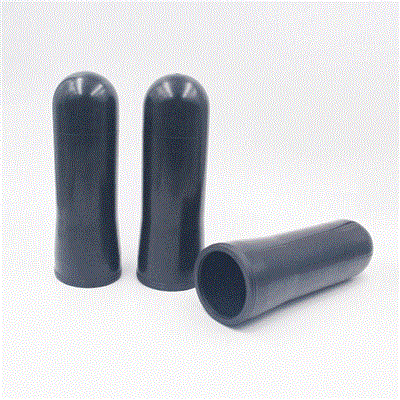
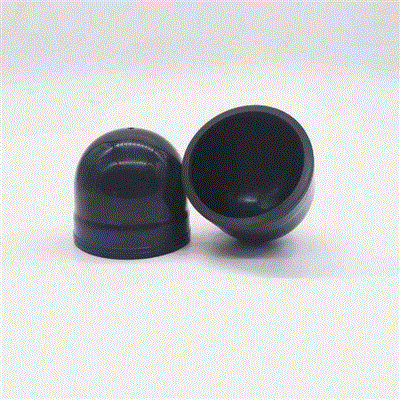
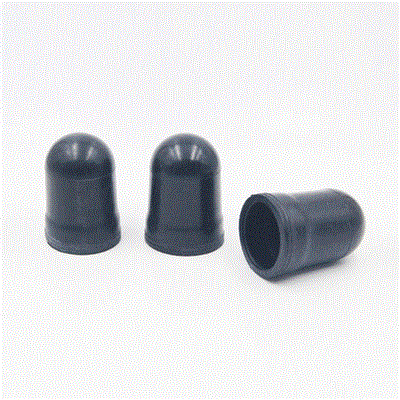
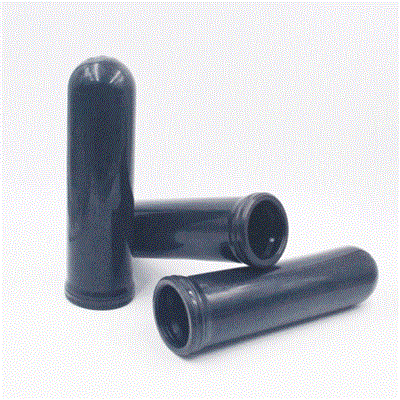
Piggyback shocks sometimes have an internal floating piston that separates oil and nitrogen. But more commonly, a rubber bladder reservoir holds the gas separately. This air bag tank is less likely to leak than a separate piston seal.
Main features:
Ensure oil and gas separation and avoid foaming
Actively prevent cavitation and improve overall impact performance
Provides consistent damping for optimal traction and control
Helps extend shock absorber life
Material: NBR, HNBR
Buyers often treat a nitrogen gas bladder as a simple rubber bag and compare quotations on price and wall thickness alone. That view hides the real variable. Two bladders that measure identically can behave very differently after a year of service, because one compound holds its elasticity while the other hardens, cracks, or lets nitrogen escape through the wall.
For a purchasing team, the compound specification is the part of the purchase order that protects the warranty. This guide explains what sits behind the grade callout, how the properties are measured, and which process controls a supplier should be running before the bladder reaches your shelf. For dimension and fit questions, see our bladder selection and specification guide.
The bladder lives in a harsh, sealed environment and is expected to last for years. In service it faces several stresses at once.
Continuous flexing as gas volume changes through every suspension stroke, often millions of cycles.
Permanent contact with damping oil, which contains additives that attack some elastomers.
Gas pressure that diffuses slowly through the rubber wall and drives any permeation weakness.
Heat from the damper body plus cold winter starts, which together set the practical temperature window.
Assembly handling, where a stiff compound is harder to seat without pinching.
A compound is therefore chosen as a balance. High oil resistance usually comes with poorer low temperature flexibility, and lower gas permeation often costs more per kilogram. The right answer depends on the duty cycle of the vehicle, not on a single headline number.
NBR is the workhorse elastomer for oil and gas separation. Its properties are set largely by the acrylonitrile content. A higher acrylonitrile grade resists oil better and permeates less, but becomes stiffer at low temperature. NBR is cost effective, widely available, and adequate for many passenger car dampers where working temperatures stay moderate.
HNBR is produced by hydrogenating the butadiene backbone of NBR, which leaves a more saturated polymer. The result is substantially better heat ageing, markedly lower compression set, and higher mechanical strength. HNBR is the usual choice for off road, motorsport, and heavy duty dampers where the reservoir runs hot or the service interval is long. It costs more, so it should be specified where the duty justifies it rather than applied to every part number.
Occasionally a designer looks at EPDM for its excellent weather and water resistance, or at fluoroelastomer grades for extreme heat and aggressive fluids. Both bring trade offs. EPDM has weak resistance to mineral oil, and fluoroelastomer is expensive and stiffer at low temperature. For a nitrogen separator inside a shock absorber, NBR and HNBR cover the majority of applications, and any departure should be supported by test data rather than by preference.
| Property | NBR | HNBR |
|---|---|---|
| Oil and additive resistance | Good, improves with higher acrylonitrile content | Good to very good, more stable over time |
| Heat ageing | Moderate; hardening accelerates above typical damper temperatures | Strong; retains elasticity well at the same exposure |
| Compression set | Acceptable for moderate duty | Low, which keeps the neck bead sealing |
| Low temperature flexibility | Better at low acrylonitrile content | Depends on grade and plasticiser package |
| Gas permeation | Higher, so some pressure loss over years | Lower, which helps hold precharge |
| Relative cost | Lower | Higher, justified by service life |
The comparison is directional only. Within a single family, formulation changes hardness, permeation, and low temperature behaviour, so the grade name alone does not define performance. The line callout on the drawing is what makes the requirement enforceable.
Hardness is quoted in Shore A with a tolerance, for example 70 plus or minus 5. A wide tolerance allows the supplier to drift within the band and still pass, which is why tight programmes ask for a narrower window and a batch certificate. Hardness also interacts with neck sealing: a compound that is too hard resists seating, while one that is too soft can extrude under clamp load.
These two values describe how much the wall stretches before it fails. Bladders flex continuously, so elongation matters as much as strength. A high tensile figure with low elongation points to a stiff compound that may crack at a fold line rather than stretch around it.
Compression set measures how much a squeezed sample fails to recover after a set time at temperature. It is the single most useful indicator for any sealing surface. A high compression set value means the neck bead takes a permanent flattened shape, and a flattened bead leaks even though the rubber itself looks intact.
Low temperature properties are normally expressed through a brittleness point or a low temperature retraction test. A bladder that stiffens severely in winter can crack as the suspension compresses, so cold climate markets should state a low temperature requirement explicitly instead of leaving it to the supplier default.
Permeation describes how quickly nitrogen migrates through the wall. It cannot be eliminated, only reduced. Its practical effect is gradual precharge loss between services. If your damper specification allows only a small pressure drop over a long interval, permeation is the property to test and to quote a limit for.
| Property | Common requirement | Typical test reference |
|---|---|---|
| Hardness | 60 to 80 Shore A, tolerance stated on the drawing | Durometer method |
| Tensile strength | Grade dependent, minimum value stated | Dumbbell tensile test |
| Elongation at break | Sufficient for the fold radius in service | Dumbbell tensile test |
| Compression set | Low, measured after a defined heat soak | Constant deflection method |
| Heat ageing | Property change limited after ageing exposure | Air oven ageing |
| Low temperature | No brittleness above the stated market minimum | Low temperature brittleness test |
| Oil immersion | Volume swell within an agreed band | Reference oil immersion |
Values in this table are orientation only. The binding numbers belong on your own drawing, referenced to a recognised material classification, because a supplier cannot be held to a target that was never written down.
The process starts with the batch. A supplier should record the compound batch number, the cure date, and a viscosity check on arrival, and should retain a cured test slab from each batch. If those records cannot be produced on request, batch to batch consistency cannot be demonstrated.
Mix order, temperature, and cycle time determine how evenly the curatives and fillers are dispersed. Poor dispersion shows up later as blotchy surfaces, inconsistent hardness, and early cracking. Reputable factories control mixing against a written recipe and review mill sheets rather than relying on operator feel.
Bladders are usually compression or transfer moulded, with injection moulding used where volumes justify it. Preform weight and placement control wall thickness and the position of the neck bead. Air trapped during moulding becomes a void, and a void in the wall becomes a leak path under pressure.
Curing time and temperature convert the compound from a soft preform into an elastic solid. Under cure leaves the part weak and prone to high compression set. Over cure makes it brittle. The cure date is not paperwork; it is the anchor for shelf life monitoring, so it should be marked on every bladder or its bag.
Trimmed flash must not leave a nick at the bead or the neck. Inspectors look for voids, foreign particles, flow lines, blisters, and short fills, normally against a photo standard and under defined lighting. A written visual standard removes most of the disagreement between shifts.
Critical dimensions are gauged on a sampling basis, and function is confirmed by an air or water pressure hold test. Where the programme requires it, a burst or cyclic flex test is run on samples from the batch to confirm that the compound still meets its fatigue expectation.
| Check | Method | Frequency | Acceptance |
|---|---|---|---|
| Compound batch record | Document review | Every batch | Batch, cure date, and slab retained |
| Hardness | Durometer on cured sample | Every batch | Within drawing tolerance |
| Wall thickness and neck dimensions | Gauge or optical | Per sampling plan | Within drawing tolerance |
| Visual defects | Inspection against photo standard | Every part | No voids, nicks, or short fills |
| Pressure hold | Air or water test at defined pressure | Per sampling plan | No leakage or distortion |
| Compression set | Constant deflection, heat soak | Per batch or periodic | Below the stated limit |
| Cyclic flex endurance | Bench cycling on sample parts | Periodic or on change | No cracking before target cycles |
An inspection plan is only useful if the records travel with the shipment. Ask for a certificate of conformity that references the batch numbers actually delivered, not a generic statement covering the product family.
Rubber ages even in storage. Heat, ozone, ultraviolet light, and deformation all shorten the useful window, so bladders should be stored flat or in their formed shape inside sealed bags, away from sunlight, electric motors, and solvents. First in, first out rotation keeps the oldest stock moving first and prevents a crate of aged bladders reaching the assembly line.
Traceability closes the loop. If a field return is traced back to one production lot, the factory should be able to identify which compound batch, which mould, and which curing shift produced it. A simple lot code on the bag is enough to make that possible, and it costs almost nothing to apply at packing.
Correct storage and rotation is also part of the rebuild workflow covered in our bladder installation and charging guide, because an aged bladder that has taken a set shape is difficult to seat without a crease.
| Observation | Likely material cause | What to review |
|---|---|---|
| Hard, shiny surface with fine cracks | Heat ageing or an under cured batch | Cure cycle records and grade choice |
| Sticky or swollen wall | Oil additive attack or wrong grade | Oil compatibility and immersion data |
| Flattened neck bead that will not seal | High compression set | Compression set values and cure date |
| Rapid precharge loss with no visible damage | High permeation compound | Permeation requirement on the drawing |
| Crack along a fold line | Stiff compound or a moulded crease | Hardness band and preform placement |
| Blister or void in the wall | Trapped air during moulding | Moulding process controls |
Each of these cases should be worked through systematically rather than assumed. Our bladder troubleshooting guide sets out the diagnostic sequence, and it separates material faults from assembly and charging faults so that a supplier is not held responsible for a fitting error and vice versa.
When you write the requirement, keep it short but enforceable. A workable specification normally contains the elastomer family and grade, the hardness with tolerance, minimum tensile and elongation, a compression set limit, the temperature window for the target market, a permeation requirement where precharge retention matters, the critical dimensions with tolerances, the required surface condition, the test references for each property, marking and packaging rules, and the documents to be supplied with each shipment.
It should also state the change notification rule. Any change of compound batch, mould, or processing site should trigger prior written approval and a fresh sample submission. That single clause prevents silent substitutions, which are one of the most common sources of a part that passes on the bench and fails in the field.
The bladder does not work alone. Its precharge interacts with the valve stack, the rod diameter, and the oil volume, and a change in one affects the others. Buying a piston rod or shock absorber components from a different supplier while keeping the bladder unchanged can shift the damping curve even though the bladder itself is proven.
That is why the specification is best viewed as a system. Consolidated ordering of chassis and suspension parts lets one supply chain owner verify compound, dimension, and precharge together, and the commercial mechanics of that approach are set out in our wholesale sourcing guide.
No. HNBR offers better heat ageing, lower compression set, and lower permeation, but it costs more and is not automatically the right answer for a mild application. Use it where the damper runs hot, the service interval is long, or the vehicle is used off road. For a standard passenger car damper within a moderate temperature range, a well specified NBR grade can meet the requirement at lower cost.
Hardness is one indicator among many. A part can sit inside the hardness band and still fail, because compression set, permeation, and cure state are not visible on a durometer reading. Use hardness as an incoming check, and rely on the batch test slab data for the properties that determine service life.
Ask for the batch records and the cured test slab results that correspond to the delivered lot numbers, and request a certificate of conformity. Compare the reported cure dates and batch numbers against the markings on the packaging. A supplier who can produce that paperwork consistently is usually controlling the process, and a supplier who cannot is the real risk in the chain.
Not immediately, but its properties do drift with age, and storage conditions decide how much. Follow the shelf life stated by the manufacturer, rotate stock first in first out, and reject any bladder that has taken a permanent set shape or shows surface bloom or cracking. Fitting an aged part to save a small amount of stock value is a poor trade against a warranty claim.
Send the damper drawing together with the compound line callout, the target temperature window, and the expected service interval. Our engineers will confirm the suitable NBR or HNBR grade, the properties that need to be tested, and the process controls to be documented, then quote against a written specification rather than a description.
We mould nitrogen gas bladders and other custom rubber and metal bonded parts to drawing, and we support both sample evaluation and volume production. Browse the nitrogen gas bladder category, review our full product index, or contact our export team to start an enquiry.