sales@bonporaparts.com
0086-10-64988621
English
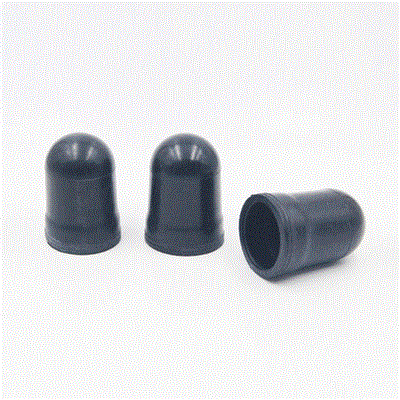
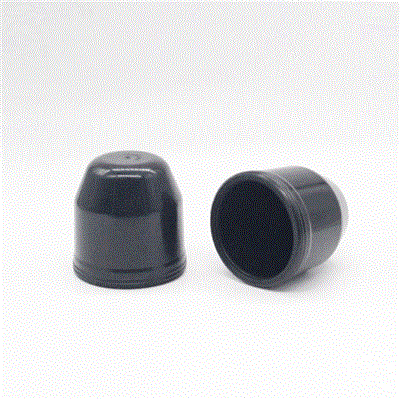
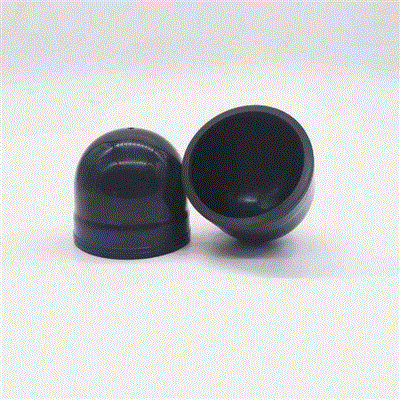
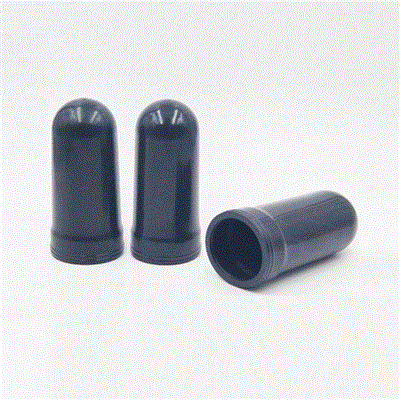
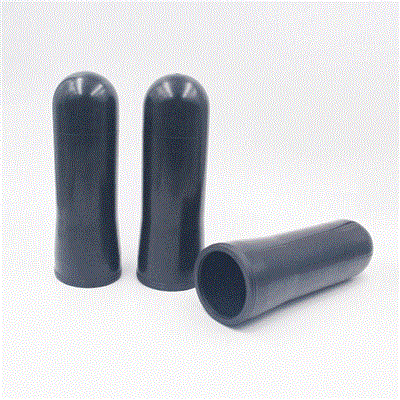
Piggyback shocks sometimes have an internal floating piston that separates oil and nitrogen. More commonly, a rubber bladder reservoir holds the gas separately, and this air bag tank arrangement is less likely to leak than a separate piston seal.
Main features:
Ensures oil and gas separation and avoids foaming
Actively prevents cavitation and improves overall impact performance
Provides consistent damping for traction and control
Helps extend shock absorber life
Material: NBR, HNBR
In a gas charged damper, the oil volume changes as the piston rod moves in and out of the body. Something has to absorb that change, and it also has to keep the nitrogen charge away from the oil. Two designs are common. The internal floating piston uses a rigid piston with an O-ring or a lip seal that slides inside a bore. The bladder design uses a flexible rubber membrane, clamped at the top of the reservoir, that expands and contracts as oil enters the reservoir. Because the bladder has no dynamic sliding seal against a machined bore, there is one less path through which nitrogen can escape into the oil, and one less bore surface whose finish has to be controlled. That is the reason a bladder reservoir is often chosen for replacement units where long, leak free service matters more than the smallest possible reservoir diameter.
| Aspect | Bladder Reservoir | Internal Floating Piston |
|---|---|---|
| Separation principle | Flexible rubber membrane | Rigid piston with a dynamic seal |
| Dynamic sealing points | Static clamp area only | Sliding seal along the bore |
| Bore finish sensitivity | Low, gas side is separated by the membrane | High, scratches can pass gas |
| Serviceability | Bladder can be replaced during a rebuild | Piston and seal replacement, bore rework |
| Reservoir envelope | Usually wider for the same gas volume | Usually more compact in diameter |
| Typical applications | Off road, racing and heavy duty dampers | Compact monotube and piggyback designs |
Neither design is universally superior. The choice depends on the reservoir envelope, the service interval and the expected gas pressure. Buyers who handle both types should keep the bladder part number and the piston kit number separate in the catalogue so that a rebuild kit is not ordered against the wrong reservoir.
The compound fixes the temperature window, the oil compatibility and how quickly the nitrogen migrates through the membrane wall. Nitrile rubber is the standard choice for general purpose dampers, while hydrogenated nitrile rubber is used where heat and long service life dominate the requirement.
| Property | NBR | HNBR |
|---|---|---|
| Service temperature, typical | About -30 C to +100 C | About -30 C to +150 C |
| Resistance to mineral oil and grease | Good | Very good |
| Nitrogen permeation | Moderate | Lower |
| Tear and abrasion resistance | Good | High |
| Ozone and weathering resistance | Needs a protective additive package | Better with the same package |
| Relative compound cost | Baseline | Higher |
| Where it is used | Standard replacement dampers | High temperature, heavy duty and long life units |
Two practical notes are worth writing into a specification. First, compounds based on EPDM or silicone are not suitable for mineral oil contact, even when the temperature rating looks attractive on paper. Second, a saturated backbone compound such as HNBR tolerates heat aging better, but it still needs the correct cure system and a post cure step to reach its full property set, so the supplier should state the cure system on the batch record rather than only the compound name.
| Specification | Typical Range | Why It Matters |
|---|---|---|
| Inlet bore and bead diameter | Set by the reservoir head | Controls sealing at the clamp |
| Overall length | Set by the gas chamber volume | Controls the usable gas volume |
| Wall thickness | 1.0 mm to 2.5 mm | Thinner walls flex easily but permeate gas faster |
| Shore A hardness | About 55 to 75 | Balances flexibility against extrusion resistance |
| Gas charge pressure | Commonly 10 bar to 30 bar | Sets the damper response curve |
| Temperature rating | NBR or HNBR dependent | Protects against hardening and cracking |
| Media compatibility | Damper oil and nitrogen | Prevents swelling and property loss |
| Marking | Size code and cure date | Supports traceability and stock rotation |
As a starting point, the gas chamber volume should be large enough that the pressure rise over the full compression stroke stays within the range defined by the damping specification. A bladder that is folded against itself at full compression cannot supply the gas volume the curve assumes.
Precharge is normally set with the shaft fully extended and recorded on the build sheet. After charging, allow the unit to sit so that temperature and pressure equalise before the final pressure reading is taken. A force against velocity curve run on a dynamometer is the practical check that the charge and the bladder volume agree with the intended damping.
A rolled or twisted bead is a frequent cause of slow leaks at the clamp. Lubricate with the specified assembly fluid, seat the bead fully in its groove, and confirm that the membrane sits square in the housing before the cap is torqued.
| Symptom | Likely Cause | Suggested Action |
|---|---|---|
| Gradual loss of gas pressure | Permeation through the wall or a slow leak at the clamp | Pressure test the joint, check the wall thickness and compound |
| Oil found in the gas chamber | Ruptured or perforated membrane | Replace the bladder, inspect the bore for debris |
| Hardened, cracked membrane | Heat aging beyond the compound rating | Move to an HNBR compound or reduce heat exposure |
| Swollen bladder with soft feel | Incorrect oil compatibility | Verify the fluid and specify a suitable compound |
| Bladder extruded into the port | Excessive pressure or an undersized support | Reduce precharge, review the support ring design |
| Foaming and fading damping | Gas mixed into the oil after a membrane failure | Rebuild the unit and flush the oil circuit |
Because a bladder is a low cost item inside a higher value assembly, a defective batch can cause expensive warranty work. A simple incoming inspection plan is usually enough: check the bead diameter and overall length with a gauge, verify Shore A hardness with a durometer on a flat area, inspect the sealing bead visually under magnification, and pressure test a sample from each batch. Ask the supplier to keep batch traceability for the compound lot and the cure date, and store stock away from direct sunlight, ozone sources and heavy electrical equipment. Rotate stock on a first in, first out basis, because rubber compounds age even in a closed bag. Buyers who also source piston rods and other shock absorber parts can place a sample pressure test requirement on the whole rebuild kit rather than on the bladder alone.
No. A bladder reservoir removes the sliding seal and is often preferred where leak free service matters, while a floating piston can be more compact in diameter. The right choice follows the reservoir envelope, the service interval and the target gas pressure.
For competition and heavy duty use, a pressure check at each rebuild is common. For road vehicles, checking the charge when the damper is serviced or when damping performance changes is a practical interval.
Continuous operation above the rated temperature of the compound shortens service life and can harden the rubber. Where the reservoir sits close to a heat source, an HNBR compound is the usual recommendation.
The most common causes are a twisted or rolled bead during assembly, a burr or pit in the groove, and over or under torqued hardware. Inspect the bead seating and the groove finish before condemning the part.
Bonpora Parts supplies nitrogen gas bladders in NBR and HNBR, moulded to your reservoir head dimensions with the hardness, wall thickness and pressure range recorded on the drawing. Send us the reservoir bore, the required length and the operating temperature, and our engineers will review the closest existing tool or quote a new one. For a first order, a small trial batch with a pressure test report keeps the release decision simple. Start from the nitrogen gas bladder range, review the wider chassis and suspension programme, or contact our team with your specification. Custom compound and custom moulded parts are quoted on request.