
- 1. 1. Different Core Protection Objectives
- 2. 2. PU Bump Stop s: From Comfort Cushion to Critical Safety Stopper
- 3. 3. Subframe Deformation Strategy: Energy Absorption Without Battery Intrusion
- 4. 4. Skid Plate Layout and Clearance Gaps
- 5. 5. Suspension Component Intrusion Risk Control
- 6. 6. Repair & Aftermarket Pitfalls for Wholesale and Repair Shops
- 7. FAQ
- 7.1. Why is EV underbody protection more critical than ICE?
- 7.2. Can I use ICE bump stops on EVs for battery protection?
- 7.3. What parts should I inspect after an EV bottom strike?
- 7.4. Does a skid plate alone fully protect the EV battery?
- 7.5. What is the main risk of mismatched aftermarket EV suspension parts?
- 7.6. Summary for Auto Wholesalers & Repair Shops
EV Underbody & Battery Impact Protection vs ICE Vehicles
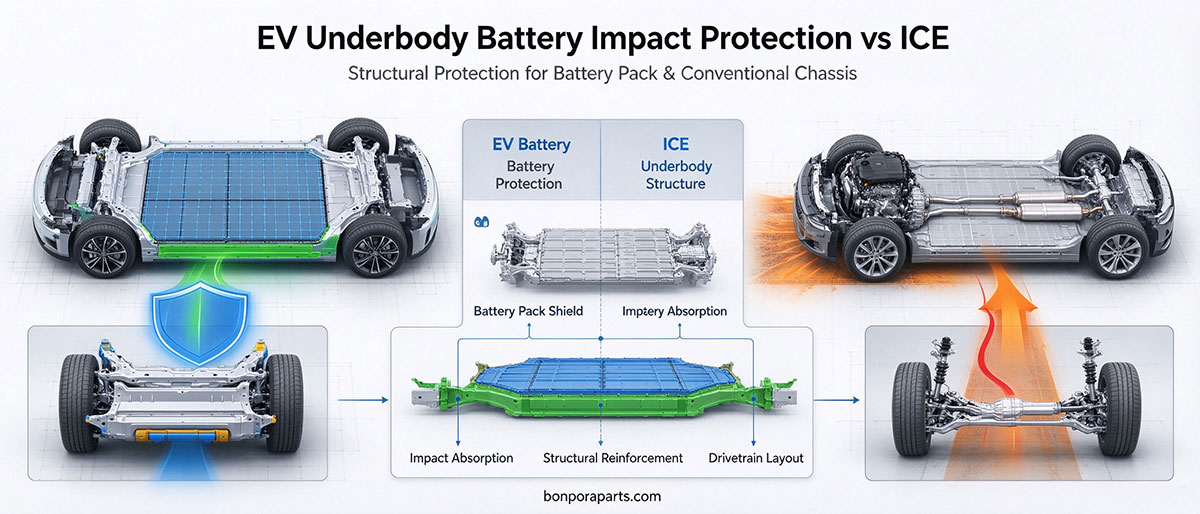
Bottom strike is a common road hazard for all vehicles, but the consequence differs drastically between EV and ICE cars. For traditional fuel vehicles, scraping the underbody usually damages the oil pan, exhaust pipe or fuel tank. For electric vehicles, a hard underbody impact can deform the battery housing, damage internal cells, trigger leakage and thermal runaway risk. That is why EV underbody protection is a whole integrated system, not just a plastic skid plate. PU bump stops, control arms, subframes and shock absorbers all take on new safety roles. BONPORA designs EV suspension components with battery clearance and impact energy absorption in mind for aftermarket replacement.
1. Different Core Protection Objectives
ICE underbody protection focuses on guarding vulnerable auxiliary components: engine oil sump, exhaust catalytic converter, fuel tank and brake lines. The protection goal is to avoid fluid leakage and mechanical breakdown. Even if the underbody structure bends, the powertrain itself is relatively tolerant of minor deformation.
EV underbody protection is centered on the high-voltage battery pack. The battery is large, thin and mounted at the lowest chassis plane. Its sealed housing cannot withstand local concentrated impact. The entire suspension travel envelope, limit structure and subframe are engineered to prevent any hard component from punching into the battery casing during a bottom strike. This is the primary safety target that ICE chassis design does not need to prioritize.
2. PU Bump Stops: From Comfort Cushion to Critical Safety Stopper
On ICE vehicles, PU bump stops only serve as soft cushions for rare extreme compression events. They are sized for ride comfort and do not define a hard safety boundary.
On EVs, bump stops become the first mechanical travel limiter. They are calibrated to contact before the suspension arm, shock body or wheel inner liner can reach the battery pack. EV-grade bump stops adopt multi-stage stiffness: soft initial compression to filter harsh impact, then rapidly rising stiffness to lock suspension travel. Repeated compression fatigue performance is mandatory, because permanent compression set will reduce the safe clearance and invalidate the battery protection function. Replacing them with ordinary ICE bump stops removes this critical safety buffer.
3. Subframe Deformation Strategy: Energy Absorption Without Battery Intrusion
ICE subframes are designed to protect the engine and transmission. Their crush zones are tuned to dissipate impact away from the powertrain.
EV front and rear subframes adopt a segmented crash path. When hitting a curb, rock or speed bump, the subframe is supposed to deform and absorb energy while keeping all suspension mounting points out of the battery envelope. Some EV subframes use sacrificial weak points so that impact force is consumed locally instead of transferring upward into the battery tray. After a bottom strike, repair technicians must inspect not only the skid plate but also bent control arms, shifted mounting brackets and compressed bump stops — hidden damage that may reduce battery clearance.
4. Skid Plate Layout and Clearance Gaps
ICE skid plates are usually partial covers, leaving large openings for exhaust and driveline. They mainly block mud and minor debris.
EV battery skid plates are large, continuous panels directly under the battery module. Materials range from high-strength steel and aluminum alloy to composite laminate. The gaps between the skid plate and suspension components are tightly calculated. If aftermarket parts change the suspension resting height or compressed travel, the skid plate may collide with control arms or shock bodies during compression. Many aftermarket fitment failures come from ignoring this tight clearance relationship.
5. Suspension Component Intrusion Risk Control
During full compression, every moving part inside the wheel arch has a defined sweep envelope. On ICEs, the only concern is tire or suspension interference with the body shell. On EVs, the envelope check adds the battery side wall and bottom tray.
Control arms must not swing inward toward the battery at maximum compression
Shock absorbers are positioned and angled to avoid battery contact
Ball joints and bushings are checked for lateral play that could shift the wheel assembly closer to the battery
Even if an aftermarket arm has the same bolt holes, slightly different geometry can create an intrusion risk under heavy compression.
6. Repair & Aftermarket Pitfalls for Wholesale and Repair Shops
Bottom strike repairs for EVs cannot follow ICE repair logic. Many repair shops only replace the scratched skid plate and ignore the suspension limit system. The hidden risks include:
Permanently compressed PU bump stops that no longer provide enough limiting travel
Bent control arms shifting wheel geometry and reducing battery clearance
Altered ride height after spring replacement, changing the compression envelope
Using ICE-spec suspension parts that have longer compression stroke
For wholesale buyers, it is essential to verify that replacement parts retain the original designed travel limit and battery clearance, not just static strength.
FAQ
Why is EV underbody protection more critical than ICE?
EVs carry a large high-voltage battery pack at the lowest chassis position. Bottom strike can damage battery cells and cause thermal hazards, while ICE underbody scratches mostly affect oil pans or exhaust components.
Can I use ICE bump stops on EVs for battery protection?
Not recommended. ICE PU bump stops are not sized or stiffness-tuned to limit suspension travel for battery clearance. They may bottom out too late and let suspension parts hit the battery housing.
What parts should I inspect after an EV bottom strike?
Check the skid plate, battery tray, PU bump stops, control arms, subframe brackets and shock absorber mounting points for deformation or permanent compression.
Does a skid plate alone fully protect the EV battery?
No. The skid plate handles direct abrasion and light impact. The suspension limit system including bump stops and subframe energy absorption is the second critical safety layer for heavy compression events.
What is the main risk of mismatched aftermarket EV suspension parts?
Incorrect travel limit or changed geometry can reduce battery clearance. Under compression, suspension components may intrude into the battery pack even without obvious collision signs.
Summary for Auto Wholesalers & Repair Shops
EV underbody protection is a multi-layer safety system combining skid plates, subframe crash design and suspension travel limit components. Unlike ICE vehicles where underbody damage is mostly a fluid leak or mechanical failure issue, EV bottom strike directly involves high-voltage battery safety. PU bump stops, control arms and shock absorbers are no longer purely comfort parts; they define the safe compression boundary around the battery pack. Sourcing ICE-spec replacement parts removes this engineered safety margin and creates hidden liability for repair shops and distributors.
BONPORA EV suspension components are validated with battery clearance and bottom strike protection requirements for pure electric platforms.
Contact us for technical drawings, clearance verification data and bulk pricing of EV safety suspension parts.