
- 1. What Is a Wave Shim?
- 2. What Is a Lockout Shim?
- 3. Why These Two Shims Matter So Much in a Damper
- 4. Wave Shim vs. Lockout Shim: Quick Comparison
- 5. Installation and Setup: Details That Make or Break the Result
- 6. Common Maintenance and Replacement Scenarios
- 7. FAQ
- 8. Conclusion: Small Parts, Big Performance Ceiling
Wave Shim & Lockout Shim Guide | Damper Shims for MTB Suspension & Shock Absorbers
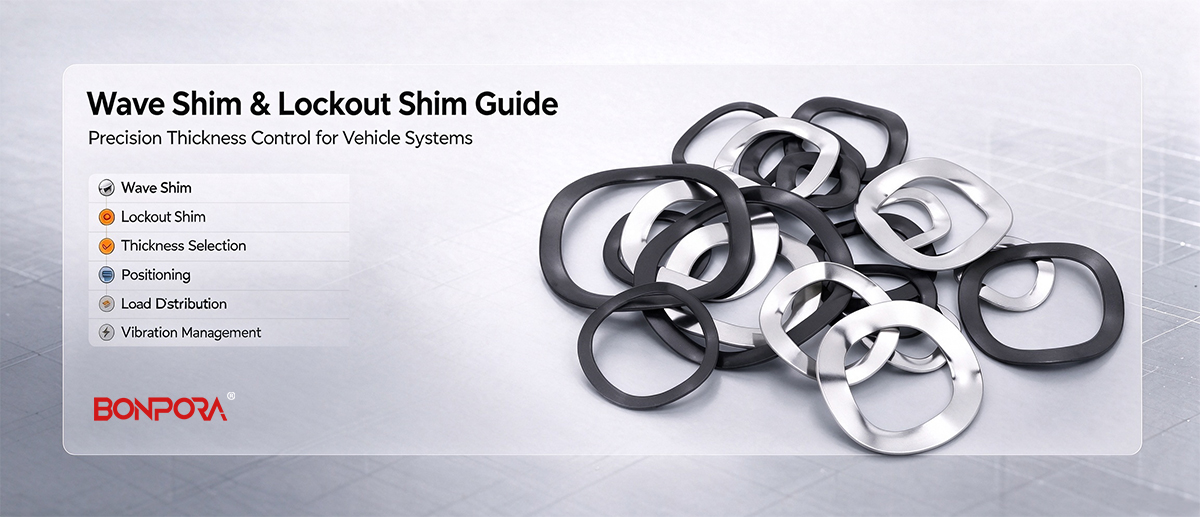
For suspension tuners, damper rebuilders, and aftermarket parts buyers, two tiny components quietly decide how your shock or fork actually feels on the trail: the Wave Shim and the Lockout Shim. They are small, inexpensive, and easy to overlook — yet they directly control valve stack behavior, lockout efficiency, and long-term stability. If you have ever chased a vague "mushy" compression stroke or a lockout that never feels fully locked, the root cause is often hiding in one of these two washers.
This guide explains what Wave Shims and Lockout Shims are, how they work inside a damper, how to choose and install them correctly, and when to replace them during a rebuild.
What Is a Wave Shim?
A Wave Shim (also called a wave washer, wave spring washer, or wave compensating shim) is an elastic metal washer with a continuous wave-shaped profile. Unlike a flat washer, it relies on its own elastic deflection to deliver a consistent preload and compensate for axial play in an assembly.
You will find Wave Shims inside mountain bike rear shocks, motorcycle forks, and industrial shock absorbers. Their job inside a damper is simple but critical:
Absorb machining and assembly tolerances between the valve stack, piston, and circlip
Prevent axial play (free play / rattle) as the damper cycles over time
Keep every valve shim or disc in the stack evenly loaded, so oil flow behaves predictably
What Is a Lockout Shim?
A Lockout Shim is a high-precision, hard washer engineered specifically for the lockout (compression gate) circuit of a suspension damper. It is typically made from hardened stainless steel or alloy steel, ground to tight parallelism tolerances.
When you flip the lockout lever on a trail bike rear shock, an e-bike fork, or a heavy-duty truck or machinery damper, the Lockout Shim is the part that seals the oil passage. It blocks bypass flow, cuts unnecessary compression travel, and delivers that near-rigid pedaling platform riders pay for.
Why These Two Shims Matter So Much in a Damper
The Value of a Wave Shim
Tolerance compensation: It cancels out tiny machining and assembly gaps, eliminating the looseness and rattling noises that develop after months of use.
Even valve preload: A continuous, uniform elastic preload keeps low-speed compression and rebound feeling linear — no dead stroke, no sudden harshness.
Temperature stability: When oil viscosity changes with temperature, a quality Wave Shim maintains its spring rate, keeping damping performance consistent from a cold morning climb to a hot summer descent.
The Value of a Lockout Shim
Reduced bypass leakage: In the locked position, it dramatically cuts oil bypass so the lockout feels crisp — no "almost locked" floating sensation.
Impact protection: It absorbs the pressure spike at the moment of lockout engagement, shielding the main valve discs from localized deformation and extending the life of the whole valve assembly.
Tunable engagement threshold: By selecting thickness, tuners can set the exact pressure at which the lockout blows off — matching rider weight, riding style, and e-bike or cargo loads.
Wave Shim vs. Lockout Shim: Quick Comparison
| Attribute | Wave Shim | Lockout Shim |
|---|---|---|
| Structure | Continuous multi-wave elastic profile | Flat, precision-ground hard washer |
| Core function | Preload & axial play compensation | Seals lockout circuit, blocks oil bypass |
| Typical material | Spring steel, stainless steel | Hardened stainless or alloy steel |
| Key spec | Wave height, load/deflection rate | Thickness, parallelism, flatness |
| Common applications | MTB shocks, motorcycle forks, valve stacks | Rear shock lockout, e-bike forks, truck & industrial dampers |
Installation and Setup: Details That Make or Break the Result
Most disappointing results after a shim swap come from a handful of avoidable mistakes. Check these before you blame the part:
Inspect flatness and geometry first. A Wave Shim's waves must be uniform — no flattened spots or cracks. A Lockout Shim's two faces must be parallel within a very tight tolerance, or it will wear unevenly under load.
Never substitute a flat washer for a Wave Shim. A flat washer has no elastic compensation. The gap returns after a short period of use, and the suspension feel goes loose again.
Match Lockout Shim thickness to the original valve stack height. Too thick and the lockout lever binds; too thin and the circuit leaks down, leaving you with a soft, unsupported platform.
Keep every working face spotless. Metal swarf or a fragment of an o-ring trapped between a shim and a valve disc is a classic recipe for scored oil passages and a dead lockout circuit.
Lubricate per the damper manufacturer's spec and torque the top cap / retaining hardware to the stated value — over-compressing a Wave Shim kills its spring rate permanently.
Common Maintenance and Replacement Scenarios
Low-speed rebound noise or ineffective preload adjustment? Inspect the Wave Shim for fatigue — a flattened or collapsed wave profile is the usual culprit.
Lockout slipping, shock still bobbing while pedaling? The Lockout Shim is likely worn or undersized in thickness. Replace with the correct high-precision specification.
Full rebuild? Treat Wave Shims and Lockout Shims as consumables. Shims that have survived repeated high-pressure spikes should not be reinstalled.
Heavy-duty use — e-MTBs, cargo bikes, industrial vehicles? Upgrade to higher-grade materials for better fatigue life and consistent performance under sustained loads.
FAQ
Is a Wave Shim the same as a regular spring lock washer?
No. A Wave Shim has a continuous wave profile that delivers smoother, more uniform force — ideal for precision valve stack preload. A split spring washer concentrates stress at the gap, can scratch mating surfaces, and is unsuitable for high-precision suspension work.
Can I sand or grind a Lockout Shim to adjust its thickness?
Not recommended. Hand grinding easily destroys face parallelism, causing uneven loading during lockout. Always use standard, precision-ground finished shims in the correct thickness.
Are Wave Shims interchangeable between suspension brands?
Substitution is possible only when outer diameter, inner diameter, wave height, and material all match — but it is always safer to use the OEM-specified part number so you do not alter the factory valve force curve.
How often should these shims be replaced?
There is no fixed mileage interval. Replace them at every damper rebuild, and immediately if you notice lockout leakage, new free play, or rebound inconsistency.
Conclusion: Small Parts, Big Performance Ceiling
In the suspension and shock absorber supply chain, Wave Shims and Lockout Shims are low-cost, low-visibility components that set the performance ceiling of the entire damping system. Choose the right specifications, install them clean and correctly, and a suspension issue you have chased for months can sometimes be solved by replacing a single washer.
Need help matching Wave Shim or Lockout Shim specifications for your fork, shock, or industrial damper? Contact our team for material options, size charts, and OEM-equivalent replacements.
- Prev.:Shim vs Notch Shim vs Triangle Shim: Differences, Applications and Installation Guide
- Next.:...