sales@bonporaparts.com
0086-10-64988621
English
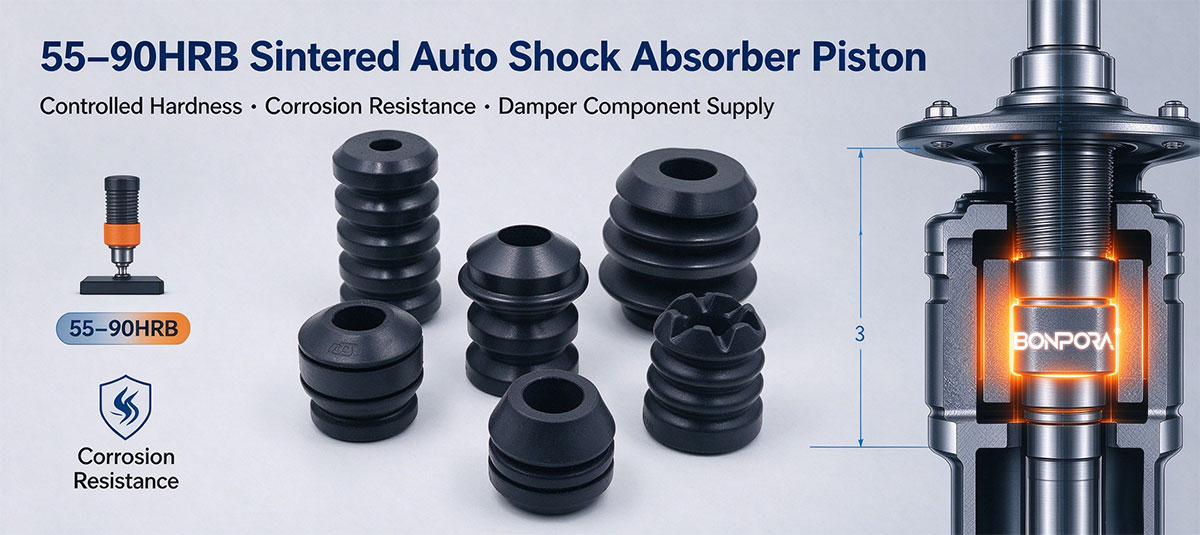
Foreign buyers searching for 55–90HRB sintered auto shock absorber piston corrosion resistance are typically looking beyond a standard metal piston. They want a powder metallurgy component with controlled hardness, good wear stability, corrosion resistance and consistent quality for automotive shock absorber production or aftermarket assembly.
This kind of search usually indicates a more technical purchase stage. The buyer may be:
An OEM shock absorber manufacturer checking material specifications for new damper development;
An aftermarket parts supplier sourcing replacement pistons for passenger cars, SUVs or light commercial vehicles;
A hydraulic damper component buyer looking for corrosion-resistant sintered parts to reduce field failures;
A quality engineer comparing hardness range, density, porosity and corrosion test performance.
These buyers are not just looking for “any piston.” They are likely evaluating:
Hardness range: 55–90HRB must be stable across production batches;
Corrosion resistance: especially for dampers used in humid, coastal or salt-exposed environments;
Wear resistance: to maintain sealing performance over long reciprocating strokes;
Dimensional accuracy: for good fit with piston rods, oil seals and damper tubes;
Material consistency: to avoid high return rates in mass production.
Sintered shock absorber pistons are widely used in automotive hydraulic dampers. Although exact vehicle fitment depends on piston size, design and OE specification, typical application categories include:
Passenger cars
SUVs
Pickups and light commercial vehicles
Some industrial or special-purpose dampers
Buyers often need parts that can be cross-referenced or custom-engineered for specific shock absorber families rather than a single vehicle model.
If the sintered piston is too soft, it may deform or wear faster under repeated reciprocating load. If hardness varies between batches, sealing performance and product life become unstable.
Shock absorbers are exposed to water, road salt and humidity. A piston with poor corrosion resistance may develop rust, surface pitting or coating separation, damaging oil seals and causing leakage.
The piston moves continuously inside the damper tube. Low wear resistance leads to dimensional change, increased clearance, reduced damping stability and eventual oil leakage.
Some generic sintered pistons suffer from unstable density, porosity or surface defects. These issues may not be visible at first, but can fail during durability testing or field service.
A controlled hardness range of 55–90HRB helps balance mechanical strength, wear resistance and machining stability. For automotive shock absorbers, this range is often associated with a material state that can withstand long-term reciprocating motion while maintaining dimensional control.
Corrosion-resistant sintered pistons add an extra layer of reliability, especially in demanding operating conditions.
Bonpora supplies sintered automotive shock absorber pistons with controlled hardness and corrosion-resistant material options. Our components are used in hydraulic damper assemblies where stability, wear performance and batch consistency are critical.
We support:
Hardness specification control around 55–90HRB;
Custom material and sintering process development;
Corrosion-resistant material solutions;
Precision sizing for piston rod and damper tube fitment;
Prototype and mass production support for shock absorber manufacturers.
For more details, visit our product page: 👉 https://www.bonporaparts.com/en/shock-absorber-parts/
A: It refers to a controlled hardness range, which is important for balancing mechanical strength, wear resistance and dimensional stability. A consistent hardness range helps reduce batch variation in shock absorber production.
A: Because shock absorbers are exposed to water, road salt and humidity. Poor corrosion resistance can cause rust, pitting and seal damage, leading to oil leakage and reduced damper service life.
A: Yes. We can develop or supply sintered pistons based on technical drawings, samples or specification requirements. Size, hardness, material and corrosion resistance can be adjusted for different damper applications.
A: We support hardness testing, dimensional inspection, material evaluation and prototype validation before mass production. This helps ensure consistent performance in hydraulic damper assembly.
