sales@bonporaparts.com
0086-10-64988621
English
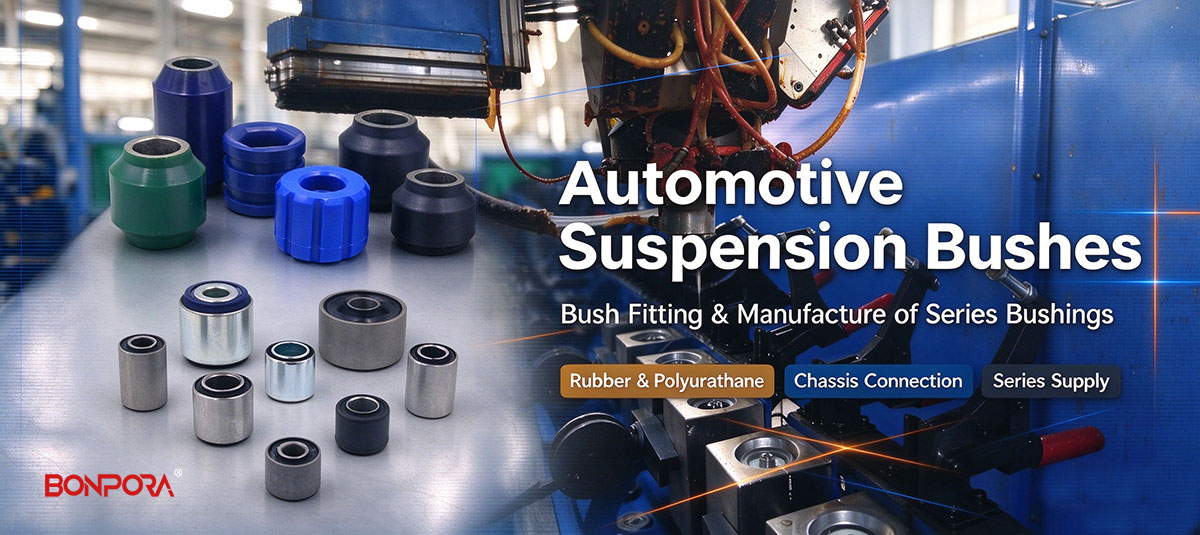
Global auto parts distributors, repair suppliers and industrial component buyers searching for automotive suspension bushes are usually looking for clearer information on material differences, fitting requirements, product series, quality control and stable manufacturing supply. Suspension bushes are widely used in control arms, stabilizer bars, radius arms, subframes and other chassis connections. They help manage vibration, noise, impact and relative movement between metal components. The aftermarket demand for series bushing products often comes from repair replacement, fleet maintenance and wholesale distribution.
Buyers commonly ask: What is the difference between rubber bushes and polyurethane bushes? What does bush fitting include? Why is series bushing manufacture important? What quality points should be checked before bulk ordering? This guide explains practical knowledge for procurement and workshop application without unsupported performance claims.
Suspension bushes are small but functionally important chassis components. They are installed between metal parts to allow controlled movement while isolating vibration and absorbing road impact. Common applications include:
Control arm to chassis or subframe connections
Stabilizer bar mounting points
Radius arm and trailing arm connections
Leaf spring or bracket mounting positions
Other chassis and suspension pivot points
When bushes wear out, crack, deform or lose interference fit, the vehicle may experience abnormal noise, loose control, vibration transfer, uneven tire wear or alignment problems. For this reason, inspection and replacement are often included in chassis maintenance.
Two common materials in the aftermarket are rubber and polyurethane. Each has application characteristics:
Rubber bushes: Often selected for vibration isolation and noise control in standard passenger vehicle applications.
Polyurethane bushes: Sometimes chosen where stiffness, wear resistance or durability is emphasized, depending on formulation and operating conditions.
Material choice is not simply a matter of “better or worse”. The final decision should consider vehicle position, load, vibration amplitude, temperature, oil exposure, noise targets and repair-market expectations.
Bush fitting is more than pressing a part into a housing. The quality of installation directly affects service life and performance. Practical fitting points include:
Checking the housing bore and outer diameter for correct interference fit.
Ensuring cleanliness and avoiding damage during pressing.
Using suitable installation tools to avoid offset loading.
Confirming the correct orientation, especially for directional or profiled bushes.
Checking lubrication or assembly paste recommendations from the supplier.
Verifying torque and alignment after installation.
Professional fitting helps reduce the risk of early failure, noise and warranty claims.
The manufacture of series bushings is especially important for aftermarket suppliers who need complete product families. A bushing series usually includes variations in inner diameter, outer diameter, length, hardness, material and housing design. Buyers value series production because it simplifies catalog management, vehicle coverage and stocking.
Key manufacturing control points include:
Material formulation and incoming material control
Molding process and dimensional consistency
Hardness and density control
Bonding quality for metal-backed bushes
Surface condition and visual inspection
Batch traceability and sample validation
Automotive suspension bushes are used across many vehicle segments. Aftermarket replacement demand is often visible in:
Passenger cars and sedans
SUVs and crossovers
Pickup trucks and light commercial vehicles
Fleet vehicles and daily-use vehicles
Some modified or heavy-duty vehicle applications
Actual vehicle coverage depends on the product catalog, application data and OE reference compatibility. Buyers are advised to confirm fitting dimensions and vehicle position before volume ordering.
Bonpora supplies automotive suspension bushes and series bushing products for the global aftermarket. Our range includes rubber bushes, polyurethane bushes, control arm bushes, stabilizer bar bushes and related chassis components. You can view our mounting bushes product page here: https://www.bonporaparts.com/en/mounting-bushes/.
Buyers evaluating Bonpora may consider the following points:
Product portfolio covering multiple chassis connection positions
Supply of both rubber and polyurethane suspension bushes
Support for series bushing development and supply according to customer requirements
Focus on dimensional consistency, material control and batch stability
Technical support for bush fitting, sample validation and application checking
A: Automotive suspension bushes are installed between metal chassis components to allow controlled movement, isolate vibration, absorb impact and reduce noise. They are commonly used in control arms, stabilizer bars, radius arms, subframes and bracket mounting positions.
A: Rubber bushes are often selected for standard vibration isolation and noise control. Polyurethane bushes may be chosen when stiffness, wear resistance or durability requirements are higher. Material selection should be based on the vehicle position, load, operating conditions and market requirements.
A: Bush fitting includes checking dimensions and interference fit, clean pressing, correct orientation, proper tool use, lubrication or assembly paste, and post-installation torque and alignment verification. Poor fitting can cause early wear, noise or failure.
A: The manufacture of series bushings helps buyers manage a complete product line, improve vehicle coverage and simplify stocking. Series production also supports better control over dimensions, material, hardness and batch consistency across similar parts.
