sales@bonporaparts.com
0086-10-64988621
English
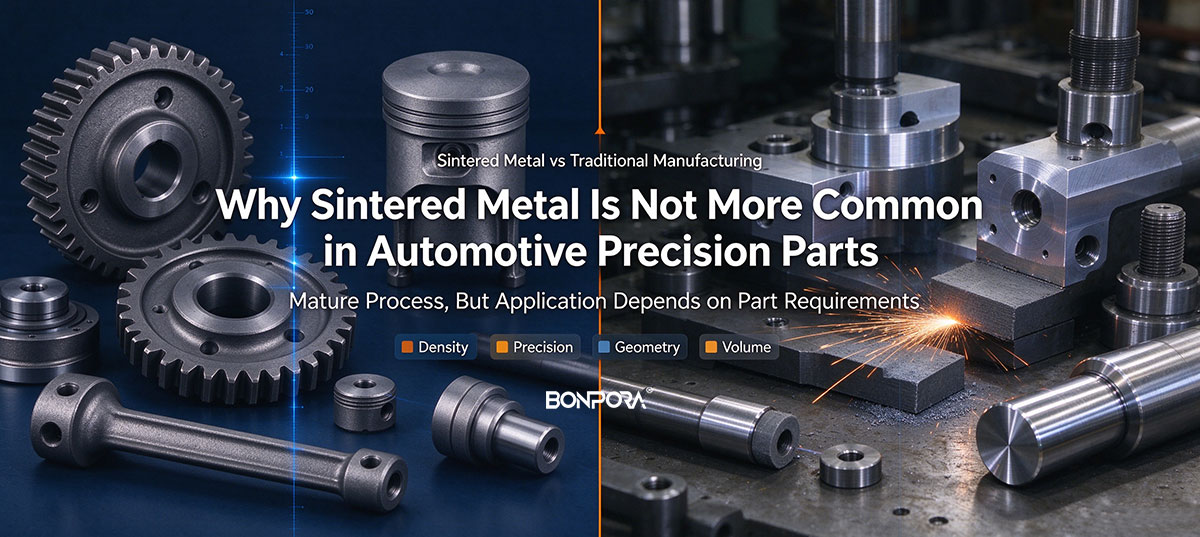
Global automotive component buyers, engineers and sourcing managers searching for sintered metal automotive precision parts often ask the same question: sintering is a mature process, so why is it not more widely used for high-precision automotive components? The answer is not that sintering is immature, but that its adoption depends on part geometry, performance requirements, volume, cost structure, material properties and manufacturing history.
Sintered metal technology has long been used in automotive parts such as gears, pistons, rod guides, valve seats, sensor components and structural brackets. However, many highly loaded or ultra-precision parts still rely on wrought materials, forgings, castings and traditionally machined components. This guide explains the practical advantages and limitations of sintered metal compared with traditional manufacturing, without unsupported claims.
Yes. Powder compaction, sintering, sizing, infiltration, heat treatment and secondary machining are all established industrial processes. Sintered parts have been used in passenger vehicles, commercial vehicles and industrial machinery for decades.
Mature does not mean universal, however. Sintering works best for parts where:
Geometry is relatively complex and compactable
Material uniformity and repeatability are valuable
Controlled porosity is useful
Production volume is stable
Cost can be balanced against machining savings
For other parts, alternative processes remain more competitive.
There are several practical reasons sintered metal has limited penetration in certain automotive precision parts.
Many sintered parts contain residual porosity. While porosity can be useful for self-lubricating applications, it may reduce tensile strength, fatigue resistance, impact toughness and corrosion performance compared with fully dense wrought or forged materials.
Some automotive precision parts require extremely tight dimensional tolerances, high surface finish and strict geometric control. Traditional machining, grinding and honing can still be easier to qualify for these requirements, especially for low-volume or high-complexity parts.
Sintering requires powder compaction tooling. Parts with large undercuts, very thin walls, extreme aspect ratios or non-uniform cross-sections may be difficult to compact reliably. Traditional machining can handle a wider range of geometries.
Sintering becomes more attractive when tooling costs can be amortized over high volume. For low-volume prototypes, single-piece production or frequently changing designs, traditional machining is often more flexible and cost-effective.
Many automotive platforms use established material and process families. Changing from a forged or wrought component to a sintered alternative often requires additional validation, testing and engineering approval, which slows adoption even when the technical case is strong.
| Factor | Sintered Metal | Traditional Machining / Forging / Casting |
|---|---|---|
| Process maturity | Mature for many automotive components | Mature and widely qualified |
| Material uniformity | Good across similar parts | Depends on material and process route |
| Density | Controlled but often below full density | Higher in wrought or forged parts |
| Strength / fatigue | Good in optimized designs, but not universal | Often preferred for highly loaded parts |
| Complexity | Strong for compactable shapes | Strong for broader geometry range |
| Tooling cost | Higher initial tooling | Lower for low-volume production |
| Volume suitability | Better in stable high volume | Flexible for low to medium volume |
| Precision finishing | May require sizing or secondary operations | Well established for tight tolerances |
Sintered metal is not rare in automotive components; it is just selectively used. It tends to be strong in:
Gears and gear-like components
Pistons and piston-like parts
Rod guides and bearing components
Valve seats and valve train parts
Sensor rings and encoder components
Structural brackets with moderate loads
These parts often benefit from near-net shape production, material uniformity and controlled porosity.
Traditional manufacturing remains dominant where:
Full density is required
High fatigue or impact strength is needed
Ultra-tight tolerances are mandatory
Part geometry is difficult to compact
Production volume is low
Existing platform qualification supports the process
Buyers should not choose sintered metal or traditional manufacturing based on trend alone. The better approach is to evaluate:
Component function and load conditions
Required density, strength and fatigue performance
Tolerance and surface finish requirements
Part geometry and tooling feasibility
Production volume and annual demand
Material, heat treatment and secondary operation options
Validation and qualification cost
Bonpora supports global buyers with precision metal component evaluation, material review and manufacturing recommendations. We help customers compare sintered metal and traditional manufacturing routes based on actual component requirements. You can view our precision metal parts product page here: https://www.bonporaparts.com/cn/precision-metal-parts/.
Buyers evaluating Bonpora may consider the following points:
Technical review of component geometry and material requirements
Comparison of sintered metal and traditional manufacturing options
Support for prototype, sample validation and volume production planning
Focus on dimensional control, density, hardness and application performance
Communication on process feasibility before large investment
A: Yes. Compaction, sintering, sizing, heat treatment and secondary machining are established industrial processes. Sintered automotive parts have been in production for decades.
A: Because sintering has limits in density, ultra-precision finishing, complex geometry and low-volume flexibility. Highly loaded or ultra-precision parts often remain with forged, wrought or traditionally machined materials.
A: No. Sintering can reduce machining waste and improve repeatability in high volume, but tooling and process development costs must be considered. For low volumes, traditional machining is often more economical.
A: It depends on component function, load, precision, geometry, volume, material and qualification requirements. Buyers should evaluate the actual specification rather than selecting one process for all parts.
For technical consultation, manufacturing route comparison, sample request or volume production discussion, please contact our sales team: sales@bonporaparts.com.
