
- 1. 1. Chassis Layout & Installation Space Constraints
- 2. 2. Sprung Mass, Gravity Center and Anti-Pitch Geometry
- 3. 3. Reinforced Limit & Bump Stop Structure for Battery Safety
- 4. 4. Unsprung Mass Control and Bushing Structural Upgrade
- 5. 5. Native Integration of Intelligent Electronic Suspension
- 6. 6. Subframe, Bracket and Underbody Protection Structure
- 7. FAQ
- 7.1. Can I install ICE suspension parts directly on an electric car?
- 7.2. Do EVs use completely new types of suspension such as a brand-new structure different from MacPherson or multi-link?
- 7.3. Why do EV bump stops matter more than on fuel cars?
- 7.4. What causes rear-end bounce after lifting off the accelerator in EVs?
- 7.5. What suspension spare parts are commonly replaced for EV repair?
- 7.6. Summary for Auto Wholesalers & Repair Shops
EV vs ICE Suspension Structure Differences | Electric Vehicle Chassis Parts
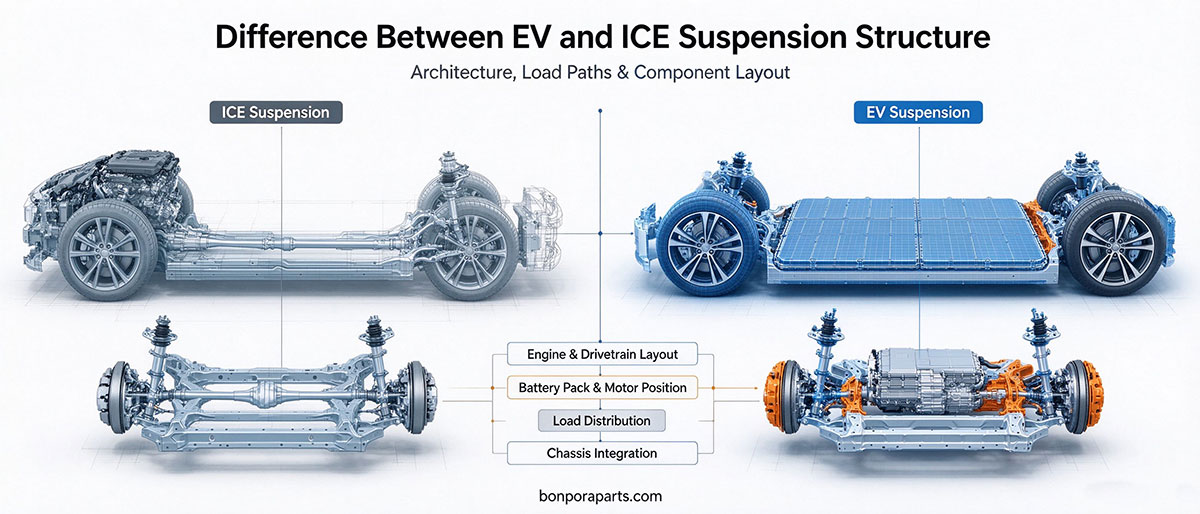
Electric vehicles and traditional ICE vehicles can adopt the same basic suspension types including MacPherson strut, double wishbone, multi-link and torsion beam. The mechanical principle is similar. However, due to the underfloor battery pack layout, weight distribution, regenerative braking and battery safety requirements, EV suspension has totally different installation layout, motion envelope, load transfer path, limit structure and component design. That is why ICE suspension assemblies cannot be directly transplanted to EV platforms. BONPORA supplies matched shock absorbers, PU bump stops, suspension bushings, ball joints and control arms for global auto repair and wholesale customers.
1. Chassis Layout & Installation Space Constraints
ICE chassis must reserve large space for engine, transmission, exhaust system, catalytic converter, drive shaft and fuel tank. The front transverse space is tight, so MacPherson strut is widely used on ordinary fuel cars. The rear suspension control arms and bushing mounting points are compromised to avoid exhaust pipes and fuel tanks.
Pure electric skateboard platforms remove engine, transmission and long exhaust pipelines, releasing extra front compartment space. Native EV platforms are easier to adopt double wishbone front suspension plus multi-link rear suspension, with longer control arms for better wheel kinematics.
The trade-off is obvious: the battery pack occupies the middle chassis area. The inner side of suspension, upper arm, shock absorber and PU bump stops must be moved inward, raised or reshaped to avoid battery housing. The vertical travel and lateral envelope of suspension are strictly restricted by battery outline. For CTC and CTB models, suspension mounting brackets are integrated with battery frame, and suspension loads transfer directly to battery structure, which never happens on ICE vehicles.
2. Sprung Mass, Gravity Center and Anti-Pitch Geometry
EVs are generally 300–600 kg heavier than equivalent ICE cars. Mass concentrates on the underfloor battery pack, bringing lower and more centered gravity. Fuel vehicles carry most weight at the front engine bay with higher gravity center and biased front axle load.
ICE suspension tuning focuses on suppressing front-heavy nose dive and understeer, with stabilizer bars and bushings matched for uneven axle load.
EV suspension needs to handle frequent load transfer caused by regenerative braking, which creates continuous pitch movement (rear-end bounce when lifting off throttle). Native EV suspension optimizes damper angle, upper mounting position and control arm layout for anti-pitch performance. Sway bars are usually thicker with reinforced end links to reduce roll and pitch.
The installation angle, travel limit of shock absorbers and contact position of PU bump stops are redesigned, so ICE versions are not interchangeable.
3. Reinforced Limit & Bump Stop Structure for Battery Safety
Bump stops on ICE vehicles are only auxiliary cushion parts for extreme impact.
On EVs, PU bump stops become critical safety components. Excessive compression travel may let control arms, dampers or tires squeeze the battery casing and trigger thermal runaway risk. Most EV suspensions adopt multi-stage limit design: soft pre-bump PU for small impact and rigid hard stop for heavy collision. Some models add limit bosses between control arm and subframe. This limit system has far higher priority than the simple cushion structure on fuel cars.
4. Unsprung Mass Control and Bushing Structural Upgrade
EV already has huge sprung mass from battery. Heavy unsprung mass will amplify road impact, accelerate fatigue of bushings and shock absorbers. Ordinary ICE lower control arms often use stamped steel for cost control.
High-end EVs widely adopt aluminum alloy control arms and hollow structures to cut unsprung weight, paired with high-strength lightweight ball joints. EV suspension bushings usually apply multi-chamber, progressive stiffness structure: soft for fine filtering at small load and stiffen automatically under large alternating load from regenerative braking. Traditional ICE rubber bushings mostly maintain single stiffness curve.
5. Native Integration of Intelligent Electronic Suspension
CDC dampers and air suspension are optional add-ons for ICE vehicles, usually powered by engine-driven air pumps. Tuning targets are mainly ride comfort.
EV high voltage platforms (400V / 800V) natively support intelligent suspension systems including CDC adaptive dampers, air springs and active anti-roll bars. Electronically controlled shock absorbers require ultra-precise valve plates, low internal leakage and premium seals. The suspension ECU works together with regenerative braking and stability control. Damping force adjusts instantly to suppress rear bounce while lifting throttle, forming an integrated chassis control system rather than isolated hardware.
6. Subframe, Bracket and Underbody Protection Structure
ICE subframes carry engine, transmission and suspension components.
EV front and rear subframes reserve space for battery packs, high voltage wiring and cooling pipelines. Suspension connection points are reinforced. Impact force from bottom strike is absorbed preferentially by subframe and suspension limit structure to protect battery cells. Large underbody covers wrap the battery, while piston rods and dust covers are exposed to splashing sand and de-icing salt. Therefore, EV suspension metal parts get upgraded anti-corrosion coating and rubber components gain better weather resistance.
FAQ
Can I install ICE suspension parts directly on an electric car?
Generally no. ICE shock absorbers, PU bump stops and bushings are designed for lighter weight and different travel limits. They may cause rear bounce, abnormal noise, early failure and battery squeeze risk.
Do EVs use completely new types of suspension such as a brand-new structure different from MacPherson or multi-link?
No. EVs still use MacPherson, double wishbone and multi-link suspension. The difference lies in mounting geometry, limit travel, bushing stiffness and safety constraints instead of inventing a brand-new suspension principle.
Why do EV bump stops matter more than on fuel cars?
EV PU bump stops act as battery protection limiters. If suspension compresses too far, the suspension assembly can hit and damage the battery pack, which is not a major concern for ICE vehicles.
What causes rear-end bounce after lifting off the accelerator in EVs?
It comes from regenerative braking which creates rapid load transfer between front and rear axles. Mismatched shock absorber damping and unsuitable bump stop stiffness will worsen this pitch movement.
What suspension spare parts are commonly replaced for EV repair?
The most frequently replaced EV suspension components are shock absorbers, PU bump stops, suspension bushings, ball joints, control arms and dust covers.
Summary for Auto Wholesalers & Repair Shops
EV suspension may share the same category name such as multi-link or double wishbone with ICE suspension, but the mounting points, motion envelope, limit travel, load transfer path, bushing stiffness curve and safety boundary are re-developed for battery and motor characteristics. Installing standard ICE shock absorbers, PU bump stops, bushings or control arms on EVs will cause rear bounce, mechanical interference, rapid oil leakage, abnormal noise and battery extrusion hazards.
BONPORA provides full EV-spec suspension replacement parts built for pure electric platform load, travel and safety requirements.