
- 1. 1. Higher Curb Weight and Continuous Axle Load
- 2. 2. Instant Motor Torque and Repeated Regenerative Braking Impact
- 3. 3. More Rigid NVH Requirements
- 4. 4. Harsher Underbody Working Environment
- 5. 5. Battery Safety Is A Non-negotiable Hard Rule
- 6. 6. Compatibility With Smart & Electronic Suspension
Why EV Chassis Suspension Parts Need Higher Standards Than ICE Vehicles
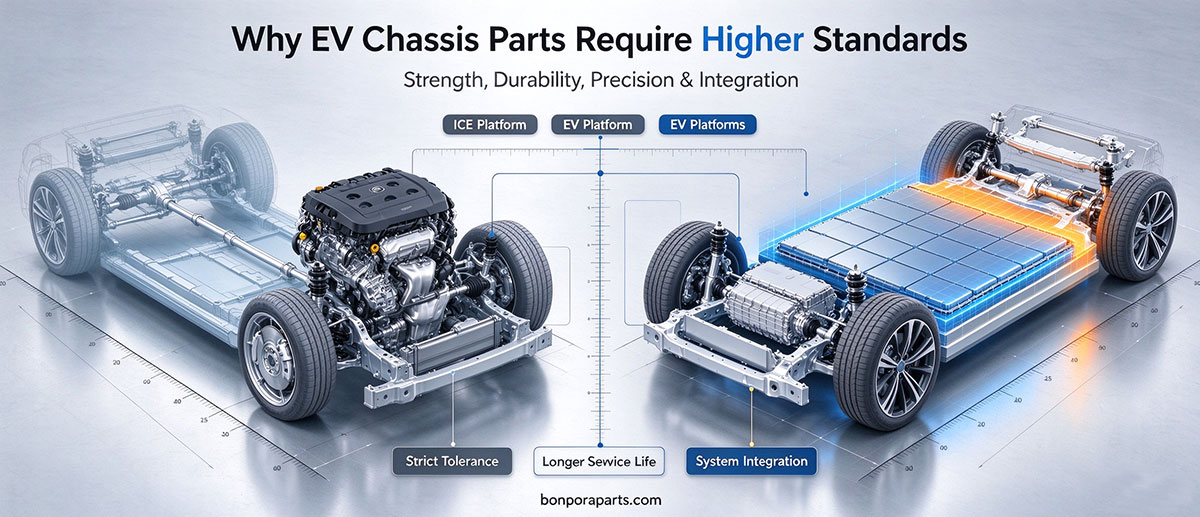
Many auto repair shops and spare parts buyers make a common mistake: directly fitting traditional ICE suspension parts to electric vehicles. EV chassis components including shock absorbers, PU bump stops, rubber bushings, ball joints and control arms must follow stricter manufacturing standards. It is not just a performance upgrade, but a requirement driven by unique vehicle weight, regenerative braking load, NVH control and battery safety regulations.
1. Higher Curb Weight and Continuous Axle Load
Most electric cars are 300–600 kg heavier than equivalent fuel vehicles, mainly because of the underfloor high-voltage battery pack. The suspension system works under constant high static load all the time.
Shock absorbers, coil springs and bushings face larger instant impact loads when passing potholes and speed bumps
Standard ICE spare parts show fast fatigue, oil leakage, cracking and loose chassis after short service time
EV-grade suspension parts require higher material yield strength and double fatigue cycle targets compared with ICE versions
2. Instant Motor Torque and Repeated Regenerative Braking Impact
Unlike combustion engines with gradually rising torque, electric motors deliver peak torque at zero speed. Combined with regenerative braking, the axle load shifts frequently and rapidly. This is the core reason for rear-end bounce and unstable ride you often see on EVs.
Lift-off throttle triggers immediate drag force, causing frequent pitch movement of the vehicle body
Suspension dampers need customized damping value, normally increased by 25%–40%
PU bump stops and suspension bushings need revised stiffness curve to absorb cyclic alternating loads
3. More Rigid NVH Requirements
Engine noise masks minor vibration and friction noise on ICE cars. EVs run quietly, so tiny abnormal sounds from bushings, shock seals and internal friction become obvious complaints from end users.
Bushings use low-friction premium compound formula for vibration isolation
Shock absorbers adopt low-friction inner coating and high-performance FKM oil seals
Tighter dimensional tolerance control for all mating chassis components
4. Harsher Underbody Working Environment
The battery pack sits low under the EV floor. The enclosed under-chassis space easily traps moisture, road salt and mud. Ambient temperature range is wider because of battery thermal management.
Enhanced anti-corrosion treatment: electrophoretic coating plus extra top paint
Rubber and PU parts require excellent heat aging and cold resistance
Dust covers and piston rods upgrade wear and stone-impact resistance
5. Battery Safety Is A Non-negotiable Hard Rule
CTC and CTB designs integrate the battery pack as part of the car body structure. Excessive suspension deformation may squeeze the battery casing and cause thermal runaway risks.
Precise limit travel design for PU bump stops
Strict deformation limit for control arms and ball joints under extreme impact
Suspension limit structure must avoid battery pack extrusion during hard hits
6. Compatibility With Smart & Electronic Suspension
More premium EVs are equipped with CDC adaptive dampers, air suspension and steer-by-wire systems. These intelligent chassis systems set higher precision standards.
Electronically controlled shock absorbers need zero or minimal internal leakage
Valve plates and internal assemblies require ultra-precise machining
Sensor-matched suspension parts maintain consistent performance for ECU calibration
Summary for Auto Wholesalers & Repair Workshops
ICE suspension spare parts are not interchangeable for EV use. Using non-EV-spec chassis components will lead to early failure, bumpy ride, abnormal noise and hidden safety hazards. BONPORA supplies full range EV suspension replacement parts: shock absorbers, PU bump stops, suspension bushings, ball joints, dust covers and shims for global auto repair and wholesale buyers.
Related reading: How to Fix EV Rear End Bounce Caused By Regenerative Energy Recovery
Contact us for EV chassis component catalog, bulk pricing and technical support.