
- 1. Why Regenerative Braking Triggers Rear Tail Hop & Bouncing
- 2. Core Suspension & Damper Optimization Strategies For Regen Hop Issues
- 2.1. 1. Switch To EV-Specific Digressive Valving Rear Shock Absorbers (Highest ROI Upgrade)
- 2.2. 2. Match Spring Rate & Preload Correctly For EV Battery Weight
- 2.3. 3. Upgrade Suspension Bushes & Mounts To Stabilize Axle Geometry
- 2.4. 4. Inspection Checklist Before Part Replacement (For Professional Technicians)
- 3. Our Supply Advantage For Auto Parts Wholesalers & EV Repair Chains
- 4. Final Summary
EV Rear End Hop On Regenerative Braking | Suspension & Damper Optimization Solution
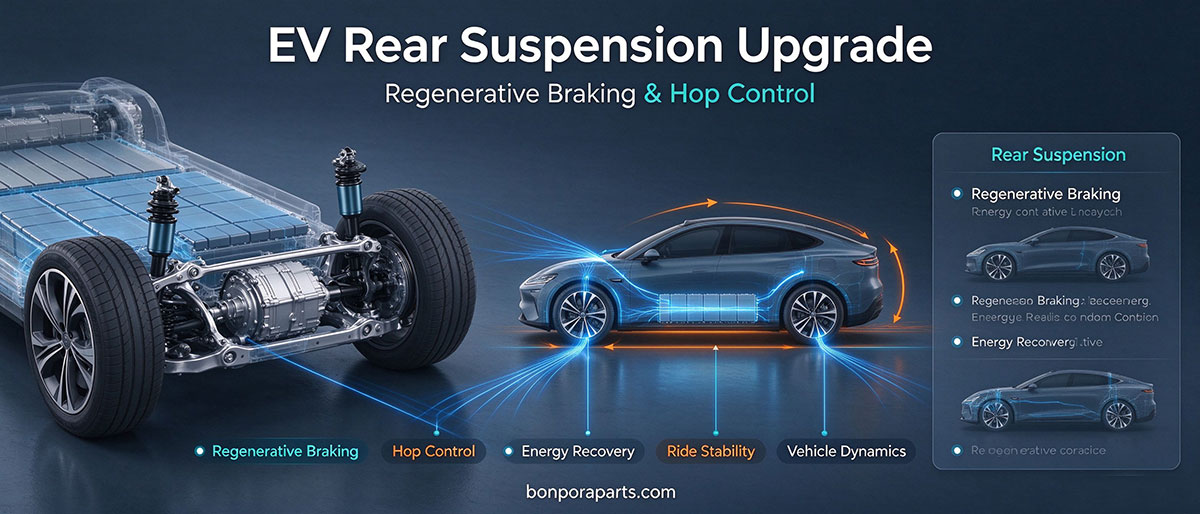
More EV service shops and fleet operators are reporting the same customer complaint: smooth cruising becomes unstable the moment regenerative braking kicks in. The rear end squats, hops, bounces repeatedly, and delivers a sharp, jittery ride even on flat pavement. Many technicians mistakenly blame motor calibration or brake blending logic, while the root weakness sits inside the rear suspension and damping system. If your workshop receives constant regen-related rear vibration cases, or you source EV suspension spare parts for resale, this guide breaks down the failure mechanism, upgrade paths and our reliable aftermarket component solutions.
Why Regenerative Braking Triggers Rear Tail Hop & Bouncing
Unlike traditional ICE vehicles, EVs apply instant, adjustable deceleration torque through the traction motor rather than hydraulic brakes alone. The regen torque loads the rear axle rapidly and repeatedly, creating a unique pitch oscillation cycle that OEM suspension rarely calibrates for fully. Three core factors combine to cause the “hopping rear” symptom:
Low-speed, sudden rear axle loading: Regen activates at low shaft velocity. Standard OEM dampers use generic valving that cannot suppress low-frequency rebound oscillation; once the rear springs release stored energy, the tail starts to oscillate and hop.
High curb weight from underfloor battery packs: EVs carry massive mass concentrated low on the chassis, raising static load and changing sprung/unsprung mass ratio. Ordinary dampers tuned for light ICE weight will overheat and lose damping force quickly under frequent regen cycles.
Compliant soft rubber OEM bushes: Stock suspension bushings flex excessively under cyclic regen torque, amplifying pitch vibration instead of stabilizing axle geometry.
Important note: Reducing regen strength via ECU settings is only a temporary workaround. It sacrifices one-pedal driving experience and energy recovery efficiency. A proper permanent fix targets suspension hardware and damping curves, not just software limits.
Core Suspension & Damper Optimization Strategies For Regen Hop Issues
1. Switch To EV-Specific Digressive Valving Rear Shock Absorbers (Highest ROI Upgrade)
This is the most effective solution for recurring rear hop under regen. Standard twin-tube shocks deliver linear damping: low shaft speed equals weak control, which is exactly the condition when regen braking starts. Digressive valving increases rebound damping at low piston speeds to contain spring rebound instantly, while softening resistance over sharp road impacts to preserve ride comfort.
Our aftermarket EV rear dampers are pre-valved for regenerative braking cycles, built with high-temperature damping oil, reinforced piston rods and heavy-duty seals to handle continuous cyclic loading. We offer both direct-fit OE replacement units and adjustable rebound variants for performance EV repair and tuning workshops. Fitment covers popular electric sedan, crossover and hatchback platforms.
2. Match Spring Rate & Preload Correctly For EV Battery Weight
Fatigued, under-rated rear coil springs are a common hidden cause. When regen loads the rear axle, weak springs compress excessively then rebound violently. Two tuning rules apply:
Select spring rates calibrated for the vehicle’s actual GVW including battery mass, not ICE equivalent spring specs.
Set static preload to maintain correct ride height and reduce excess suspension travel before regen torque hits.
We supply matched spring & damper kits sold as complete sets, so repair shops avoid mismatched spring-damper combinations that make hopping worse.
3. Upgrade Suspension Bushes & Mounts To Stabilize Axle Geometry
Soft stock rubber bushes deform under cyclic regen torque, allowing lateral and pitch movement of the rear subframe and control arms. Even new shocks cannot eliminate tail bounce if bush compliance is too high. Polyurethane or reinforced rubber rear control arm bushes, subframe bushes and shock top mounts reduce unwanted flex, lock axle geometry and stop vibration resonance during deceleration.
These bush kits are high-volume add-on items for auto parts wholesalers; they pair perfectly with rear shock replacement jobs and increase average order value for repair garages.
4. Inspection Checklist Before Part Replacement (For Professional Technicians)
Before selling or installing new dampers, verify these points to avoid misdiagnosis:
Check for leaking rear shocks, faded oil or weak rebound hand-test
Inspect cracked, split or loose rear bushes and mounting points
Confirm no worn wheel bearings or trailing arm play
Rule out driveline torsional vibration from half shafts or motor mounts
Many regen bounce jobs only require dampers + bushes instead of full coilovers, giving your customers a cost-effective repair package.
Our Supply Advantage For Auto Parts Wholesalers & EV Repair Chains
We specialize in manufacturing and wholesale supply of EV rear shock absorbers, coil springs, polyurethane bush kits and suspension hardware targeted for regenerative braking vibration issues. Our strengths for B2B buyers:
Pre-developed regen-tuned digressive damping specs, validated on common EV platforms
Direct-fit OE-style replacement dampers and adjustable performance versions available
Custom packaging, private labeling and batch MOQ options for distributors
Global shipping, technical datasheets and fitment catalog support for your sales team
Consistent quality control on sealing, damping oil temperature resistance and fatigue testing
Whether you run an auto repair garage looking for reliable stock to solve recurring customer complaints, or an auto spare parts importer searching for differentiated EV suspension products to compete in your local market, our rear suspension portfolio solves a very specific, fast-growing EV pain point that generic shock suppliers cannot address.
Final Summary
EV rear hopping and bumping under regenerative braking is not inevitable. The issue arises from OEM suspension valving and components designed without priority for repeated low-speed regen torque cycles. The most practical fix is upgrading to low-speed rebound-focused EV dampers, paired with matched springs and reinforced bushes. Software regen reduction is just a compromise; proper suspension hardware tuning restores both stable handling and full one-pedal efficiency.
Contact our sales team today to request catalogs, sample units and wholesale pricing for EV rear shock absorbers and suspension upgrade kits.
Email:sales@bonporaparts.com
- Prev.:Shock Absorber Dust Cover: Function, Service Life and Why Original Replacement Parts Matter
- Next.:Why EV Chassis Suspension Parts Need Higher Standards Than ICE Vehicles