
- 1. 1. The core difference: masking noise disappears on EVs
- 2. 2. Suspension bushing design changes for low friction & controlled vibration
- 3. 3. Shock absorber internal friction and seal NVH optimization
- 4. 4. Shim, ball joint and mating clearance control for rattle prevention
- 5. 5. PU bump stop contact noise and progressive buffering tuning
- 6. 6. Common aftermarket NVH mistake: visual matching does not equal NVH matching
- 7. FAQ
- 7.1. Why do EVs have stricter NVH standards than ICE vehicles?
- 7.2. What are the most common suspension NVH faults on EVs?
- 7.3. Can I fix EV suspension squeak just by greasing the bushings?
- 7.4. How do I select EV suspension parts with good NVH performance for wholesale?
- 7.5. Will regenerative braking worsen EV chassis NVH?
- 7.6. Summary for Auto Wholesalers & Repair Shops
EV Chassis NVH Requirements Compared With ICE Vehicles
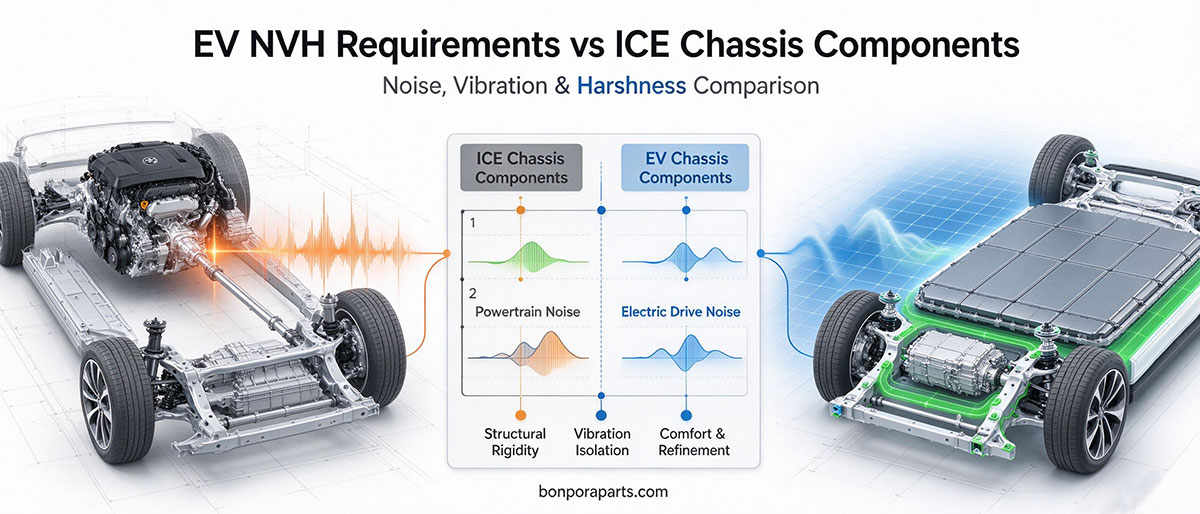
NVH (Noise, Vibration and Harshness) is one of the most obvious dividing lines between electric vehicles and internal combustion vehicles. ICE cars rely on engine sound to mask subtle chassis friction, squeaking and vibration. EV powertrains run nearly silently, so tiny abnormal noises transmitted from suspension components become instantly noticeable to drivers and passengers. Many repair shops and wholesalers encounter frequent complaints after fitting conventional ICE suspension spare parts on EVs. BONPORA supplies NVH-optimized suspension bushings, shock absorbers, PU bump stops and shims engineered for low-noise EV chassis operation.
1. The core difference: masking noise disappears on EVs
On traditional ICE vehicles, continuous engine combustion noise, intake and exhaust noise form a natural sound masking layer. Minor friction between rubber and metal, slight damping friction inside dampers and micro-vibration at bushing mating points are rarely perceived by occupants. Even low-level squeaks and rattles are acceptable in most after-sales scenarios.
For battery electric vehicles, there is no combustion engine background noise. Road noise, tire noise, and chassis component friction stand out clearly. Low-speed cruising, parking and lifting-off throttle are the most sensitive scenarios for NVH complaints. A bushing squeak that is unnoticeable on a fuel car can turn into a warranty return for an EV repair job.
2. Suspension bushing design changes for low friction & controlled vibration
Standard ICE rubber bushings mainly focus on load bearing and basic vibration isolation. Formulations and inner structures are not optimized for low friction. When the suspension moves under regenerative braking load, relative sliding between rubber and metal sleeves easily creates squeaking.
EV-grade suspension bushings adopt specially modified low-friction rubber compounds and multi-chamber progressive stiffness structures:
Low sliding friction surface formula to eliminate stick-slip squeak under small displacement
Progressive stiffness curve: soft for fine vibration filtering, stiffens under heavy alternating load from regenerative braking
Precise pre-compression control to avoid empty clearance and impact rattle
Better compatibility with frequent pitch and load transfer during energy recovery
3. Shock absorber internal friction and seal NVH optimization
Shock absorber internal friction is another major hidden noise source. ICE dampers allow relatively higher internal friction, which is covered by engine noise. EV shock absorbers require low breakaway friction, uniform damping response and quiet sealing performance.
Low-friction inner cylinder coating reduces piston sliding noise
Premium FKM oil seals are selected to avoid lip squeaking during slow rod movement
Valve stack tuning reduces internal fluid chattering under small amplitude suspension movement
Tight control of piston and rod tolerance to avoid micro impact noise
4. Shim, ball joint and mating clearance control for rattle prevention
Many NVH issues are not caused by large structural failure, but tiny clearance and micro-slip at mating interfaces. That is why shims and ball joints gain stricter NVH specifications for EV applications.
ICE aftermarket replacement parts often have wider tolerance bands. When installed on EVs, accumulated loose clearance creates clicking or clunking noises when lifting throttle or passing minor road undulations. EV matched ball joints use low-clearance internal structures and stable grease formulas. Precision shims are used to eliminate assembly gap and distribute contact pressure evenly across control arm mounting surfaces.
5. PU bump stop contact noise and progressive buffering tuning
ICE PU bump stops are tuned for simple cushioning. Sudden hard contact between bump stop and mounting shell may produce obvious thud noise, which is acceptable on fuel cars.
EV bump stops use gradient density PU material. The soft outer layer touches first to suppress impact noise before hard load-bearing contact. Combined with the battery safety limit requirement, the contact timing and compression curve are tuned together for both quietness and protection. Hard, single-density ICE bump stops often produce obvious knocking sound when the EV suspension compresses.
6. Common aftermarket NVH mistake: visual matching does not equal NVH matching
This is the most frequent trap for auto wholesalers and repair garages. Two parts may share the same outline, drawing dimension and mounting hole position, but differ in rubber formula, PU density, preload and internal friction characteristics.
An ICE replacement part may fit physically and pass a quick road test. After delivery to the end EV owner, squeaks, clicks and damping noise will appear under quiet driving conditions, leading to customer complaints, rework and return losses. NVH performance cannot be judged only by appearance.
FAQ
Why do EVs have stricter NVH standards than ICE vehicles?
EVs have no engine noise to cover chassis friction and vibration. All minor suspension noises can be directly heard inside the cabin, so NVH performance becomes a key evaluation index for EV replacement parts.
What are the most common suspension NVH faults on EVs?
Squeaking from bushings, friction noise from shock absorbers, clicking noise from loose ball joints and knocking sound from PU bump stops.
Can I fix EV suspension squeak just by greasing the bushings?
Grease can only provide temporary relief. If the bushing is ICE-spec with a high-friction compound, squeaking will return quickly after grease wears off. Replacing with EV low-friction bushings is the reliable solution.
How do I select EV suspension parts with good NVH performance for wholesale?
Check material formulation, friction optimization, preload design and tolerance control. BONPORA EV suspension components are validated under quiet-chassis NVH test conditions instead of only ICE durability standards.
Will regenerative braking worsen EV chassis NVH?
Yes. Regenerative braking triggers frequent and fast load transfer and suspension pitch movement. It repeatedly excites friction points of bushings and dampers, making hidden noise problems easier to expose.
Summary for Auto Wholesalers & Repair Shops
EV NVH requirements reshape the design, material selection and tolerance control of the whole suspension kit. Appearance-interchangeable ICE suspension parts are high-risk for EV after-sales service, even if they look identical. Noise complaints will hurt your workshop reputation and increase rework costs. BONPORA’s EV suspension lineup including suspension bushings, shock absorbers, PU bump stops, ball joints and shims are NVH tuned for silent electric chassis.
Related reading: Why EV Chassis Suspension Parts Need Higher Standards Than ICE Vehicles EV vs ICE Suspension Structure Differences How to Fix EV Rear End Bounce Caused By Regenerative Energy Recovery
Contact us for NVH test data, catalog and bulk pricing of EV suspension replacement parts.