
- 1. 1. Same Mounting Holes Do Not Mean Interchangeable
- 2. 2. Tighter Underbody Envelope and Battery Interference Zones
- 3. 3. Different Preload and Assembly Sequence Requirements
- 4. 4. Ride Height and Static Load Calibration Difference
- 5. 5. Inspection Checklist After EV Suspension Replacement
- 6. 6. Catalog and Sourcing Risks for Wholesale Buyers
- 7. FAQ
- 7.1. Can I use ICE suspension parts if the bolt holes are the same?
- 7.2. What is the most common fitment issue after installing ICE shocks on EVs?
- 7.3. Why do EV suspension bushings require special tightening procedures?
- 7.4. What clearance should be checked after EV suspension replacement?
- 7.5. How can wholesalers avoid ordering non-validated EV suspension parts?
- 7.6. Summary for Auto Wholesalers & Repair Shops
EV Suspension Fitment, Clearance & Installation Differences From ICE Vehicles
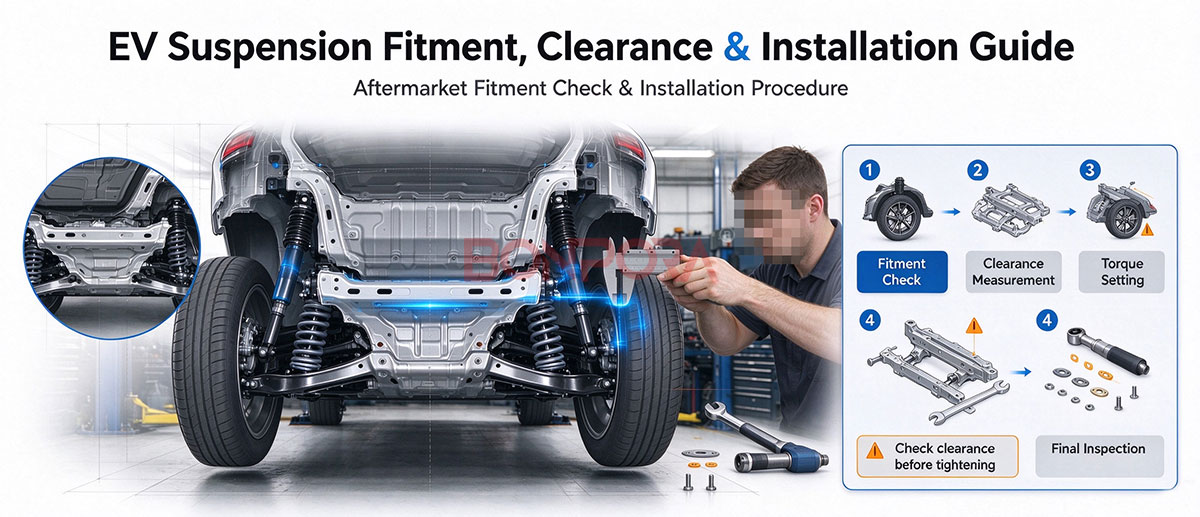
Many auto spare parts buyers and technicians fall into a common trap: two suspension parts may look identical and share the same mounting hole dimensions, but they are not interchangeable between EV and ICE vehicles. The difference lies in working clearance, compression travel, preload setting, surrounding envelope and battery pack interference risk. Even if the part bolts on successfully, hidden problems such as bottoming out, battery contact, abnormal noise and early failure will appear after road testing. BONPORA supplies shock absorbers, PU bump stops, suspension bushings, ball joints and control arms engineered for EV-specific fitment and clearance requirements.
1. Same Mounting Holes Do Not Mean Interchangeable
It is quite common that aftermarket parts catalogues list ICE and EV versions with the same drawing outline and bolt spacing. However, critical internal parameters are different:
Maximum compression stroke of shock absorbers
Free height and progressive stiffness curve of PU bump stops
Bushing pre-compression amount after installation
Control arm swing trajectory and limit angle
For ICE cars, the only consequence of excessive compression is a harsh impact stop. For EVs, over-travel can make suspension components strike the battery housing, which is a severe safety hazard. Visual matching and hole-size matching are not enough for EV replacement work.
2. Tighter Underbody Envelope and Battery Interference Zones
ICE chassis has plenty of empty space around the suspension for exhaust pipes, fuel tanks and other components. Minor contact between suspension arms and surrounding parts is acceptable in some extreme cases.
On skateboard EV platforms, the battery pack occupies almost the entire floor area. Every suspension component has a strictly defined motion envelope. The inner side of control arms, shock body, bump stop and dust boot must stay outside the battery protection zone during full jounce and rebound travel.
Even a small difference in bump stop height or shock rod length will change the final compression point. A part that fits perfectly on an ICE model may swing into the battery area under heavy load or when hitting potholes.
3. Different Preload and Assembly Sequence Requirements
ICE suspension assembly mostly focuses on restoring ride height and tightening torque values. EV suspension installation adds extra preload rules, especially for suspension bushings and bump stops.
EV bushings are designed with progressive stiffness for regenerative braking load cycles. They must be preloaded at the normal ride height position before final tightening. If technicians follow the old ICE procedure of tightening bushings at full suspension droop, the rubber will be under constant twist stress. It will generate squeaking noise and crack quickly after a short mileage.
PU bump stops also need correct pre-gap setting. Too small clearance triggers continuous contact and stiff ride; too large clearance removes the safety buffer for battery protection.
4. Ride Height and Static Load Calibration Difference
EV static axle load is much higher because of battery weight. If you install an ICE shock absorber or spring assembly, the vehicle will sit lower than the designed ride height. The static compression position shifts the whole working range toward the bump stop zone.
When the vehicle hits speed bumps or potholes, there is almost no remaining buffer stroke. The suspension will bottom out frequently, and the PU bump stops take impact repeatedly. This is one of the top causes of warranty claims and customer complaints for repair shops.
5. Inspection Checklist After EV Suspension Replacement
Technicians cannot rely only on a test drive for EV suspension jobs. A clearance check is mandatory after fitting new parts:
Check minimum gap between control arms / shock assembly and battery cover under full compression
Verify bump stop working gap at static ride height
Check bushing twist angle at normal loaded position
Confirm no contact between dust covers, brake lines and chassis brackets during full suspension movement
Record ride height and compare it with OEM EV specification
6. Catalog and Sourcing Risks for Wholesale Buyers
Many aftermarket suppliers reuse ICE part numbers for EV lookalike components to reduce mould cost. This creates huge risks for wholesalers. You may receive orders from repair shops based on photos and cross-reference numbers, but the batch will not fit safely on EVs.
Key points for sourcing: confirm whether the component is validated under EV load spectrum, not only dimension checked. Ask suppliers for EV-specific stroke data, bump stop gap parameters and bushing preload instructions, instead of only drawings.
FAQ
Can I use ICE suspension parts if the bolt holes are the same?
No. Matching mounting holes only means it can be bolted on. Stroke limit, bump stop clearance, bushing preload and battery interference envelope are different. It may lead to battery contact risk and early part failure.
What is the most common fitment issue after installing ICE shocks on EVs?
The most frequent issue is reduced available compression travel. The suspension bottoms out easily, the PU bump stops overload, and there is a risk of touching the battery pack under impact.
Why do EV suspension bushings require special tightening procedures?
EV suspension bushings use progressive stiffness structures. They must be locked at normal ride height to avoid permanent torsional stress, otherwise squeaking and cracking will occur rapidly.
What clearance should be checked after EV suspension replacement?
Check the gap between control arms, shock body and battery pack under full jounce, together with bump stop pre-gap, ride height and interference of dust covers and brake hoses.
How can wholesalers avoid ordering non-validated EV suspension parts?
Confirm EV-specific load validation, stroke data and installation instructions. Do not purchase only by appearance and cross-reference ICE part numbers. BONPORA provides EV fitment data and technical support for bulk orders.
Summary for Auto Wholesalers & Repair Shops
Fitment for EV suspension is far more complex than simple bolt matching. ICE replacement parts may look compatible, but they are not designed for EV static load, limited underbody envelope and battery protection rules. Incorrect fitment leads to frequent bottoming, interference, abnormal noise and critical battery safety risks. Always choose suspension components validated for pure electric platforms.
BONPORA EV suspension replacement parts come with clear fitment data, stroke specifications and installation guidance for global repair networks and wholesale clients.