sales@bonporaparts.com
0086-10-64988621
English
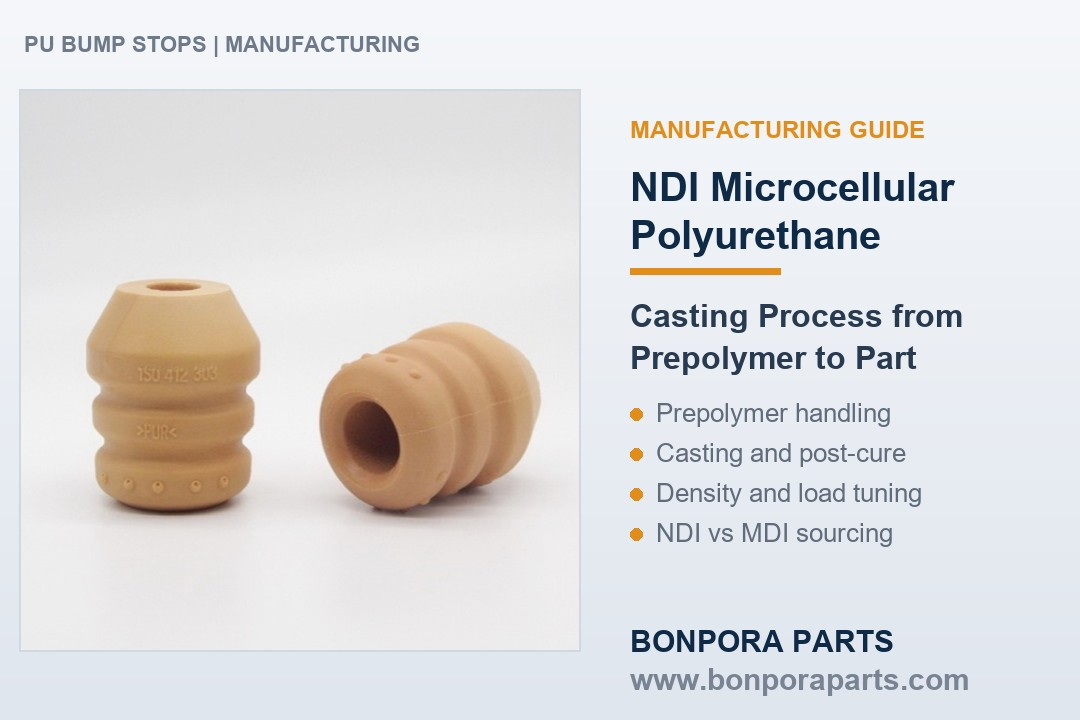
NDI microcellular polyurethane is a family of elastomers built on 1,5-naphthalene diisocyanate (NDI) prepolymers, finished with a fine, closed cell structure that gives the material its characteristic progressive compression behavior. In a suspension system, this is the material class behind most high-load polyurethane bump stops, also called jounce bumpers or buffer limit blocks. When a wheel hits a deep pothole and the strut reaches full compression, the bump stop absorbs the last stretch of travel before metal meets metal, protecting the piston rod, the seal package, and the strut housing above it.
The microcellular structure matters as much as the chemistry. Instead of behaving like a solid rubber block, a microcellular elastomer contains millions of tiny cells that collapse progressively under load. The result is a rising-rate spring: soft at small deflections for ride comfort, firm near full compression to control impact energy. For buyers comparing quotes, understanding how that structure is actually manufactured explains much of the price and performance spread between suppliers.
Both NDI and MDI based polyurethanes appear in suspension programs, and both are legitimate choices. They differ in what they tolerate. NDI systems are generally specified where a bump stop sees high load levels, elevated underbody temperatures, and many thousands of compression cycles, for example on commercial vehicles, SUVs, and trucks. MDI systems are widely used for passenger car struts where cost and processing windows matter and duty cycles are moderate.
Two properties drive the NDI choice. First, NDI cured parts hold their dynamic stiffness at temperature better, so a stop that feels right on the bench is less likely to go soft in a hot climate or under sustained fleet duty. Second, NDI systems show lower compression set when properly post-cured, which means the part returns to its original height after repeated bottom-out events instead of slowly losing stand-out height. A shortened bump stop reduces travel reserve and can transfer harsh impacts into the tower, the spring seat, and adjacent chassis and suspension parts.
Production begins long before casting. NDI prepolymers are moisture-sensitive: free isocyanate groups react with water to form carbon dioxide and urea bonds, which creates bubbles, voids, and weak spots in the final part. A disciplined factory therefore stores prepolymers in sealed, nitrogen-blanketed containers, keeps them at the temperature band stated by the system supplier, and tracks shelf life and open time for every drum.
Chain extenders and additives receive the same treatment. Moisture pickup in a glycol-based extender shows up later as pinholes and a coarse, irregular cell structure. Reliable manufacturers dry and filter components before use, log batch numbers for full traceability, and validate each new drum by casting a test coupon and checking its density and hardness before releasing the drum to production parts.
NDI prepolymers are typically solid or semi-solid at room temperature, so the first process step is controlled melting in a heated tank. Temperature is held in a narrow band: hot enough for low viscosity and easy pumping, but not so hot that the NCO groups start reacting with themselves and shortening the usable pot life. The melted prepolymer is then degassed under vacuum to pull out dissolved air and any moisture traces.
This stage looks unremarkable but sets the ceiling for part quality. A poorly degassed prepolymer cannot be fixed later; entrained air becomes visible voids and weak cells in the finished bump stop. Buyers auditing a supplier should ask how melting temperature and vacuum degassing are monitored and whether the parameters are recorded per batch.
Casting polyurethane is a two-component reaction. The prepolymer is metered together with the chain extender, usually a short glycol or aromatic diamine depending on the system, in an exact ratio set by the formulator. Metering machines keep the ratio within tight tolerances; even a small drift changes final hardness, density, and cure behavior.
Mixing quality determines cell uniformity. The two streams must blend completely within the pot life of the system, which for NDI casting grades is often only a few minutes. High-shear mixing heads, temperature-controlled lines, and short transfer distances all help the reaction proceed evenly through the whole charge. This is where repeatability separates an experienced caster from an opportunistic one: a shop that casts the same part number every day learns exactly how its mixing head behaves with that viscosity profile.
The reactive liquid is poured into heated metal molds shaped to the bump stop geometry: the familiar tapered skirt with ribs, the cylindrical body, and the mounting flange or bore. Molds are preheated and often coated with a release agent sized for the system. For parts that mount over a strut rod or bolt to an axle bracket, steel or plastic inserts may be placed before casting so the elastomer bonds directly to them.
Fill pattern matters. Pouring too fast entrains air; pouring too slow leaves flow lines and weld seams inside the part. Skilled operators adjust pour height, stream position, and fill time for each geometry. For a tall truck bumper with deep ribs, the mold may be tilted during filling so the liquid reaches the rib roots without trapping air pockets, which would later become collapse points under compression.
The part gains enough green strength to hold its shape within roughly 15 to 60 minutes depending on the system and part mass, at which point it is demolded. But at demolding it is nowhere near final properties. NDI systems in particular need a long post-cure, typically one to several days at elevated temperature, for the polymer network to fully develop and for residual reaction heat to dissipate.
Skipping or shortening post-cure is one of the most common shortcuts in low-cost casting. An under-cured bump stop can pass a first inspection and still show drifting hardness, higher compression set, and early cracking in service. When evaluating a supplier, ask for the post-cure schedule per part family and whether hardness is checked after full cure rather than straight off the mold.
The microcellular structure is not carved in afterwards; it is formed during the reaction. Depending on the system, a small, precisely metered amount of water or a chemical blowing agent reacts to generate a controlled volume of gas, which nucleates into millions of fine cells as the polymer cures around them. Cell size, cell wall thickness, and overall density are set by formulation plus process: mixing energy, melt temperature, mold temperature, and fill dynamics all leave their signature.
Density is the headline number for buyers. A strut bump stop commonly lands in a band roughly between 0.4 and 0.7 g/cm3, while solid skirted bumpers for trucks can run much higher. Within one part, the manufacturer tunes density so the load-deflection curve matches the vehicle program target. This is why two visually identical beige stops can feel completely different on a compression rig, and why requesting a load-deflection report matters more than comparing hardness values alone.
After post-cure, parts are trimmed of flash, and functional features are machined where needed: the central bore for a strut-mounted stop, the stepped pilot for a truck bumper, flat seating faces, or a flange edge that must sit square against a spring seat. Machining microcellular elastomer demands sharp tooling and controlled feeds so cells are cut cleanly instead of tearing.
Finishing also covers part marking, surface inspection, and packaging. Because polyurethane can mark against adjacent rubber and plastic parts, many programs specify a light talc or separate bagging. Parts destined for a kit with shock absorber parts, dust covers, and spring seats are often packed in the same carton so a distributor receives one matched set instead of loose components from three warehouses.
| Stage | Key Parameter | Typical Concern | What Poor Control Causes |
|---|---|---|---|
| Prepolymer storage | Moisture, temperature, shelf life | NCO reactivity retained | Void growth, weak cure, batch drift |
| Melting and degassing | Melt band, vacuum level, time | Low viscosity, air-free liquid | Visible voids, coarse cells |
| Metering and mixing | Ratio tolerance, mix energy | Uniform chemistry | Hardness scatter, uneven cells |
| Casting | Pour pattern, mold temperature | Air-free fill of ribs and flanges | Flow lines, trapped pockets |
| Demolding | Green strength timing | Shape held without distortion | Warped flanges, torn skirts |
| Post-cure | Time at temperature | Full network development | Drifting hardness, high set |
| Finishing | Tooling sharpness, feed rate | Clean bores and faces | Torn cells, poor seating |
| Aspect | NDI Microcellular | MDI Microcellular |
|---|---|---|
| Prepolymer state | Often solid, needs controlled melting | Commonly liquid at processing temperature |
| Pot life | Short, demands fast disciplined cycling | Longer, more forgiving window |
| Post-cure | Long, multi-day at elevated temperature | Shorter, milder schedule |
| Dynamic performance | Holds stiffness at temperature, low set | Good general duty, more economical |
| Typical use | Commercial vehicles, heavy duty, hot climates | Passenger car struts, moderate duty |
| Sourcing question | Ask for post-cure and set test data | Ask for consistency across batches |
Neither system is automatically better; the duty cycle decides. A distributor serving mixed markets often stocks both: MDI parts for volume passenger car coverage and NDI parts where fleet feedback or climate demands it. Bonpora manufactures both NDI and MDI polyurethane grades and helps buyers match the system to the application instead of defaulting to one chemistry for everything.
Buyers who understand the process can also ask sharper questions at goods-in. A practical incoming inspection set covers the failure modes the process can create:
Density check against the agreed band, since density drives the whole load curve.
Hardness after full post-cure, not off the mold, measured at a defined temperature.
Compression set on sampled parts, especially for NDI grades sold into hot markets.
Visual inspection for voids, torn ribs, flow lines, and flash residue in bores.
Dimensional check of height, flange diameter, bore, and pilot fits against the drawing.
Load-deflection report from the supplier at defined stations, where the program requires it.
Batch traceability, so a field complaint can be traced back to prepolymer and extender lots.
These checks mirror how the parts are actually made. If a supplier cannot produce set or density data, the risk is not only a soft part; it is that the process behind every shipment is not being measured at all.
Not every requirement is catalog coverage. Regional vehicles, modified suspensions, EV front trunks and battery trays, and special axle layouts all create demand for bump stops that do not exist in any catalog. For these projects, development starts from a drawing, an OE sample, or the failed part itself. Geometry is measured or scanned, the duty cycle and load targets are discussed, and the material system, NDI or MDI, and density band are selected to match.
From there the flow follows the process described above: tooling cut, trial castings produced, load-deflection curves compared against targets, and dimensional reports issued before mass production. Bonpora supports custom development from drawings or samples for polyurethane bump stops and related shock absorber parts, including matching hardness, density, and mounting features to an existing reference part. Buyers are welcome to send a sample or a dimensioned sketch for a feasibility review before committing to tooling.
NDI systems build a tighter polymer network that continues to develop after demolding. The long, elevated-temperature post-cure is part of the material design, not a delay added by the factory. Parts sold before post-cure completes will drift in hardness and set during their first weeks in the field, which is why responsible casters hold NDI parts through the full schedule before packing.
Yes. Development normally starts from the OE number, the vehicle platform, and a physical sample or drawing. Density, hardness, and overall geometry are tuned to the reference part, then confirmed with load-deflection measurement. Fitment should always be verified with the original part number, production year, and position on the vehicle, since the same platform can use different stops across model years.
Most passenger car strut stops fall roughly between 0.4 and 0.7 g/cm3, but the number that matters is the one attached to a load-deflection curve for the specific part number. Treat any quote without density and load data as incomplete, and ask for the test method so results from different suppliers can be compared on equal terms.
For many part families, both systems are available, and the right choice depends on duty cycle, climate, and cost target. Sharing the vehicle application and market with the supplier usually produces a clear recommendation within days, and mixed pallets of NDI and MDI parts can be shipped together to simplify import planning.
