
- 1. What Is Included in an OEM Bump Stop Private Label Program
- 2. Product Customization: Where the Brand Meets the Part
- 3. Packaging Formats for Retail and Wholesale Channels
- 4. Labeling, Barcodes and Compliance Text
- 5. MOQ, Tooling and Mold Ownership
- 6. Lead Times and Production Planning
- 7. Mixed Container Loading and Kit Consolidation
- 8. Quality Documents Under Your Brand
- 9. How to Start a Private Label Project: Five Steps
- 10. FAQ
- 11. Start Your Private Label Range With Bonpora
OEM Bump Stop Private Label Branding Guide
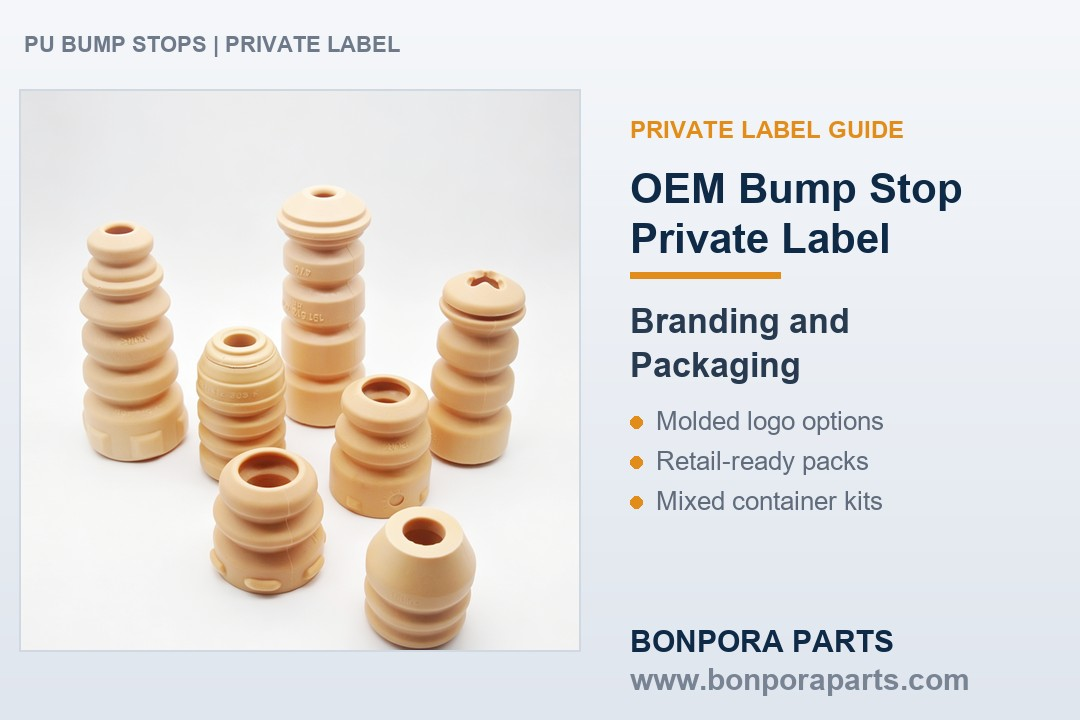
Polyurethane jounce bumpers, also called bump stops or compression bumpers, are compact suspension parts with a steady replacement cycle: every strut teardown, every lift kit installation and every fleet service interval creates fresh demand. For distributors, parts wholesalers and aftermarket chains, this makes the category a natural fit for private label programs. This guide explains how an OEM bump stop private label project works in practice: what can be customized on the product itself, which packaging formats suit retail and warehouse channels, how MOQ and mold ownership are usually arranged, and what to plan for in labeling, lead times and container logistics. The aim is to help purchasing teams move from a first inquiry to shelf-ready stock with a clear checklist.
What Is Included in an OEM Bump Stop Private Label Program
A private label program for polyurethane bump stops covers three layers, and it helps to keep them separate when you scope the project with a manufacturer.
The product layer is the bumper itself: the microcellular polyurethane compound, the density and hardness, the outer geometry and the mounting bore. Even within one product family, small changes here define how the part feels and performs on the vehicle.
The identity layer is what makes the part yours: molded logos or letters, molded or printed reference numbers, and consistent part numbering across your catalog so your team and your customers always order the same item by the same code.
The packaging layer turns a bulk part into a sellable SKU: poly bags, header cards, boxes, barcodes, carton labels and pallet configuration. Brands that already sell shock absorber parts or chassis and suspension parts usually extend the same identity rules to bump stops, so the whole range reads as one system on the shelf.
Clarifying these three layers early also clarifies cost: product customization touches tooling and compound development, identity work touches molding and printing, and packaging work touches print suppliers and pack-out labor. Each layer can be adopted step by step.
Product Customization: Where the Brand Meets the Part
Molded Markings and Part Numbers
The most durable branding on a polyurethane bumper is molded directly into the part during casting. Because microcellular PU is formed as a viscoelastic mass and then cured, raised or recessed text on the top face or skirt survives washing, road salt and years of compression cycles without any ink to wear off. Molded markings can carry your logo, your part number, a grade code or a production batch code.
Three practical points matter here. First, supply vector artwork rather than a photo of a label, because the marking is machined or engraved into the mold. Second, keep characters reasonably large: very fine text loses definition on a flexible microcellular surface, so a clear, bold layout reads better after molding. Third, agree on marking placement with the manufacturer before the mold is cut, because the position affects both demolding and the visible area once the part is installed on the strut.
Compound Color, Hardness and Grade
Color is the fastest visible customization. Standard beige, black and grey compounds are common; brand colors are possible with pigment trials on the casting line. For export brands it is worth checking pigment behavior under UV exposure, since some strong colors shift tone over years outdoors even when mechanical properties are unaffected.
Hardness and load capacity are tuned through compound formulation and density rather than color. As a working split, NDI-based microcellular polyurethane is chosen where loads, heat and compression set demands are high, for example commercial vehicle axles and heavy SUV applications, while MDI-based compounds cover a wide range of passenger car strut applications at a friendly cost level. A capable polyurethane bump stops manufacturer will ask for vehicle model, axle load and installation position before recommending a grade, and will confirm the choice with samples rather than promising performance on paper.
Packaging Formats for Retail and Wholesale Channels
Packaging decisions follow the sales channel. A workshop buying through a distributor needs identification and protection; a retail chain needs shelf presence and barcode compliance. The table below summarizes the common formats used for bump stop sets.
| Format | Best suited for | Typical contents | Notes |
|---|---|---|---|
| Poly bag with header card | Wholesale, fast-moving SKUs | 2 pcs per axle set | Lowest cost, barcode on header card |
| Boxed set | Retail shelves, brand building | 2 or 4 pcs with printed insert | Strong shelf presence, higher unit cost |
| Blister pack | DIY and accessory chains | Single pair | High product visibility, higher pack cost |
| Master carton | Warehouse and distributor stock | 20 to 50 sets | Corrugated grade and stacking strength matter |
Poly Bags with Header Cards
The poly bag plus header card is the workhorse format for polyurethane bump stops. It protects the surface, carries the barcode and keeps packing cost low. Ask for the bag to be sized so the parts are held without heavy compression, and specify the header card stock so it survives humid warehouse conditions. For sets with two different heights, a small internal divider prevents scuffing between parts.
Boxes and Blister Packs
Boxed sets suit brands building a visible range on retail shelves. The box front carries the brand and application data, the side panels carry cross-reference information, and an insert keeps the parts aligned. Blister packs present the actual product to the customer, which helps in DIY environments, but they need a backing card and sealing equipment, so they make sense once volumes justify the packing line.
Master Cartons for Warehouse Programs
For distributor stock, master cartons matter more than retail looks. Specify carton board grade, maximum stacking height and gross weight, and ask for a carton label layout that shows part number, quantity, net and gross weight, dimensions and destination marking. Well-planned cartons reduce damage claims and speed up receiving at your warehouse.
Labeling, Barcodes and Compliance Text
Under a private label agreement, the product leaves the factory already carrying your codes, so your receiving team never re-labels anything. Items to align on the label artwork include: your part number and its mapping to the factory reference, the EAN or UPC barcode, the brand logo, country of origin, material family marking, and any application or fitment text your market requires. For export ranges, plan the language panel early, because multilingual layouts change the card size.
Carton-level labeling deserves the same attention: a consistent carton label with quantity, weights and a scannable code speeds up inbound scanning and reduces errors when your team picks stock for dealers. Batch codes molded or printed on the product should map to the production record, so any field question can be traced back to a specific casting batch.
MOQ, Tooling and Mold Ownership
MOQ questions in private label projects almost always come down to tooling. If an existing mold already produces the geometry you need, the manufacturer can run your SKUs at modest quantities, and mixed SKUs in one order are common practice. If you need a new geometry, a new tool is cut, and the commercial question becomes who owns that tool.
| Scenario | Typical MOQ pattern | Tooling | Notes |
|---|---|---|---|
| Standard part, your branding | Low, per SKU | None, existing tool | Fastest route to market |
| Standard part, custom color | Low to medium | None | Pigment trial batch first |
| New geometry | Project based | New tool required | Allow sampling and validation time |
| Exclusive design for your market | Negotiated | New tool plus agreement | Exclusivity scope defined in contract |
On mold ownership, the points to put in writing are: who pays for the tool, who owns it, where it is stored, who maintains it, and what happens if you move production. For exclusive designs, define the exclusive territory and any minimum purchase commitment tied to it. A manufacturer offering a custom polyurethane parts service will normally send a short tooling agreement that covers these points before cutting steel.
Lead Times and Production Planning
Private label lead times combine three clocks: product manufacture, packaging production and freight. Casting and post-curing of microcellular PU take a defined number of days that cannot be compressed without risk, followed by machining, inspection and packing. Packaging runs in parallel: once your artwork is approved, printed cartons and header cards usually arrive within a similar window, so the two streams meet at the packing stage.
Plan the first order with margin: sampling, artwork rounds and trial pack-outs add time before the first bulk run. After that, repeat orders behave like any standard production order. Brands selling suspension parts seasonally should place reorder points before the peak, because suspension rebuilds and lift kit installations cluster in spring and early summer in many markets. Keeping one reorder cycle of safety stock in your own warehouse is usually cheaper than air freight in the peak.
Mixed Container Loading and Kit Consolidation
One advantage of sourcing from a manufacturer with a wide catalog is container consolidation. Polyurethane bump stops pack efficiently, and a mixed container can also carry dust covers, spring seats, shock absorber parts such as piston rods and valve plates, nitrogen gas bladders, and chassis and suspension items such as stabilizer links. Consolidation reduces freight cost per SKU and lets a new brand launch a coherent range instead of a single item.
Browse the manufacturer product center to shortlist families that fit your catalog, then ask for a mixed loading plan. Two packing rules protect quality in transit: parts should be stored in their natural shape without sustained point loads, and cartons should specify a maximum stacking height so lower layers are not crushed. Microcellular PU recovers well from short-term compression, but sustained heavy loads in a hot container are still worth avoiding as good practice.
Quality Documents Under Your Brand
A private label brand inherits the quality obligations of the manufacturer, so agree on the document set before the first shipment. A practical baseline includes: dimensional inspection reports, hardness and density data per batch, compound data sheets, and appearance standards with agreed sample parts as the reference. These documents are issued against batch codes, which link to the molded markings on the parts themselves.
Ask how nonconforming material is handled: the manufacturer should be able to explain quarantine, disposition and corrective action in plain terms. Brands that sell to fleet customers often add a short warranty statement based on the manufacturers test data rather than writing promises the supply chain cannot support. Measured, documented quality is also a sales argument your team can use with professional buyers.
How to Start a Private Label Project: Five Steps
Define the SKU list. Select the bump stop references, application coverage and target markets, and check whether related families should join the first launch.
Choose grades and colors. Share vehicle models, axle loads and climate data so the manufacturer can recommend NDI or MDI compounds and confirm hardness targets.
Select packaging and send artwork. Pick the format per channel, supply vector logos and barcode numbers, and agree the label layout and carton marking.
Approve golden samples. Sign off physical samples for part quality, marking quality and packed appearance; these samples become the reference for incoming inspection.
Schedule production and reorders. Fix the first bulk window, agree reorder points, and review the first shipment feedback together.
FAQ
What MOQ applies when we start with existing bump stop tools?
When an existing mold already produces the geometry, quantities per SKU can stay modest, and mixed SKUs in one production run are common. Exact figures depend on compound, color and packaging, so send the SKU list and ask for a per-item MOQ sheet before committing to a launch range.
Can we get an exclusive design for our market?
Yes, through a tooling and exclusivity agreement. The contract normally defines the exclusive territory, the minimum purchase commitment that supports the tooling investment, mold ownership and maintenance. Exclusive geometry is worth considering once your range data shows which applications sell steadily in your region.
Which grade should we choose for a hot climate market, NDI or MDI?
For high axle loads, sustained heat and demanding compression set behavior, NDI-based microcellular polyurethane is generally the safer choice; MDI-based compounds perform well in most passenger car strut applications. Provide real application data rather than guessing, and confirm with sample parts installed on representative vehicles.
How are bump stop sets packed to avoid deformation in transit?
Parts are packed in their natural shape without sustained point loads, bags and trays are sized to avoid over-compression, and cartons carry a maximum stacking height. Microcellular PU recovers from short-term compression, so with sensible carton design, transit deformation is not a practical issue for this product family.
Start Your Private Label Range With Bonpora
Bonpora (Beijing) Auto Parts manufactures polyurethane jounce bumpers in NDI and MDI grades, together with shock absorber parts, chassis and suspension parts and precision metal components, and supports custom development from drawings or samples. If you are planning a private label range, send your SKU list, target markets and packaging preferences, and the team will reply with grade recommendations, packaging options and a quotation. A short pilot order with golden sample approval is the most reliable way to start, and it gives your team real parts to test before the first container.
- Prev.:NDI Microcellular Polyurethane Manufacturing Guide
- Next.:Strut Bump Stop for VW Crafter | Buyer Guide