sales@bonporaparts.com
0086-10-64988621
English
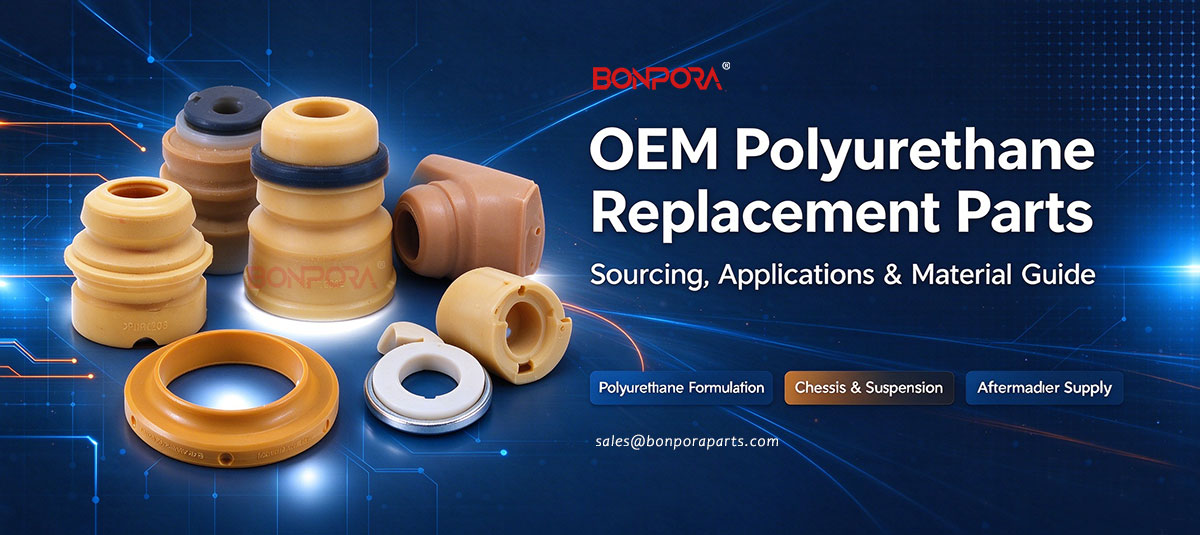
Global auto parts distributors, repair chains and importers searching for OEM polyurethane replacement parts are usually looking for material-performance comparisons, application guidance, reliable manufacturing sources and information on whether polyurethane components are suitable for their target vehicle parc. Polyurethane is widely used in automotive replacement parts where wear resistance, stiffness and durability are required. Compared with standard rubber components, polyurethane parts often show different performance characteristics under specific load, temperature and vibration conditions.
Buyers commonly ask: What automotive positions use OEM polyurethane replacement parts? Are polyurethane parts better than rubber parts? Which vehicle types have stronger replacement demand? How do I evaluate manufacturing quality before bulk ordering? This guide explains practical application and sourcing knowledge without making unsupported claims about market size or universal performance.
Polyurethane materials are selected for automotive replacement parts mainly for their mechanical properties and resistance characteristics. In suspension and chassis applications, polyurethane components are often evaluated for stiffness, wear resistance, load distribution and resistance to certain environmental factors. However, material selection must be based on the specific vehicle position, load, movement amplitude, temperature range and noise control requirements.
From a buyer’s perspective, OEM polyurethane replacement parts can be found in several product categories:
Suspension bushings
Control arm related components
Stabilizer bar bushings and mounts
Shock absorber related components
Other chassis and vibration-damping parts
It is important to note that “polyurethane” is not a single fixed quality level. Different formulations, hardness levels, densities and manufacturing processes will produce different results.
OEM polyurethane replacement parts appear in many vehicle segments, but demand is especially visible in segments where chassis wear and replacement frequency are relatively high:
Passenger cars and sedans
SUVs and crossovers
Pickup trucks and light commercial vehicles
Performance vehicles and modified vehicle parts
Some industrial and special vehicle applications
In the North American aftermarket, pickup trucks, SUVs and daily-driven passenger vehicles generate significant ongoing replacement demand. Parts located in the control arm, stabilizer bar, steering linkage and suspension mounting areas are commonly inspected during maintenance and repair.
Because polyurethane parts can differ significantly by formulation and process, buyers are advised to evaluate suppliers based on practical criteria rather than surface similarity:
Material formulation and hardness matching the vehicle position
Compatibility with operating temperature, oil exposure and environmental conditions
Dimensional accuracy and assembly consistency
Bonding quality between polyurethane and metal components
Batch-to-batch stability and testing records
Sample support before volume ordering
Bonpora supplies a range of automotive chassis and suspension components for global aftermarket customers. Our product portfolio includes rubber and polyurethane components, metal-backed parts and related replacement assemblies. Buyers interested in OEM polyurethane replacement parts can view our product range here: https://www.bonporaparts.com/en/auto-parts/.
A: OEM polyurethane replacement parts are mainly used in automotive suspension, chassis, stabilizer bar, control arm and vibration-damping applications. They are often selected where stiffness, wear resistance and durability are important requirements.
A: It depends on the application. Polyurethane parts may offer higher stiffness and wear resistance in certain conditions, while rubber parts often perform well in vibration isolation and noise control. The best choice depends on vehicle position, load, temperature and noise targets.
A: Passenger cars, SUVs, crossovers, pickup trucks and light commercial vehicles commonly use polyurethane replacement parts in chassis and suspension positions. Demand is often higher in vehicles exposed to heavy loads, rough roads or frequent maintenance.
A: Buyers should check material formulation, hardness, operating condition compatibility, dimensional accuracy, metal bonding quality, batch stability and sample testing support. It is also recommended to confirm application position and vehicle compatibility before bulk ordering.
