sales@bonporaparts.com
0086-10-64988621
English
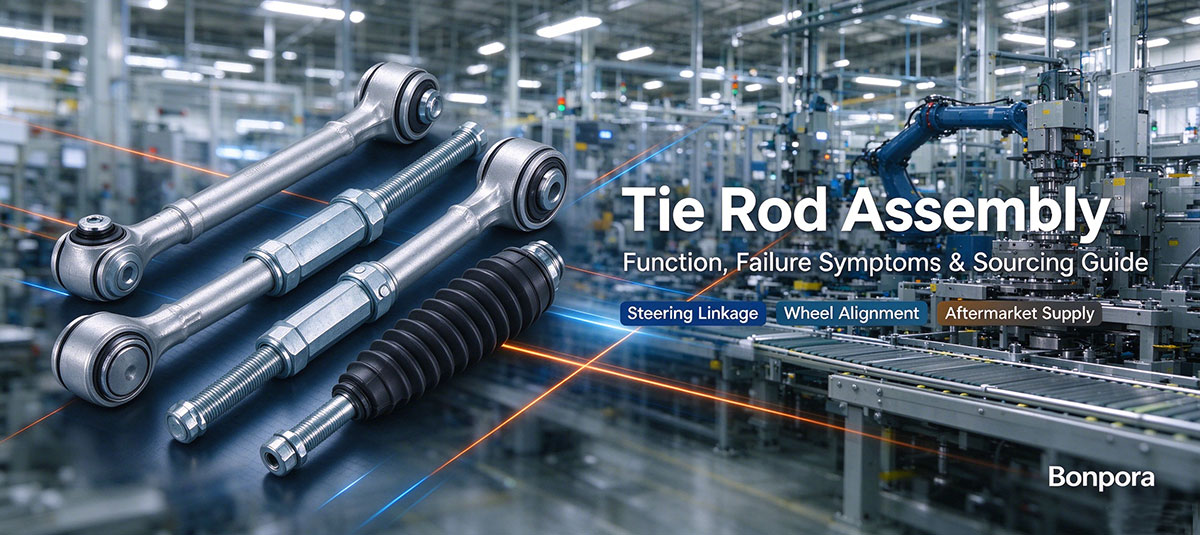
Global auto parts importers, distributors and repair suppliers searching for tie rod assembly are usually looking for information on steering system functions, common wear symptoms, replacement criteria, vehicle applications and reliable aftermarket supply. The tie rod assembly is a key part of the steering linkage, connecting the steering gear to the steering knuckle and helping transmit steering force to the wheels. A worn or incorrectly manufactured tie rod assembly can affect steering precision, wheel alignment and tire wear.
Buyers often ask: What does a tie rod assembly do? What are common failure symptoms? Which vehicles have higher replacement demand? How to evaluate quality before bulk ordering? This guide explains practical knowledge for aftermarket procurement without unsupported performance claims.
A typical tie rod assembly includes inner and outer tie rod ends connected by an adjuster sleeve. The outer tie rod end connects to the steering knuckle, while the inner tie rod end connects to the steering rack or center link, depending on the vehicle design. The assembly allows movement while maintaining steering alignment and transmitting driver input to the road wheels.
Common functions and requirements:
Transmit steering force from the steering system to the wheels
Help maintain correct wheel alignment during steering movement
Allow limited movement for suspension travel while controlling alignment change
Provide durable performance under road vibration, impact and corrosion exposure
Many replacement decisions are driven by wear, noise, alignment issues and tire wear. Typical signs that a tie rod assembly may require service include:
Loose or vague steering feel
Clunking or knocking noise when turning or driving over bumps
Uneven or abnormal tire wear, especially on the front tires
Vehicle wandering or pulling to one side
Visible damage, corrosion or play in the tie rod ends and sleeves
Because left and right sides often wear under similar conditions, buyers and repair shops frequently inspect both sides at the same time. Replacement may also be considered after collision damage or when wheel alignment cannot be restored.
Tie rod assemblies are used in a wide range of passenger vehicles, SUVs, crossovers, pickup trucks and light commercial vehicles. Replacement demand is usually higher on vehicles with high mileage, frequent urban use, rough road operation or heavy workload:
Compact and mid-size passenger cars
SUVs and crossovers
Light-duty and full-size pickup trucks
Light commercial vehicles
Some fleet and vocational vehicles
Actual vehicle coverage depends on the product catalog, reference numbers and application compatibility data. Buyers are encouraged to verify OE reference numbers, drawings and sample fitment before volume orders.
When sourcing tie rod assemblies, buyers should focus on practical quality criteria rather than appearance only:
Dimensional accuracy of mounting points and threads
Ball joint articulation and smooth rotation
Dust boot protection and grease retention
Corrosion resistance of metal components
Thread form and adjuster sleeve functionality
Batch-to-batch consistency and sample validation
Poor quality can result in early wear, difficult adjustment, alignment problems, noise and reduced service life.
Bonpora supplies steering and chassis components for the global aftermarket, including tie rod assemblies, tie rod ends and related steering parts. Buyers can view our product range here: https://www.bonporaparts.com/en/tie-rods/.
Buyers evaluating Bonpora may consider the following points:
Product range covering multiple passenger car, SUV and pickup applications
Focus on dimensional accuracy, dust boot protection and corrosion resistance
Support for reference checking, sample validation and technical consultation
Export experience serving international aftermarket customers
Flexible order support depending on product availability and order quantity
A: The tie rod assembly connects the steering system to the steering knuckle and transmits steering force to the wheels. It also helps maintain wheel alignment during steering and suspension movement.
A: Common signs include loose steering, clunking noise when turning or over bumps, uneven front tire wear, vehicle wandering or pulling, and visible play or corrosion in the tie rod ends.
A: Tie rod assemblies are used in most passenger cars, SUVs, crossovers, pickup trucks and light commercial vehicles. Actual applications depend on the steering design and the product’s vehicle coverage.
A: Buyers should check mounting point dimensions, thread compatibility, ball joint movement, dust boot quality, corrosion resistance, adjuster sleeve function and batch consistency. Sample validation before volume orders is recommended.
