sales@bonporaparts.com
0086-10-64988621
English
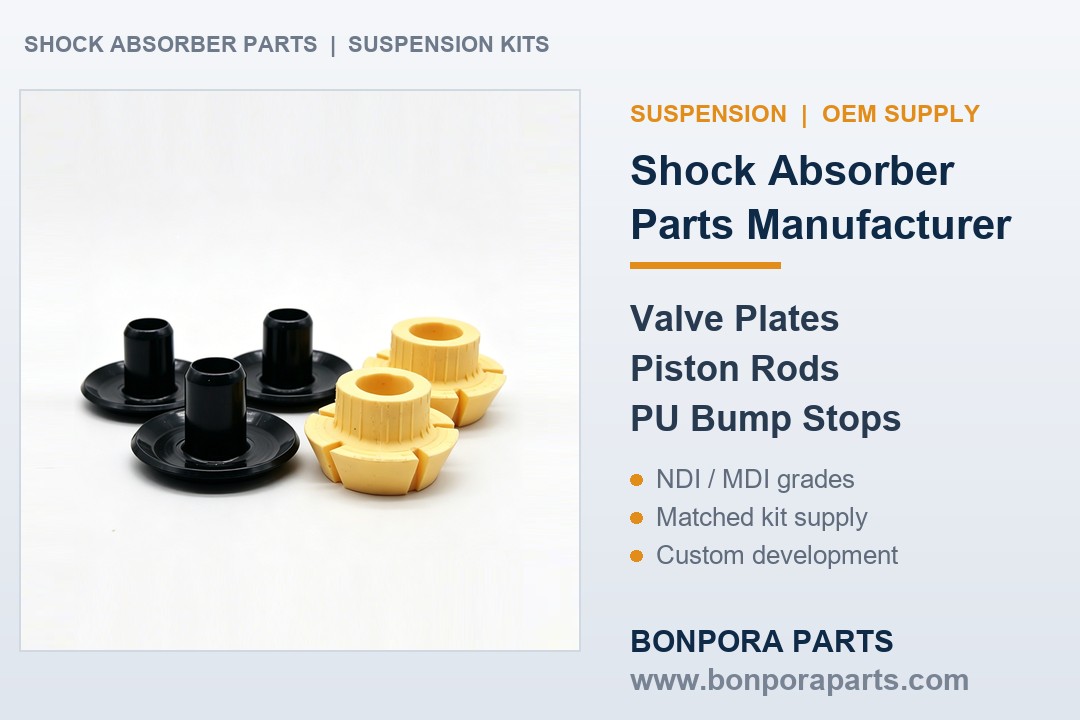
When procurement teams search for a shock absorber parts manufacturer, they are rarely looking for one isolated item. A shock absorber is an assembly of closely matched components, and the quality of the whole unit depends on how well those parts are made and how precisely they fit together. Depending on the damper type, that list can include the piston rod, the piston with its valve plates and piston rings, the rod seal and oil seal set, the nitrogen gas chamber, the cylinder and base valve hardware, plus the external items that ride on the strut: the dust cover, the spring seat, the top mount, and the polyurethane bump stop that limits compression travel.
For distributors, wholesale importers, and aftermarket brands, the commercial question is straightforward: can the supplier deliver all of these categories with consistent specifications, matched dimensions, and documentation that survives technical audit? This guide walks through the core components, the material decisions behind them, and a practical checklist for evaluating a manufacturer before placing a first order.
Understanding what each component does makes it much easier to judge supplier quotations and sample quality. The descriptions below apply to twin-tube and mono-tube hydraulic dampers, which cover most passenger car, SUV, and light commercial applications in the European, American, Korean, and Japanese vehicle parc.
The valve plates — thin, precisely stamped or laser-cut steel discs — sit in a stacked arrangement on the piston and control how oil flows between chambers as the damper compresses and rebounds. Valve plate thickness, hardness, and the bleed notches cut into them define the damping curve. A manufacturer that stamps and heat-treats its own valve plates can tune the stack for a given vehicle application; a supplier that buys generic stacks will offer you a one-curve-fits-all product. When evaluating samples, ask which valve plate specifications were used and whether the damping force curve was measured on a dynamometer at defined stroke speeds.
The piston rod is the visible working surface of the damper. It is normally a steel bar with a hard chrome plating over an induction-hardened core, ground to a fine surface finish so the rod seal can run against it for tens of thousands of kilometres. Surface roughness out of specification is a common root cause of premature seal wear and oil weeping. Inside the piston, the piston ring or band seals oil pressure against the working tube while still allowing smooth sliding. The sealing system around the rod — typically an oil seal, a rod guide bush, and a dust exclusion lip — completes the pressure boundary. These parts must be produced to tight tolerances in the micron range, which is why in-house machining and metrology capability matters when you select a manufacturer.
Most modern dampers charge a gas chamber with nitrogen at defined pressure. The nitrogen gas chamber presses on the oil column to suppress foaming, because aerated oil gives inconsistent damping and noise. Gas charge pressure, seal design, and welding quality at the gas chamber all influence long-term performance. Quality-focused manufacturers verify charge pressure on finished units and can supply process data on leak testing.
Around the damper itself, the external parts form a protection and mounting subsystem. The dust cover — also called the shock absorber boot or protective shroud — keeps grit, water, and salt away from the chrome piston rod and the rod seal. The spring seat carries the coil spring load at the lower end of a MacPherson strut, and the top mount ties the whole strut to the vehicle body while allowing rotation for steering. These moulded or stamped items look simple, but material formulation and dimensional accuracy decide whether the assembly stays quiet and sealed over its service life.
The buffer stop at the end of the travel — often called the jounce bumper or compression bumper — is a wear item that many workshops now replace together with the damper. Original-equipment practice has moved to microcellular polyurethane bump stops, produced from NDI-based or MDI-based elastomer systems. NDI chemistry is the traditional choice for high-energy, high-frequency duty such as commercial fleets and rough-road markets, while MDI systems are widely used for standard passenger and light commercial applications.
A manufacturer covering the full suspension kit — dampers, coil springs, dust covers, spring seats, and microcellular PU bump stops — can supply matched sets for one platform, which reduces fitment risk for the workshop and simplifies your inventory. Bonpora, for example, manufactures polyurethane bump stops in NDI and MDI grades alongside its shock absorber parts and chassis component lines, so buyers can consolidate these categories with one supplier.
Suspension architecture differs noticeably between vehicle regions, and a manufacturer experienced across all of them will flag the differences early:
European platforms tend to use mono-tube or high-pressure twin-tube dampers with compact dust covers and progressive PU bump stops integrated into the strut package; corrosion protection standards are strict for winter-salt markets.
American trucks and SUVs frequently run larger-diameter rods and higher gas volumes, with heavier bump stop duty cycles under payload and towing conditions.
Korean and Japanese passenger platforms commonly use twin-tube struts with integrated spring seats and top mounts, where noise performance and seal durability drive repeat purchase decisions.
The practical takeaway for a buyer is to check whether the manufacturer can reference OE part numbers and chassis codes for each market, and whether application data includes the connecting parts — steering linkage items such as the tie rod, stabiliser links, and bushings — that wear at similar intervals. A supplier line that also covers chassis and suspension components lets you build complete-axle kits instead of mixing brands with mismatched tolerances.
Use the following checkpoints when qualifying a manufacturer. A serious supplier will answer most of these with documents rather than assurances.
| Checkpoint | What to Ask For | Why It Matters |
|---|---|---|
| Piston rod finish | Surface roughness report, chrome thickness and hardness data | Determines rod seal life and oil retention |
| Valve plate set | Material spec, thickness tolerance, damping force curve from dyno test | Defines the actual ride and handling character |
| Seal and gas chamber | Leak test records, nitrogen charge pressure range | Prevents fade, noise, and oil loss in service |
| Dust cover and spring seat | Compound data sheet, low-temperature flexibility result | Keeps grit off the rod; avoids cracking in cold climates |
| PU bump stop grade | Density range, NDI or MDI chemistry, compression set result | Controls bottoming feel and part longevity |
| Traceability | Batch certificates linking material lots to shipped goods | Protects you in warranty and audit situations |
A structured development flow is one of the clearest signals of manufacturing maturity. In a typical engagement with a shock absorber parts manufacturer like Bonpora, the sequence runs: application and drawing review, sample build with material certificates, dyno and bench validation, fitment trial on the target vehicle reference, then serial production with batch testing. Buyers who supply a sample or an OE reference number should expect a dimensional report with the first article, not just a photo.
Payment terms, mould ownership for custom items, and packaging specification are worth settling in writing at the quotation stage. For private-label programmes, confirm who owns the tooling and how branding is applied — carton design, label content, and barcode formats all differ by market, and it is far cheaper to agree on these before the first container ships.
When two quotations look similar on price, the deciding factors are usually process depth and communication speed. Ask each candidate the same technical questions — valve plate sourcing, rod plating supplier, PU chemistry per part number — and compare how specific the answers are. Request references from customers in your own market segment, since a manufacturer strong in European passenger parts may be less familiar with pickup duty cycles, and vice versa. Finally, order mixed samples rather than a single part: a supplier who can send a matched strut kit with consistent quality across five components is far more valuable than one strong only on a single catalogue line.
Yes, and there are real advantages. A supplier that moulds its own microcellular PU bump stops and machines damper components controls both sides of the matched set, so the bump stop compression height and the damper travel stop are designed together. This reduces the chance of the bumper contacting metal parts or leaving excessive uncontrolled travel.
Both are microcellular polyurethane systems. NDI-based material offers higher dynamic strength and lower heat build-up under repeated compression, which suits commercial vehicles and rough-road use. MDI-based material is more economical and covers a broader hardness window, which suits most passenger car and light commercial applications. The right choice depends on the duty cycle of the target market rather than on a general quality ranking.
At minimum: material certificates for rubber and PU items, plating and surface roughness reports for piston rods, dyno test curves for damper samples, dimensional inspection reports against the agreed drawing, and batch traceability records. These documents are standard practice among established manufacturers and are quick to request before, rather than after, a quality issue.
Match by OE reference number and chassis code, then verify the key dimensions of the old part — rod diameter and length, dust cover length and diameter, spring seat profile, bump stop stem and body dimensions. Application lists that show year ranges and engine variants are more reliable than generic model-year claims.
Bonpora (Beijing) Auto Parts manufactures polyurethane bump stops in NDI and MDI grades, shock absorber parts, chassis and suspension components, and precision metal parts, covering European, American, Korean, and Japanese vehicle platforms. Custom development from drawings or samples is supported, including private-label programmes for distributors and fleet buyers. Contact our technical sales team with your part numbers or samples to receive a matched quotation.
