sales@bonporaparts.com
0086-10-64988621
English
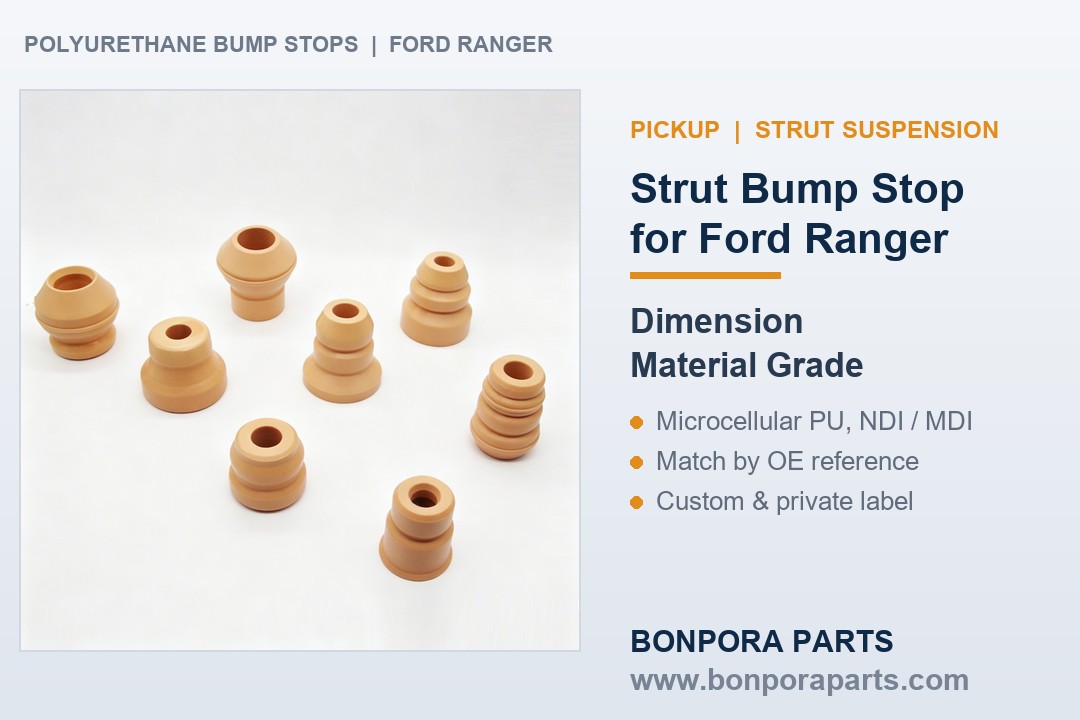
The Ford Ranger is one of the most widely used mid-size pickups in mining, agriculture, construction and overland fleets across Australia, Southeast Asia, South America and Europe. Its suspension takes a beating on corrugated dirt roads and loaded worksites, and one of the first components to wear out is the strut bump stop. For distributors, aftermarket brands and fleet buyers, sourcing a reliable replacement strut bump stop for Ford Ranger platforms is a recurring purchase decision — and one where the wrong specification leads to harsh ride, chassis slam and warranty claims.
This guide explains how the bump stop functions on Ranger front and rear suspensions, why microcellular polyurethane (PU) has largely replaced rubber in quality replacements, how NDI and MDI grades differ, and how to match dimensions and load ratings before placing an order. Whether you buy in OE reference or develop a private-label range, the same engineering checklist applies.
A bump stop (also called a jounce bumper or suspension buffer) is a compressible block mounted on the strut rod or axle housing. It is the last line of defence when the suspension reaches full compression. On the Ford Ranger, it works together with the shock absorber, coil spring or leaf spring, and the chassis and suspension components to prevent metal-to-metal contact between the axle, control arm or strut and the frame.
The Ranger front end uses a double wishbone arrangement with a coil-over strut. When the truck hits a deep pothole or lands after an off-road jump, the damper shaft travel runs out. A well-designed strut bump stop engages progressively: the first contact is soft, then the microcellular foam stiffens as cells collapse. This progressive curve absorbs the final energy spike instead of transmitting it straight into the cabin and the damper's internal valving.
At the rear, Ranger models with leaf springs carry the bump stop on the frame rail above the axle housing. Beyond protecting the damper, it also limits overload compression when the tray is loaded beyond rated payload — a common real-world condition in commercial fleets. A collapsed or missing rear bump stop is a frequent cause of dented frame rails and damaged shock absorber parts such as piston rods bent from bottoming out.
A hard "clunk" or bang over sharp bumps, especially with a load on board.
Visible crumbling, cracking or permanent compression (the block looks shorter than the new part).
Oil streaks on the strut body — repeated bottoming damages the damper seal and dust cover.
Uneven tyre wear caused by erratic suspension geometry at full compression.
Because replacement dampers cost far more than bump stops, fleet maintenance teams increasingly treat the bump stop as a scheduled wear item rather than a "fit when broken" part.
Original equipment on many Ranger generations and most quality aftermarket references has moved from solid rubber to microcellular polyurethane. The difference is structural: microcellular PU is a foam with millions of sealed microscopic cells, so it compresses progressively and returns to shape without permanent set. Rubber bottoms out sharply once its elastic limit is reached.
| Property | Microcellular PU bump stop | Conventional rubber bump stop |
|---|---|---|
| Compression behaviour | Progressive, rising rate | Sharp end-of-travel stop |
| Ride comfort at limit | Energy absorbed, no harsh slam | Metallic clunk transmitted to cabin |
| Permanent set | Very low; shape recovery over thousands of cycles | Higher; hardens and cracks with age |
| Temperature stability | Consistent from roughly -40°C to +80°C | Stiffens in cold, softens in heat |
| Damping consistency | Predictable force-stroke curve, repeatable in production | Batch variation is common |
| Weight | Lighter for the same load rating | Heavier |
For pickup duty cycles — heavy payloads, long corrugated stretches, high ambient temperatures — the progressive PU curve protects both the damper and the driver. This is why our polyurethane bump stops line is built exclusively on microcellular PU chemistry.
Not all microcellular polyurethane is the same. The two industrial prepolymer systems used for bump stops are NDI (naphthalene diisocyanate) and MDI (methylene diphenyl diisocyanate). The grade decides how the part behaves at the end of its stroke and how long it survives the Ranger duty cycle.
NDI cast elastomers offer outstanding dynamic performance at high frequencies and elevated temperatures — exactly the conditions of a loaded pickup crossing rough terrain. Compression set stays low even after continuous hammering, which is why NDI is the reference grade for heavy-duty jounce bumpers on commercial vehicles and off-road pickups. The trade-off is a more demanding casting process with tight temperature control, which is why NDI parts come mainly from manufacturers with dedicated casting lines.
MDI systems are more forgiving to process and cost less, with good all-round properties for standard payload applications. For a city-delivery Ranger running paved roads with occasional gravel, a well-formulated MDI bump stop is a sound, economical choice. MDI also supports a wider hardness range, which helps when matching a specific OE force-stroke curve.
A common purchasing rule of thumb: specify NDI for mining, overland and constant-payload fleets; specify MDI for light commercial and road-biased usage. If the vehicle frequently carries near-maximum payload over unsealed roads, NDI pays for itself in damper life. Bonpora produces both grades and can supply a comparative force-deflection report for each, so buyers can match the feel of the original part before committing to a batch.
Bump stops are not generic. Different Ranger generations and markets (Ranger T6, T7, T8, Raptor variants and regional payload ratings) use different heights, base diameters and stem designs. Ordering by "it looks similar" is the most common cause of returns.
Free height: overall length uncompressed, from base to top surface.
Base diameter and shape: round flange, rectangular foot or adapter plate.
Stem or bore: diameter and depth of the mounting stem, or the central hole if the part slides over the strut rod.
Profile type: straight taper, multi-stage bell or ribbed design — the profile sets the progressive engagement point.
Compressed height at rated load: confirms the end-of-travel clearance matches the chassis design.
Two bump stops with identical dimensions can behave completely differently if the foam density differs. Ask the supplier for the Shore hardness (typical range for bump stops is roughly 60 to 85 Shore A equivalent) and the force at a defined compression, for example the load at 50% deflection. Reputable manufacturers publish a force-stroke curve per part number; if a supplier cannot produce one, treat that as a warning sign.
Buyers in the Ranger aftermarket typically work from an OE reference or a competitor part number. When sourcing from an Asian manufacturer, send the OE number together with a sample or a dimensioned drawing. A capable supplier will reverse-check the dimensions, produce a first article, and supply a dimensional inspection report before mass production. Bonpora supports custom development from drawings or samples, including first-article inspection and batch traceability.
For aftermarket brands and regional distributors, the Ford Ranger range is usually one of the first SKU families added to a suspension program because demand is steady and applications are well documented. Typical cooperation models include:
OEM supply: parts produced to your drawing and specification, with material certification.
Private label: Bonpora's existing Ranger-referenced toolings branded with your logo, packaging and part number scheme, shortening time to shelf.
Kit programs: bump stops packaged with dust covers, strut mounts or spring seats to raise basket size per repair.
Minimum order quantities for private label are typically measured in hundreds of pieces per part number, with custom foam colour and moulded logo options. Confirm tooling ownership terms in writing if you commission a new mould.
A short supplier audit checklist prevents most aftermarket quality problems:
| Check point | What to ask for | Why it matters |
|---|---|---|
| Material grade declaration | NDI or MDI system, density, hardness in writing | Prevents grade substitution between samples and batch production |
| Force-stroke curve | Test report per part number | Confirms progressive engagement matches OE feel |
| Compression set data | Result after standard heat ageing test | Predicts service life under payload and heat |
| Dimensional report | First article inspection against drawing | Ensures fit without on-site modification |
| Cold performance | Hardness retention at low temperature | Ranger fleets operate in both tropical and alpine climates |
| Packaging and marking | Part number, batch code, box print proof | Avoids warehouse mix-ups across Ranger variants |
There is no fixed mileage, because life depends on payload and road quality. On mixed road use, a quality microcellular PU bump stop commonly serves several years of typical fleet driving; on mining or constant heavy-payload duty, inspection every major service is recommended. Replace it when free height has dropped noticeably, the surface is crumbling, or bottoming-out noise appears.
Not blindly. The bump stop is calibrated to the chassis travel and damper stroke. A taller or harder part engages earlier, which can lift the axle, change handling at full compression and transfer more load into the strut mount. If the vehicle carries loads beyond the OE rating, choose a bump stop engineered for that load range rather than simply a harder durometer, and verify clearance at full bump and full droop.
Sometimes similar, rarely identical. Mounting stems, base shapes and free heights differ between the T6/T7 and later T8 platforms, and the Raptor uses its own specification. Always match by measured dimensions or OE reference rather than by visual similarity, and confirm the compressed-height clearance before fitting.
The minimum set is: a sample or dimensioned drawing (free height, base, stem or bore, profile), target durometer or a force-stroke target, annual volume, and preferred grade (NDI or MDI) or the duty cycle description so the manufacturer can recommend one. With those inputs, a first article and quote usually follow within a few weeks.
Bonpora (Beijing) Auto Parts Co., Ltd. manufactures microcellular polyurethane bump stops in NDI and MDI grades, together with shock absorber parts, chassis and suspension components and precision metal parts, covering European, American, Korean and Japanese vehicle lines — including the full Ford Ranger pickup family. We support OEM drawings, sample-based reverse engineering and private-label programs with force-stroke reporting and batch traceability.
Send us your Ranger OE reference or sample, and our engineering team will reply with a matched specification and quotation. Visit our product centre to browse the catalogue, or contact us to start a custom development project.
