sales@bonporaparts.com
0086-10-64988621
English
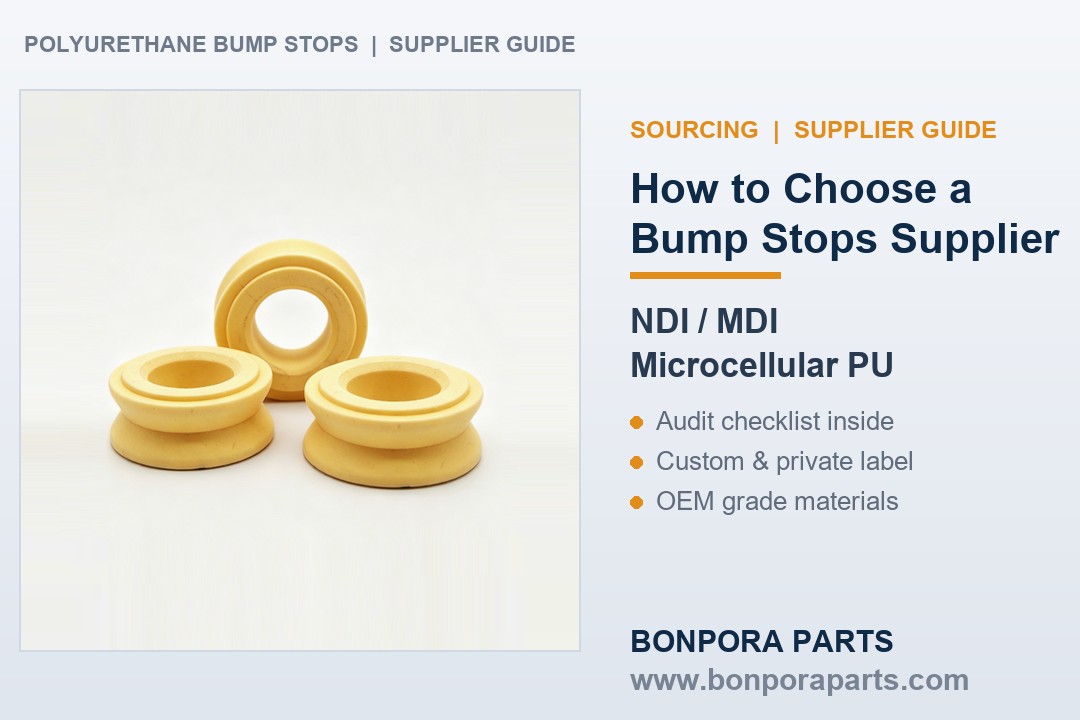
In most suspension assemblies, the bump stop is one of the smallest components on the drawing - and one of the most exposed. Also called a jounce bumper or 缓冲限位块 (buffering and limit block), it takes over exactly where the damper runs out of travel: when a wheel drops into a pothole or a loaded truck bottoms out on a loading ramp, the polyurethane bumper compresses in milliseconds and converts impact energy into controlled deceleration. If it is too stiff, the vehicle crashes through it; if it is too soft or collapses, the metal-to-metal contact destroys strut mounts, 防尘罩 (dust covers) and spring seats.
That is why sourcing teams who treat the polyurethane bump stops supplier as a commodity vendor usually pay for it later - in warranty claims, in noise complaints, and in re-engineering costs. Choosing the right supplier is less about price per piece and more about whether the supplier can control foam chemistry, hold dimensions, and support your platform for years. This guide walks through the evaluation criteria that professional buyers use when qualifying a polyurethane bump stops supplier, from material selection to private-label programs.
A modern bump stop is not a solid rubber pad. It is a microcellular polyurethane part - a closed-cell foam with engineered density, typically between 0.35 and 0.70 g/cm3 depending on the load curve required. Under compression, the nitrogen gas cells inside the material (氮气气囊, nitrogen gas pockets) resist progressively, producing the rising-rate stiffness curve that engineers specify in the vehicle ride and handling targets.
A qualified supplier must demonstrate control over three properties at once:
Density and cell structure - uniform microcells, no coalesced voids, no skin delamination.
Compression force deflection (CFD) - the force-vs-stroke curve must match the OE specification, not just "feel similar".
Durability - resistance to compression set, ozone, road salt, and temperature cycles from roughly -40°C to +90°C.
These properties are set at the formulation stage. A supplier who only machines or molds the part but buys premixed foam systems will have limited ability to adjust the load curve when your engineering team requests it.
Polyurethane foam systems for bump stops are built on two main isocyanate chemistries, and the choice drives both performance and price:
| Property | NDI-based (naphthalene diisocyanate) | MDI-based (methylene diphenyl diisocyanate) |
|---|---|---|
| Rebound and damping | Excellent resilience, stable damping at high frequency | Good, slightly more hysteresis |
| Temperature stability | Very stable across -40°C to +90°C range | Stable; marginally more set at sustained high temp |
| Compression set | Low, suitable for high-load jounce events | Acceptable for light and medium duty |
| Typical use | Premium passenger cars, heavy trucks, off-road | Volume passenger cars, light commercial |
| Processing window | Narrower, requires experienced control | Wider, easier for high-volume lines |
| Cost level | Higher | Lower |
A serious supplier will not tell you "NDI is always better". They will ask about the application first: axle load, suspension travel, climate, and target service life. For a heavy-duty truck cab mount or an off-road strut bump stop, NDI grades justify their cost. For a compact car rear axle, a well-controlled MDI grade often meets every requirement at a better price. If a supplier pushes one chemistry for everything, that is a signal to look deeper.
Whether you audit in person or remotely, these are the capability checkpoints that separate a genuine polyurethane bump stops supplier from a trading office:
Ask whether the supplier develops its own foam systems or purchases them. In-house formulation means the load curve, density and color can be tuned for your application. Check for a lab with CFD testers, compression set fixtures, low-temperature chambers and at minimum a universal testing machine.
Microcellular PU parts are typically compression molded or reaction injection molded. Confirm the supplier designs and cuts its own tooling - this shortens the sample loop from weeks to days when a dimension needs adjusting. Tooling ownership terms should also be stated in the contract: who pays, and who owns the mold after the program ends.
Bump stops interface with tight cavities inside strut assemblies, between spring seats, or under dust cover boots. A good supplier controls key dimensions to +/-0.5 mm or better on critical features and can supply full dimensional reports, not just a sample photo.
A supplier who also produces 减震器配件 (shock absorber parts) - valve plates (阀片), piston rods (活塞杆), piston rings (活塞环), spring seats (弹簧座), dust covers (防尘罩) and shock absorber boots (减震护罩) - plus 底盘悬挂件 (chassis and suspension parts) such as tie rods (转向拉杆) and ball joints can consolidate your purchasing. Fewer suppliers means fewer audits, harmonized quality systems, and simpler logistics. Bonpora, for example, covers all four lines, which is why many buyers source the bump stop together with the surrounding hardware.
| Document | What it proves |
|---|---|
| Material data sheet (per batch or per system) | Density, hardness, tensile properties of the actual foam |
| PPAP / sample approval report | Full dimensional and material conformance to your drawing |
| Compression force deflection curve | The real stiffness curve, measured not estimated |
| Compression set / fatigue test report | Durability over the claimed service life |
| IATF 16949 or ISO 9001 certificate | A managed quality system, not just inspection at the end |
| Traceability records | Any field claim can be traced back to the production batch |
If a supplier cannot produce the CFD curve for the exact part you are buying, you are effectively buying on faith. That is acceptable for a garden tool; not for a safety-related suspension component.
Many distributors and brand owners do not need a catalog part - they need their own. A capable supplier supports this at several levels:
Catalog parts, your brand - existing geometries with your packaging and labels, the fastest route to market.
Modified catalog parts - adjusted length, stem or base diameter to match a specific vehicle reference.
Full custom development - from a sample, a drawing, or even the old broken part: 3D scanning, load-curve target setting, prototype tooling, batch production.
Bonpora supports all three levels of OEM bump stop private label work, including to-figure development where the customer supplies the print and we take responsibility for material and process. Typical development runs from drawing confirmation to first samples in two to four weeks depending on tooling complexity, and every project is documented so reorders are repeatable. You can review the custom program details at the custom parts service page.
Bump stops are application-specific: a Toyota Hilux front strut bumper, a Ford Ranger rear axle bumper and a Mercedes control-arm limit stop share nothing but the material family. When evaluating a supplier, check the depth of the application list rather than just the catalog length. A strong supplier can cross an OE number to their own part, state the exact position (front strut, rear axle, spring assist, cab mount) and confirm the dimensions. Bonpora's range covers European, American, Korean and Japanese vehicle platforms, and the product center at bonporaparts.com/en/products/ lets you browse by category and reference number before you even send an inquiry.
Polyurethane parts are light but bulky, and shipping terms matter. Three practical points to close during qualification:
MOQ per part number - custom tooling usually implies a minimum batch; ask whether the supplier will split first batches for pilot programs.
Lead time structure - distinguish tooling lead time, first sample lead time and serial production lead time. A supplier quoting only one number is hiding something.
Packaging - microcellular PU is cut-resistant; bulk poly bags will mark surfaces. Ask for individual bagging or divider trays for finished surfaces.
None of these are technical, but they decide whether the program runs smoothly after the first order.
Summarizing the criteria above into a scoring sheet you can apply to any candidate polyurethane bump stops supplier:
| # | Criterion | What "good" looks like |
|---|---|---|
| 1 | Material systems | Both NDI and MDI grades available; formulation tuned per application |
| 2 | Lab and testing | In-house CFD, compression set, temperature and aging tests |
| 3 | Tooling | In-house tool design and manufacture; clear mold ownership terms |
| 4 | Quality system | IATF 16949 or ISO 9001, batch traceability, PPAP capability |
| 5 | Application knowledge | Asks about vehicle, axle load and travel before quoting |
| 6 | Range synergy | Can supply shock absorber parts and chassis parts alongside bump stops |
| 7 | Commercial terms | Transparent MOQ, staged lead times, export packaging options |
| 8 | Responsiveness | Engineering answers within days, drawing-based quotes, sample discipline |
None in function - the terms describe the same part. "Bump stop" is the common aftermarket name; "jounce bumper" is the term used in OE engineering for the component that stops upward suspension travel (jounce). Both refer to the polyurethane buffering element mounted on the strut rod, axle or body.
It depends on load, climate and duty cycle rather than on chemistry alone. NDI grades offer very stable damping and low compression set for heavy loads and high-frequency impacts, which suits trucks, off-road and premium platforms. MDI grades are cost-efficient for light and medium duty passenger applications. Share the vehicle reference and load conditions with the supplier and let them recommend the grade with test data.
Yes. A capable supplier will measure the sample, 3D scan the geometry if needed, test or estimate the density and load behavior, then build tooling and deliver prototypes for your validation. Bonpora regularly develops parts from customer samples, drawings, or OE reference numbers, and supports from-sample reproduction when drawings are unavailable.
It varies with part size and tooling. For catalog geometries with your branding, MOQs are usually modest because tooling already exists. For fully custom geometries, the first batch typically starts in the low thousands of pieces to amortize tooling, but split deliveries are often possible. The practical advice is to discuss MOQ and tooling amortization together in the RFQ stage.
The test of a polyurethane bump stops supplier is simple: send them one real inquiry - a vehicle reference, a drawing, or a sample - and see what comes back. A strong partner returns a material recommendation, a dimension check, a lead time structure and a quotation with no hand-waving. Bonpora (邦博润) has manufactured microcellular PU bump stops in NDI and MDI grades, shock absorber parts and chassis suspension components for global distributors and fleet operators, with to-figure and to-sample custom development on request. Browse the polyurethane bump stop range or the chassis and suspension line, then send your reference number for a same-week engineering reply.
